
Business Process Management (BPM) isn't software you buy; it’s a discipline. It’s a hands-on method for understanding, controlling, and improving how work gets done in your organization.
Think of it as a framework to systematically discover, map out, analyze, and refine every step of a process. The goal is to make your operations smoother, more predictable, and more efficient.
What Business Process BPM Actually Means
A business process is the recipe for a recurring task. Onboarding a new employee, processing an invoice, or handling a customer support ticket are all business processes.
Without a clear recipe, people do things their own way. That leads to mistakes, delays, and inconsistent results.
Business Process BPM is the act of managing those recipes. It’s the deliberate, ongoing effort to ensure each step is logical, efficient, and aligned with your company's goals. Instead of letting workflows run on autopilot, you actively watch, measure, and improve them. This isn't a one-time project; it's a continuous cycle.
From Chaos to Control
Many organizations run on unwritten, ad-hoc processes. An urgent request lands, and a team member figures it out on the fly. That might solve the immediate problem, but it creates hidden inefficiency and makes growth impossible without things breaking.
BPM shifts from reactive firefighting to proactive process design. It formalizes the "how" behind the "what," which brings several advantages:
- Consistency: Every customer gets the same quality of service because the steps are standardized.
- Efficiency: You can spot and eliminate bottlenecks and redundant steps that waste time and money.
- Scalability: New hires can be trained on a proven method instead of relying on vague "tribal knowledge."
More businesses are catching on. In the Netherlands alone, the Business Process Management market reached USD 193.20 million and is growing. You can see more details on this BPM market growth over at imarcgroup.com.
A business process is the series of steps taken to achieve a specific organizational goal. BPM is the management of those steps to ensure they are as effective as possible.
A process can exist without BPM, but it will almost certainly be messy. Adopting a BPM mindset means you move from just doing the work to intentionally designing how that work gets done.
BPM vs Ad-Hoc Process Management
Most businesses start with ad-hoc methods, but the ones that scale successfully use a more structured BPM approach. Here's how they compare.
| Aspect | Ad-Hoc Management | Business Process BPM |
|---|---|---|
| Approach | Reactive; problems solved as they arise. | Proactive; processes are designed and improved. |
| Documentation | Minimal or non-existent; relies on "tribal knowledge". | Formal and detailed; processes are mapped and stored. |
| Consistency | Low; outcomes vary depending on who does the work. | High; standardized steps lead to predictable results. |
| Improvement | Accidental or sporadic; changes are rarely tracked. | Continuous and data-driven; based on measurement. |
| Scalability | Poor; difficult to train new people or handle more volume. | Excellent; new team members can follow a clear playbook. |
Relying on ad-hoc methods might feel faster in the moment, but it creates long-term drag. A proper BPM approach requires upfront effort but pays off with stability, efficiency, and the ability to grow without constant chaos.
For more on what separates a basic workflow from a managed one, you can learn more about process management in our dedicated article.
Navigating the Five Stages of the "Business Process BPM" Lifecycle
Adopting BPM isn’t a one-time project. It's a continuous cycle of refinement. This lifecycle gives managers a repeatable framework to turn goals into measurable improvements.
Each stage flows into the next, making sure any changes are planned, tested, and based on performance, not just gut feelings. We'll use a common example: onboarding a new employee.
Stage 1: Design
This is the blueprint phase. You either map out an existing process or design a new one from scratch. The goal is to define the ideal workflow, spelling out tasks, responsibilities, data needs, and the final outcome.
For employee onboarding, the design stage details everything that happens from the moment a candidate accepts an offer. This isn't a vague checklist. It’s a precise plan covering who sends the contract, when IT sets up a laptop, how software access is granted, and what training materials go out before day one. You define the what, who, and when for the entire process.
Stage 2: Model
Once you have the design, you need to visualize it. The modeling stage turns that plan into a process flow diagram. This creates a process map that anyone, from an executive to a new hire, can understand.
Using our onboarding example, you’d build a flowchart. It would show the sequence: the offer letter is sent. Once signed, parallel tasks begin—HR starts paperwork while IT sets up accounts. This visual model helps spot potential bottlenecks or logical gaps before the process goes live.
Stage 3: Execute
With a clear model, it’s time to put the process into action. The execution stage is about rolling out the new workflow to the team. This can be done manually, with people following documented steps, or it can be automated using BPM software.
For our new hire, this is go-time. The HR coordinator follows the script, the IT technician gets an automated ticket to prep the hardware, and the manager gets a notification to schedule an intro meeting. The process is no longer a theory; it's the live system for how work gets done.
The diagram below shows a simplified version of this iterative approach, focusing on the core activities of discovering, analyzing, and improving a process.
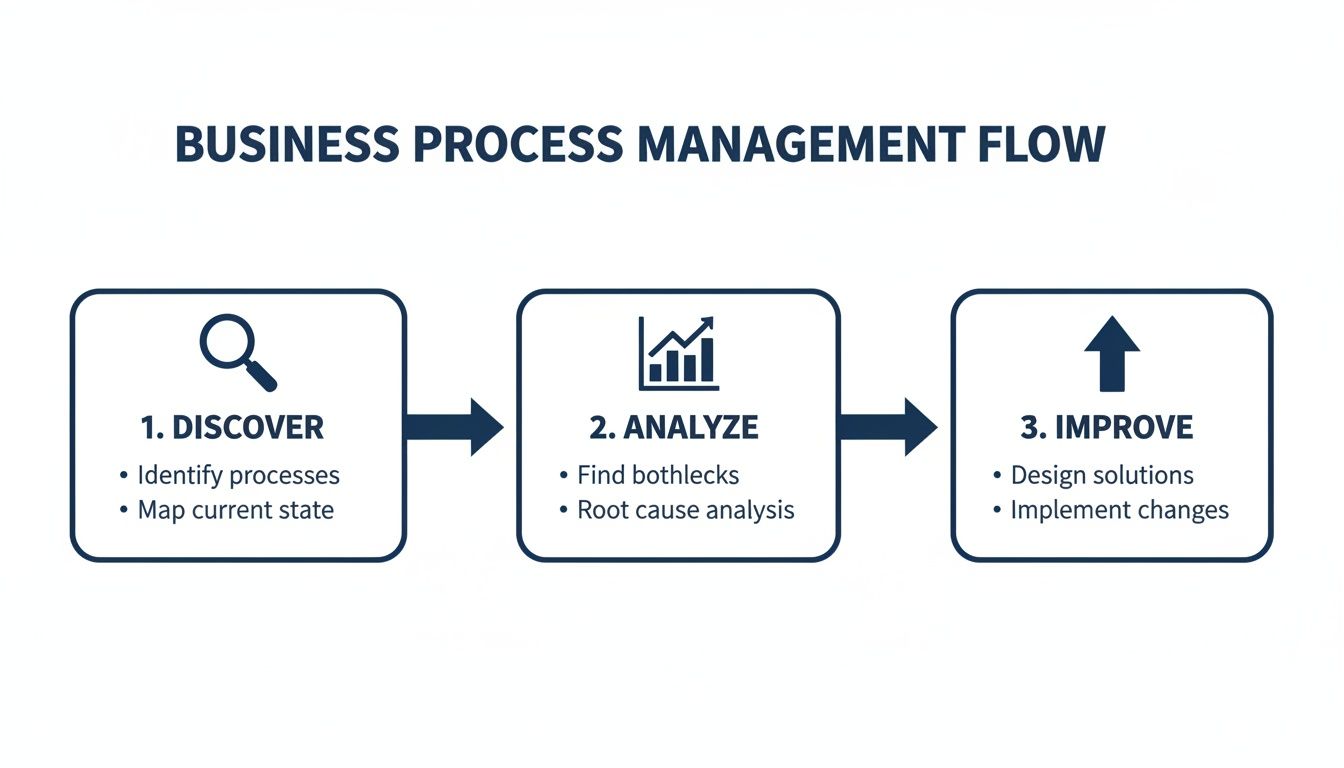
This visual shows that BPM isn't a straight line but a continuous loop driven by looking at data and taking action.
Stage 4: Monitor
No process is perfect on the first run. In the monitoring stage, you collect data to see how the process performs in reality. You track key performance indicators (KPIs) to measure things like efficiency, costs, and quality.
For onboarding, you'd track metrics like:
- Time to Productivity: How long does it take for a new hire to become fully operational?
- Onboarding Cost: What is the total cost in staff time and resources for each new employee?
- Error Rate: How often do mistakes happen, like a laptop not being ready on day one?
This is where you gather the hard evidence needed for an objective look at what’s working and what isn’t.
You cannot improve what you do not measure. This stage transforms business process management from a theoretical exercise into a data-driven discipline.
Stage 5: Optimise
In the optimization stage, you put that data to work. You use the insights from the monitoring phase to find bottlenecks and figure out how to make things better. Then, the cycle begins again with a newly refined design.
If your data shows it takes IT three days longer than planned to set up new accounts, you’ve found a bottleneck. Now you can find the cause. Is it a staffing issue? A clunky approval step? You analyze the cause, redesign that part of the process, and roll out the new version. This completes the loop, ensuring the business process BPM approach leads to constant, incremental gains.
Choosing the Right BPM Methodology
You have the BPM lifecycle. How do you do the optimization part? Different problems need different tools. Picking the right BPM methodology isn't about finding the one "best" option. It's about matching the framework to the specific challenge you're trying to solve.
There’s no magic bullet. If you apply a rigid, data-heavy framework to a creative process, you will frustrate everyone. Using a loose, flexible approach where strict quality control is needed can lead to serious mistakes. Understanding what each methodology is built for helps you pick the right tool for the job.
Here are three common and practical methodologies.
Lean: All About Speed and Eliminating Waste
The core idea behind Lean is simple: find and remove anything that doesn't add value for the customer. "Waste" can be anything from wasted time and unnecessary steps to excess inventory or redundant approvals.
Lean started in manufacturing, but it's useful in any process-driven work. Think about a content production schedule. Delays waiting on an edit, endless rounds of minor revisions, or an overly complicated approval chain are all forms of waste. A Lean approach would map that process and systematically cut away at those non-value-adding steps to get content out the door faster.
This is your go-to methodology when the main goal is efficiency. If your team complains that a process is "too slow" or "clunky," Lean is almost always the right place to start.
- Best For: Streamlining production lines, speeding up internal approvals, or simplifying client-facing service delivery.
- Core Question: "Does this step add real value to the final product or for the customer?"
Six Sigma: The Pursuit of Quality and Perfection
While Lean focuses on speed, Six Sigma is about quality and consistency. Its purpose is to reduce variation and eliminate defects until a process is as close to perfect as you can statistically get. It’s a data-heavy approach that uses statistical analysis to find the root causes of errors.
Imagine a software development team using Six Sigma to reduce the number of bugs in a new release. Instead of just fixing bugs as they pop up, the team would analyze data to figure out why they’re happening. Is one specific module causing most of the trouble? Is there a blind spot in the testing process?
Six Sigma is the right choice when the cost of a mistake is high. Financial reporting, medical device manufacturing, or any process where precision is non-negotiable are good candidates. It requires a rigorous, disciplined mindset.
A Six Sigma process is one in which 99.99966% of all opportunities to produce some feature of a part are statistically expected to be free of defects.
That level of precision isn't needed for everything a business does. But for mission-critical operations, it provides a powerful framework for achieving high quality and reliability.
Agile: Built for Change and Adaptability
The Agile methodology came from the software world but has been adopted by teams in marketing, product management, and elsewhere. Unlike Lean or Six Sigma, Agile isn't about perfecting one fixed process. It’s about being able to adapt to change quickly.
Agile operates in short, iterative cycles called "sprints." A team works on a small piece of a bigger project, gets feedback, and adjusts its plan for the next sprint. This helps a marketing team managing a fast-moving digital campaign. They can launch a small set of ads, see what works, and shift their budget based on performance data instead of being locked into a rigid six-month plan.
You should use Agile when the final destination isn't clear from the start, or when you’re working in an environment where customer needs or market conditions are constantly shifting. It values responsiveness over sticking to a plan.
Matching the Method to the Mission
How do you decide which to use? It comes down to your main goal. You don't have to pledge allegiance to a single methodology. The most successful organizations often mix and match elements from each.
| Methodology | Primary Goal | Ideal Scenario | Example Use Case |
|---|---|---|---|
| Lean | Increase Speed & Efficiency | The process has too many steps or takes too long. | Reducing the time it takes to process customer orders. |
| Six Sigma | Improve Quality & Consistency | The process produces too many errors or defects. | Eliminating billing errors in an accounting department. |
| Agile | Enhance Adaptability & Response | The environment is unpredictable and requirements change. | Managing a new product launch with shifting priorities. |
The most effective business process BPM initiatives often blend these ideas. You might use Lean to strip out waste from a process, then apply Six Sigma principles to one critical step to ensure its quality. The key is to be intentional, know what you’re trying to achieve, and choose your approach accordingly.
Measuring Success with the Right BPM KPIs
You can’t improve what you don’t measure. Moving past vague goals like “making things better” means getting specific with Key Performance Indicators (KPIs). These metrics are the hard data that prove your efforts are working, helping you justify investment and decide what to optimize next.
Without KPIs, you’re guessing. With them, you give finance and operations leaders a direct line of sight between process changes and results like lower costs, faster delivery, or better quality.
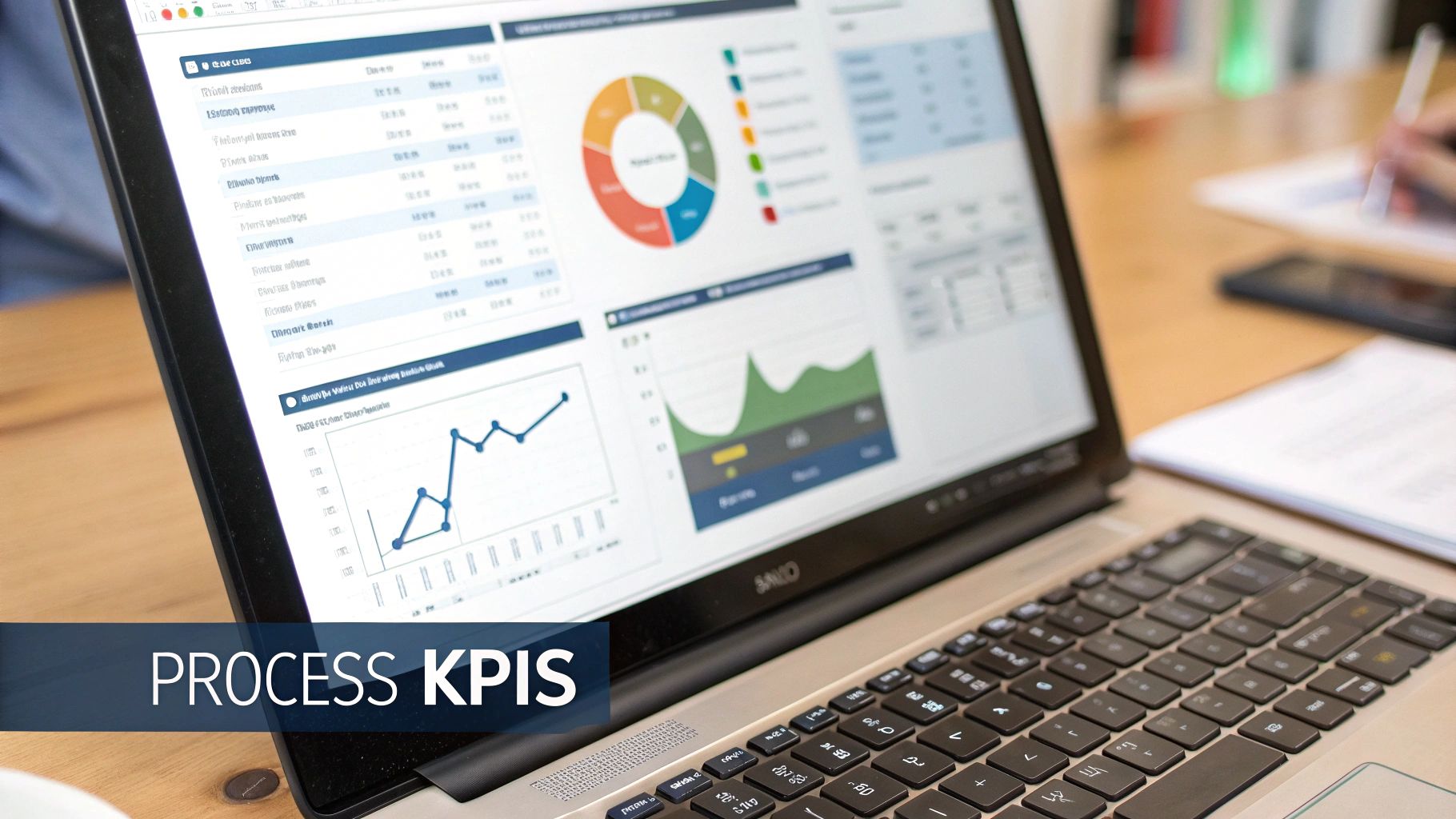
Core KPIs for Process Performance
A handful of core KPIs give you a solid starting point for almost any workflow. They generally focus on time, cost, quality, and output.
Here are a few essential ones:
Cycle Time: This is the stopwatch for your process—the total time from start to finish. For a customer support ticket, it’s the moment it’s opened until it’s resolved. A long or growing cycle time is a sign that something’s inefficient.
Error Rate: This tracks the percentage of outcomes that have mistakes or need to be redone. In an invoicing process, a high error rate means delayed payments and staff wasting time fixing things.
Resource Utilization: This KPI shows how effectively you’re using your people and technology. Low utilization could mean you’re overstaffed. High utilization (over 90%) can lead to burnout and indicates a bottleneck.
Tracking these metrics gives you a baseline. It’s the “before” picture you need to accurately measure the “after” of any changes you make.
Translating KPIs into Business Impact
The power of KPIs isn't just in the numbers. It’s about what they tell you about the business. Each metric should connect to a strategic goal.
A 20% reduction in the cycle time for new client onboarding means you start earning revenue from that client sooner. A lower error rate in manufacturing leads to less wasted material and happier customers. Link small operational tweaks to big-picture financial results.
Choosing the right KPIs is the difference between being busy and being effective. The goal isn't to track everything; it's to track the few things that indicate process health and business success.
This focus on hard data is a huge theme in modern process research. The BPM 2023 conference in Utrecht, for example, had many studies on how event log data can reveal the real-world impact of process complexity on performance.
Key BPM Performance Indicators
This table summarizes some essential KPIs, what they measure, and why they matter for optimization.
| KPI | What It Measures | Business Impact |
|---|---|---|
| Cycle Time | Total duration of a process from start to end. | Shorter cycle times lead to faster service delivery and quicker revenue generation. |
| Error Rate | Percentage of outputs with defects or requiring rework. | Lower error rates reduce costs, improve quality, and boost customer satisfaction. |
| Resource Utilisation | The efficiency of how people and systems are used. | Optimized utilization prevents burnout while ensuring resources aren't being wasted. |
| Process Cost | Total cost to execute a process instance one time. | Reducing process costs directly improves the company's bottom line and profitability. |
| Throughput | Number of process instances completed in a set time. | Higher throughput without adding resources is a key indicator of improved efficiency. |
Tracking a balanced mix of these indicators gives you a holistic view of process performance.
Financial and Output-Based Metrics
Beyond operational speed and quality, you have to measure the financial side of your processes. These are the KPIs that get leadership’s attention.
Process Cost: Work out the total cost to run a process once. This includes labor (employee time), technology (software licenses, server use), and other overhead. Most BPM projects aim to push this number down without hurting quality.
Throughput: This is about volume—how many times can you complete a process in a given period? For an HR team, it might be the number of candidates they process per week. Increasing throughput without adding more staff is the sign of an efficient process.
It’s also helpful to know what kind of indicators you’re looking at. For a deeper dive, check out our article on the differences between lagging and leading indicators. Lagging indicators like Process Cost measure what’s already happened, while leading indicators might track things that predict future success, like how quickly employees adopt a new tool.
For German businesses, leveraging tools for process intelligence with Celonis offers a strategic way to diagnose and fix these kinds of operational bottlenecks, boosting the effectiveness of any BPM initiative.
How to Implement BPM Without Disrupting Operations
Kicking off a BPM initiative doesn't have to be a massive, high-risk event. Planned smartly, it becomes a steady process that builds momentum instead of resistance. Avoid a "big-bang" rollout that shocks the system.Introduce change in manageable, value-driven steps. Many BPM projects fail because they try to leap from the current state to a perfectly automated future overnight. A more grounded approach focuses on low-friction changes that deliver clear, early wins. This makes everyone more receptive to what comes next.
Start with a Clear Business Case
Before you touch a single workflow, get leadership on board. Don't talk about abstract ideas like “efficiency.” Build a business case that speaks their language: return on investment (ROI).
Pick one single, painful process—maybe it's customer returns or supplier invoicing—and put real numbers on its current cost. Calculate the time wasted, the financial impact of errors, and how it's affecting customer satisfaction. Then, project the tangible savings a better process could deliver. A case built on hard numbers is tough to ignore.
The Power of a Pilot Project
Your first move should be small but strategic. Select a pilot project that's high-impact but low-complexity. This is your chance to prove BPM’s value quickly, without risking a major operational meltdown.
Choosing the right pilot is everything:
- Visible Impact: Pick a process where improvements will be obvious to everyone involved.
- Measurable Results: Make sure you can track KPIs to show a clear "before and after" picture.
- Contained Scope: It should be a process you can improve in a few weeks, not months.
A successful pilot creates champions for your cause and gives your team a real-world win to build on. It's also a low-stakes learning ground where you can refine your implementation approach before tackling bigger challenges. To get a quick win, focusing on foundational improvements like automated data processing can deliver significant benefits right from the start.
Assemble a Cross-Functional Team
Process problems rarely stay inside one department’s box. A workflow might start in sales, move through finance, and end in operations. Your implementation team needs to reflect that reality.
Bring together the people who actually do the work, not just their managers. A team with representatives from each stage of the process offers priceless insight into how things operate on the ground. This setup also builds shared ownership, which is critical for getting buy-in later.
Don't Underestimate Change Management
Ignoring the human element is the biggest mistake you can make in a BPM rollout. You can design the most brilliant process on paper, but if your employees don’t adopt it, it’s worthless.
Effective change management is an ongoing communication effort.
Explain the why behind the change. Show employees how the new process makes their jobs easier, removes frustrating bottlenecks, or frees them up to do more valuable work. When people see what's in it for them, resistance starts turning into support.
Provide clear documentation and training. You can learn how to create effective standard operating procedures that make new processes easy for anyone to follow.
Most importantly, gather feedback continuously. Make it safe for team members to point out what isn’t working so you can make adjustments. Treating implementation as a conversation, not a command, is the key to making new processes stick.
Using Privacy-First Analytics to Gain Real Insight
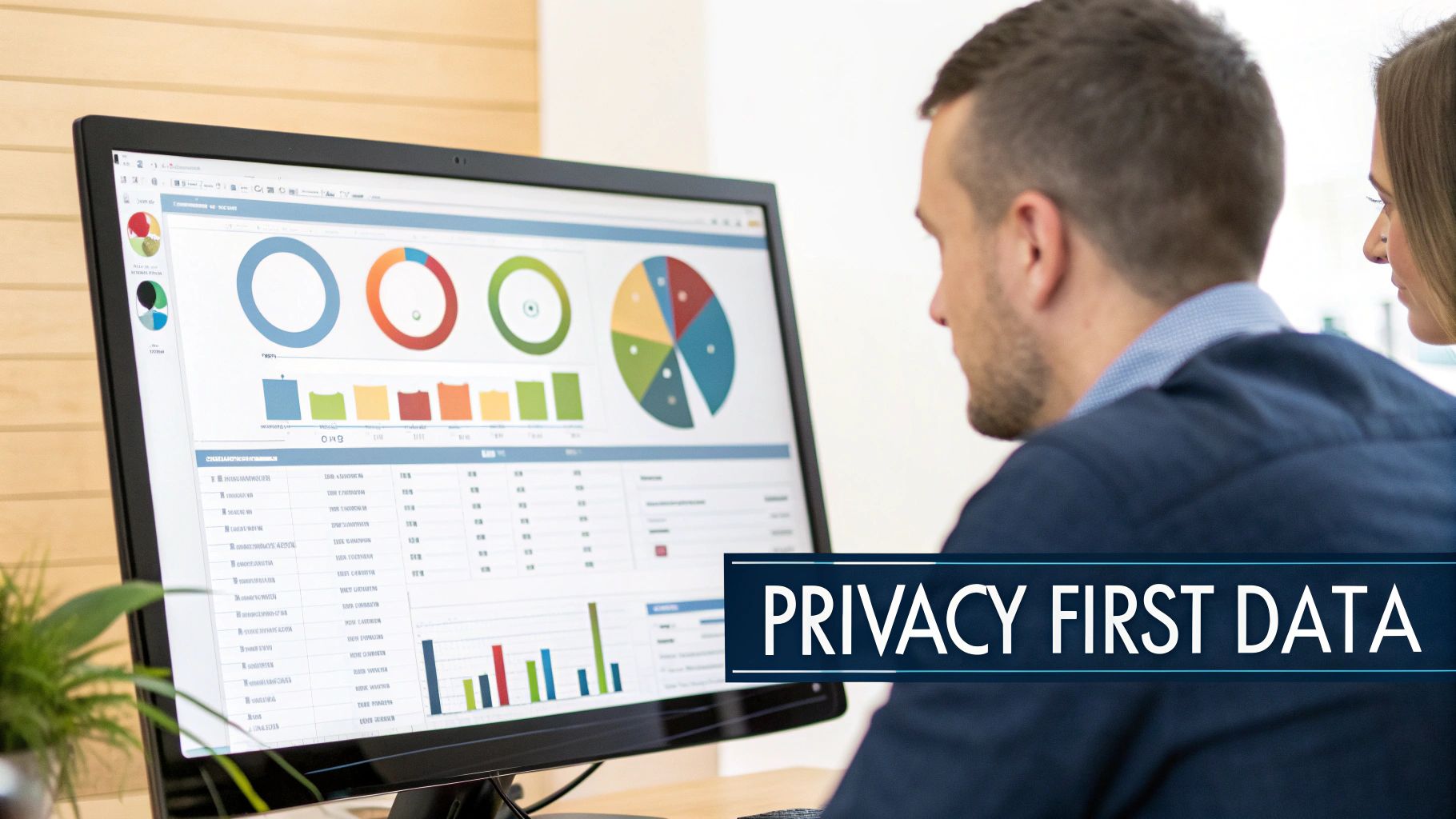
Most process monitoring is built on shaky ground. Surveys are subjective. Timesheets are notoriously inaccurate. This leaves a gap between what you think is happening and the reality of how your team works.
For the "Monitor" and "Optimize" stages of the BPM lifecycle to work, you need objective evidence. Without real data, every decision is an assumption, and you have no way of knowing if a process change made a difference.
Modern analytics tools can help, but many come at the cost of employee trust. Invasive tactics like screen recording or keylogging might give you data, but they create a culture of surveillance, not improvement. A privacy-first approach is different.
Gathering Ground-Truth Data Respectfully
Privacy-first tools collect aggregated, anonymous data about how tools are used, not what is being done. They measure application usage, focus time, and workflow patterns without capturing screen content, keystrokes, or any sensitive information.
This approach gives you objective answers to big BPM questions:
- Adoption Rates: Is the new CRM actually being used, or are people still clinging to old spreadsheets?
- Time Allocation: Did the new workflow really cut down the time spent on admin tasks?
- Bottlenecks: Where are the delays? Are people constantly switching between three apps to complete one task?
By focusing on aggregated usage data, you get the insights you need to make smart decisions without making your team feel watched. It's about understanding workflows, not monitoring individuals.
From Data to Decisions
Objective data turns your BPM initiatives from a theoretical exercise into a measurable project. It gives CIOs and team leads a way to verify outcomes with ground-truth information, ensuring every optimization is backed by solid evidence.
After rolling out a new project management tool, you can see adoption trends across different departments. If one team is lagging, you can offer them targeted training instead of guessing why the rollout is stalling. If another team’s usage shows they spend 40% less time on manual reporting, you now have a powerful success story to share.
The goal is to replace "I think this is working" with "I can see this is working." Objective usage data provides the proof you need to justify BPM investments and guide the next cycle of improvements.
This approach gives you a clear line of sight into the real-world impact your process changes are having.
Practical Applications for Business Process BPM
Here are a few concrete ways privacy-first analytics can support a BPM project.
- Validating Process Changes: You rolled out a streamlined invoicing process. Usage data can confirm if the time spent in your accounting software has actually decreased and if error-checking activities are happening less often.
- Identifying Unused Software: The data might show that 70% of employees with a premium software license use it less than once a month. That’s a signal to optimize costs by adjusting licenses—a clear financial win from your BPM efforts.
- Mapping Digital Workflows: By seeing which applications are used together, you can build a real-world map of your digital workflows. This often uncovers inefficient processes where employees manually copy data between systems. That’s a perfect target for your next optimization.
This analysis provides the evidence needed to move from one BPM lifecycle stage to the next with confidence. It ensures your efforts are focused on solving real problems, not just perceived ones.
Common Questions About Business Process Management
Getting started with BPM can bring up a few common questions. Here are some straightforward answers.
What’s the Difference Between BPM and Workflow Automation?
It’s easy to mix these two up, but they have different roles. Workflow automation is a specific tool for a specific job, like a power drill. It automates a predictable sequence of tasks, such as getting an invoice approved or onboarding a new hire. It makes a single, repeatable path faster.
BPM is the blueprint for the entire house. It’s the broader practice of looking at a whole business process from start to finish. That process might include several automated workflows, but BPM also accounts for all the manual steps, human decisions, and handoffs in between.
Workflow automation is a tactic. BPM is the strategy that decides where and why you should use automation.
How Long Does It Take to Implement a BPM Initiative?
This depends on the scope. If you try to overhaul the entire company at once, you’re looking at a multi-year project that will probably fail. A smarter approach is to think small.
Start with a single, high-impact pilot project. Pick a process that’s causing real frustration and aim to show a measurable improvement in 30-60 days.
This approach delivers a quick, visible win that gets leadership on your side. It builds momentum and enthusiasm. And it gives you lessons you can apply to the next project. A quick success is better than a slow-moving plan for perfection.
Can BPM Work for Small Businesses?
Yes. The core ideas of business process management aren’t just for giant corporations. Mapping out how work gets done, spotting bottlenecks, and finding smarter ways to operate is valuable for any business.
Small businesses often have an advantage: they’re more agile. They can make changes and see the results much faster than a large organization.
The trick is to keep it simple. You don’t need complex software or a formal methodology. Start by solving one real problem. Maybe it’s streamlining how you handle customer orders or making your sales inquiry process more consistent. The discipline of improving your processes is what creates value, not the tools.
Ready to get objective data on how your processes actually run? WhatPulse provides privacy-first analytics to measure software adoption, identify workflow bottlenecks, and validate the impact of your BPM initiatives—all without compromising employee trust. See how it works at whatpulse.pro
Start a free trial