
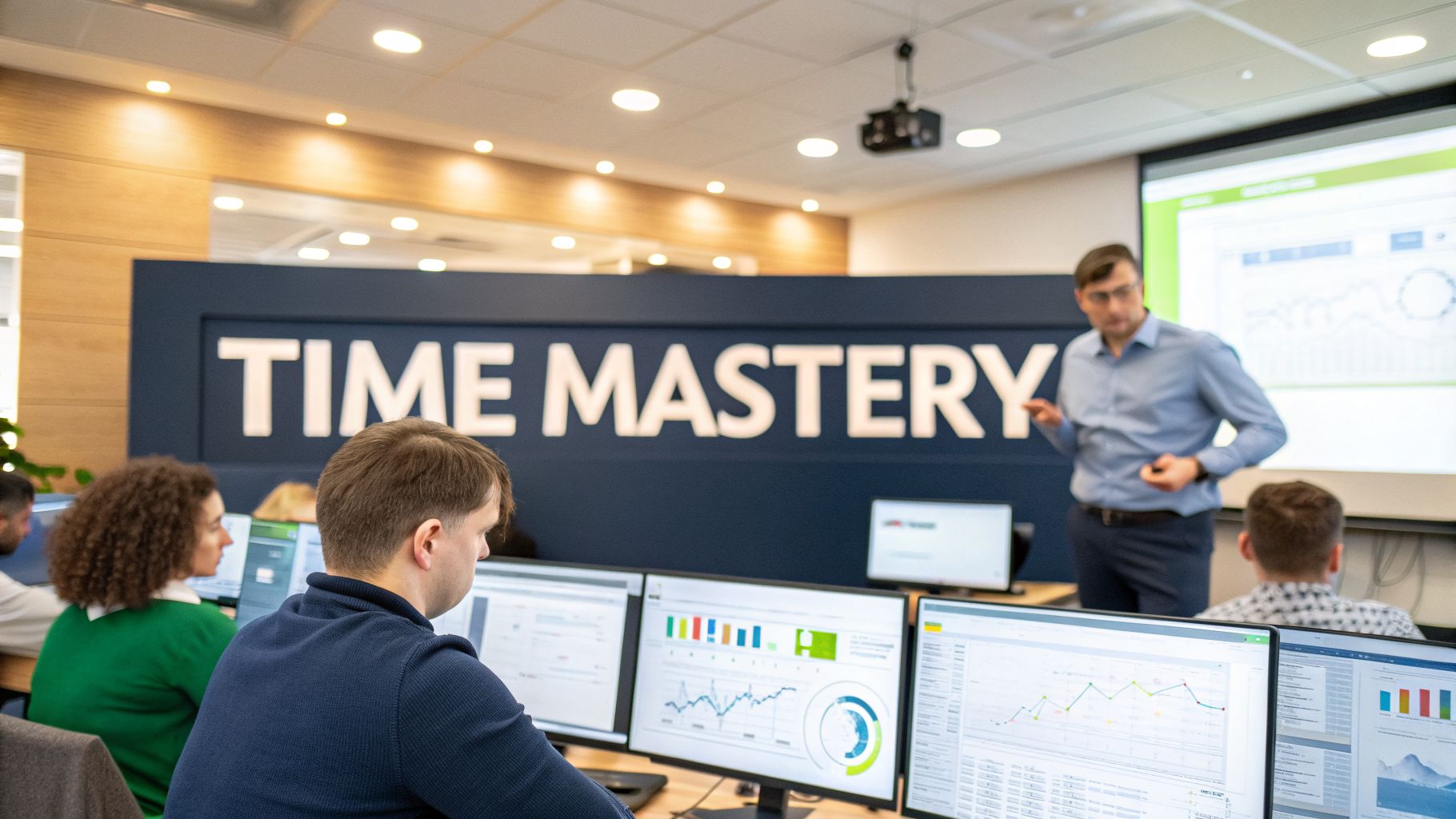
Effective training time management isn't about handing out generic tips. It starts with a proper diagnosis of how your team works. You have to dig into real-world work patterns to find specific problems—like a calendar choked with meetings or constant context switching—and then design a plan to fix them.
Stop Guessing How Your Team Spends Time
Most time management training fails because it’s built on assumptions. A workshop on the Pomodoro Technique is useless if the real problem is a day packed with back-to-back meetings. Before you can solve anything, you need objective data.
The goal is to move from guessing to knowing. Instead of asking people how they spend their time—a process flawed by bad memory and personal bias—you can use privacy-first analytics to build a clear, factual baseline. This isn’t surveillance; it's diagnosis.

Identify the Real Bottlenecks
By looking at aggregated, anonymized data, you can find the systemic issues draining your team's energy. These are the problems generic training almost always misses.
Here are a few patterns I look for:
- High Meeting Load: Are people’s calendars so full there’s no time for deep work? A high meeting-to-work ratio is a classic cause of missed deadlines and burnout.
- Frequent Context Switching: How often are team members jumping between apps? High switching rates point to a fragmented workday, which kills focus. Our guide on the art of effort tracking explains how to measure this.
- Consistent After-Hours Work: Does work regularly spill into evenings and weekends? This signals unsustainable workloads or broken processes, not just poor individual habits.
This data-first approach is useful where a strong culture of professional development exists. In the Netherlands, for instance, over 52% of the workforce takes part in work-related training each year—one of the highest rates in Europe. When people are already juggling core tasks with skill development, you have to be precise about how their time is being spent.
A data-driven diagnosis turns an abstract problem like "we're not productive enough" into a specific, solvable one, like "we spend 12 hours a week in low-value meetings."
The table below shows the kind of metrics you can track to get started.
Key Metrics for Diagnosing Time Management Issues
This table summarizes the initial data points I recommend collecting and what they can tell you about your team's productivity hurdles.
| Metric to Track | What It Reveals | Example Insight |
|---|---|---|
| Meeting Load | The ratio of time spent in meetings vs. time for focused work. | “Engineers spend 45% of their week in meetings, leaving only two afternoons for coding.” |
| Interruption Rate | The frequency of context switching between applications and communication tools. | “Team members switch apps over 150 times a day, indicating a highly fragmented workflow.” |
| Workday Span | The average time between the first and last work activity of the day. | “A 12-hour workday span suggests chronic after-hours work and potential burnout risk.” |
| Focus Time | Uninterrupted blocks of time (>2 hours) spent in productive applications. | “The team averages only one 2-hour focus block per week, making deep work nearly impossible.” |
These metrics give you a solid starting point.
To stop guessing, you need a structured way to gather this information. Using a training needs assessment template helps organize your data collection. Once you have a clear baseline, you can build a business case for a training program that targets the actual issues your team is facing.
Designing a Training Program That Sticks
You’ve done the diagnosis and have the data. Now for building a training curriculum that solves the problems you found. Forget generic advice. The point of the data is to design modules that hit your team's specific pain points.
Your WhatPulse data might show the team is drowning in context switching. If so, a session on deep work and taming notifications is your top priority. Or maybe their calendars are a wall of meetings? Then you’ll need a module on meeting hygiene and asynchronous communication.

This approach separates training that feels like a lecture from training that creates practical change. The focus is always on what the team can do differently that same afternoon.
Building The Core Modules
A good curriculum isn't one giant session; it's a series of focused, modular workshops. Each one should tie directly to a problem you spotted in the data.
Here’s how I’d structure a session on context switching:
- The "Why" (10 mins): Kick off by sharing the anonymized team data. Show them the numbers on application switching and what it’s costing in lost focus. Frame it as a shared challenge, not an individual failure.
- The Deep Work Case (15 mins): Briefly explain the cognitive science behind interruptions. I use the analogy of a chef trying to cook a complex meal while being constantly tapped on the shoulder—it doesn't work.
- Hands-On Workshop (45 mins): Get everyone to perform a "notification audit" on their own machines, right then and there. Guide them through disabling non-essential pings, pop-ups, and badges on their desktops and phones.
- Introduce a Tool (15 mins): Show them a technique like time-blocking or a focus mode app. Don't just talk about it; walk them through the setup.
- The Commitment (5 mins): End by asking each person to commit to one small change for the next week, like scheduling a single 90-minute focus block.
It’s active, not passive. People are doing, not just listening. That’s what makes new habits stick.
Choosing The Right Delivery Format
How you deliver the training matters as much as what you deliver. Your diagnostic data is your guide.
Choosing between a workshop and coaching isn't just about logistics. It's about matching the intervention to the problem's severity and nature.
If you have a widespread issue like meeting overload, a team-wide workshop is efficient. It helps everyone get on the same page and establish new norms around agendas and scheduling. We have a full guide on how to optimise work patterns using data transparency that digs into this.
But what if the data shows only a couple of individuals are struggling with working late or a fragmented schedule? A workshop for the whole team would be overkill. In that case, small-group or one-on-one coaching is more effective. It creates a space to address specific workflows and role-based challenges without singling anyone out.
Leading the Change Without Mandates
Even the best time management training will fall flat if your team sees it as just another top-down mandate. The goal is adoption, not enforcement. How you frame the program—and any analytics tools—is the difference between it being seen as a helpful resource or a new way to micromanage.
Your first job is to build trust. Be transparent about what data you’re looking at and why. This is about spotting systemic issues we can fix together, not monitoring individual performance.
From Monitoring to Coaching
Managers need to be coaches, not supervisors policing activity logs. Their role is to use insights to help people, clear roadblocks, and guide their teams toward healthier work habits. When someone feels supported instead of watched, they're more likely to buy into the training and make real changes.
A small shift in language makes a big difference.
- Instead of: “I noticed your focus time was low last week.”
- Try: “The data suggests our team is getting interrupted a lot. How can I help protect your time so you can get into a flow state?”
This switch turns an awkward conversation into a collaborative problem-solving session.
Once people see data is being used to justify fewer meetings or protect their deep work time, they stop seeing it as a threat and start seeing it as a shield.
Building Your Communication Plan
Before you launch anything, get your communication sorted. It needs to be simple, consistent, and rolled out across the organization.
Here’s a sample announcement you can adapt for your team:
Subject: A New Way to Tackle Our Workload Together
Hi Team,
We’ve all felt how busy things have become. I want to find practical ways to make our work more manageable. To do that, we first need to understand where our time is really going.
Starting next week, we’ll be using WhatPulse to get an anonymous, high-level view of our collective work patterns.
What this IS:
- A way to spot system-wide problems (like too many meetings or constant pings).
- A tool to help us build a case for changing broken processes.
What this IS NOT:
- A tool for tracking individual performance.
- A way to monitor your screen or keystrokes.
This aggregated data will help us design a time management training program that solves our specific problems. The goal is to find and fix the friction that gets in the way of us doing great work.
We’ll share the findings with everyone and decide on the next steps as a team.
Thanks, [Your Name]
Find and Empower Your Champions
Finally, look for the natural leaders on your team—the people who are already organized and respected by their peers. These are your champions. Get them involved early.
Ask for their feedback on the training plan and encourage them to model the new behaviors first. When a colleague sees a peer successfully blocking out focus time or declining a non-essential meeting, it suddenly feels more achievable. Their social proof is more powerful than any memo from management.
Measuring the Real Impact of Your Training
The training is done. Everyone feels motivated. But how do you prove it worked?
This is where you close the loop, shifting the conversation to tangible return on investment. It's time to go back to the same analytics platform you used for your initial diagnosis and see how the new data compares to your original baseline.
The goal isn't just to see if people liked the training; it's to see if their behavior changed. That's how you reframe "time management training" as "improving organizational efficiency," backed by numbers that leadership can't ignore.
The KPIs That Matter
Vague metrics are a waste of time. To show progress, you need to track Key Performance Indicators (KPIs) that connect directly to the problems you found in your diagnosis.
Here are the core metrics I track after a training session:
- Average Focus Time: Has the amount of uninterrupted work time gone up? An extra 30 minutes of focus per person each day adds up to hundreds of recovered hours across the team.
- Context Switches Per Hour: Are people jumping between apps less often? A drop here is direct proof that your sessions on deep work and notification management worked.
- Total Meeting Hours: Has the collective time your team spends in meetings gone down? This KPI shows a direct impact on the company's most expensive resource—employee time.
- Adoption Rates: If you rolled out a new tool or process, what percentage of the team is actively using it? Low adoption signals you need to offer more coaching or rethink the rollout.
Of course, tracking these numbers is only possible if you've managed the change effectively. You can't just throw new habits at a team and expect them to stick without support.

These principles—building trust, empowering people, and providing ongoing coaching—are what make training insights transform into measurable habits.
Connecting Data to Business Outcomes
Once you have a few weeks of post-training data, you can start translating these KPIs into the language leadership understands. It’s no longer about "focus time"—it's about what that focus time produces. To get this right, you first need to establish solid baseline metrics for continuous improvement.
To demonstrate the value of your training, frame the results in a clear before-and-after format that shows the business impact.
| ROI Metrics for Time Management Training |
|---|
| A breakdown of KPIs to track before and after training to demonstrate concrete business value. |
| KPI |
| Focus Time |
| Meeting Load |
| Interruption Rate (Context Switches) |
| Adoption of New Practices |
By presenting the data this way, you're not just showing activity; you're proving value. This transforms the conversation from a soft "people skill" into a hard business strategy.
Now, you can walk into a stakeholder meeting with a story that lands. Instead of saying "people are less distracted," you can say:
A 10% reduction in meeting load across our 50-person engineering department has reclaimed 200 hours of developer time per month. That's the equivalent of hiring three full-time engineers, allowing us to accelerate our product roadmap.
This is the kind of reporting that gets you budget for future initiatives. You’re not just saying the training was good; you're showing how it contributed to the bottom line. It’s objective proof that your investment paid off.
Coaching for Sustained Improvement
A one-off training workshop can generate buzz, but the motivation often fades. If you want lasting change in how people manage their time, it has to come from something more consistent: ongoing coaching.
The initial training is the curtain-raiser. The real work happens in regular, informal conversations between managers and their team members.
This is where your work pattern analytics become a coaching tool. The data gives managers a neutral, objective place to start a conversation. Instead of guessing, they can walk into a 1-on-1 with specific insights, turning abstract feedback like "you seem distracted" into a collaborative problem-solving session. This is the heart of training time management reinforcement.
The goal is to weave these principles into the team’s normal feedback loop. It stops feeling like a special “initiative” and becomes part of how you get work done.
How to Structure a Data-Informed Coaching Conversation
These chats should feel supportive, not like an interrogation. A manager's job here is to act as a partner, helping their team member spot and remove the roadblocks that get in the way of better time management.
The data isn't a weapon. It's a map that shows you where to dig for buried treasure—in this case, more focus time and less frustration.
A typical conversation can follow a simple, three-part flow:
- Observe and Share: Start by sharing a high-level team trend or a specific, non-judgmental observation from the individual's work patterns.
- Ask and Listen: Use open-ended questions to get their perspective. What challenges are they facing? What’s getting in their way?
- Brainstorm and Commit: Work together to find one or two small, practical adjustments they can try before your next check-in.
This approach shifts the dynamic from manager-as-enforcer to manager-as-coach. That shift is essential for building the trust needed for genuine behavior change.
Sample Coaching Scripts
Nobody likes a script, so think of these as conversation starters. Tweak the language to fit your own style and the person you're talking to.
Scenario 1: High Context Switching
- Manager: "Looking at the team’s data, I’m seeing a pattern of high fragmentation—lots of jumping between apps. I know how disruptive that can be. How has your focus felt over the past week?"
- Employee: "Honestly, it’s been tough. I feel like I'm constantly getting pulled in different directions with chat messages and emails."
- Manager: "That makes sense. What's one thing we could try this week to protect a block of your time? Maybe we could experiment with you setting your status to 'Focus' for 90 minutes every morning."
Scenario 2: Consistent After-Hours Work
- Manager: "I noticed there's been some activity late in the evenings. I want to make sure your workload is manageable and you're able to switch off. What’s driving the need to work late?"
- Employee: "The days are so full of meetings that I don't get to my actual tasks until late afternoon."
- Manager: "Okay, that’s a system problem, not a you problem. Let's look at your calendar together. Are there any recurring meetings we can challenge, or maybe I can run interference for you on a few requests?"
These small, consistent coaching moments are what make good time management habits stick. The data provides the opening, but the empathetic, solution-focused conversation is what drives the change.
For organizations looking to embed this kind of coaching into their culture, exploring options like High Performance Executive Coaching can give managers the structure and skills they need to become great coaches. This ongoing dialogue is what ensures your training investment pays off.
Got Questions About Data-Driven Training?
Bringing analytics into team development can make people nervous. It’s a good idea to get out ahead of these worries, as they’re reasonable. Here are a few of the most common questions I get from managers and their teams, along with how I usually answer them.
How Do We Introduce Analytics Without Making Employees Feel Spied On?
The only answer is total transparency. Before you install anything, be clear about what’s being measured and what isn’t. Tell them straight up: you’re looking at application usage and activity levels, not keystrokes or screen content.
Frame the whole thing as a team-wide improvement project. The goal isn’t to micromanage individuals; it’s to spot the systemic friction that makes everyone’s job harder. When you share data, show the team aggregated, anonymized reports. Turn it into a collaborative puzzle: "Look at this pattern. What do you think is causing it? How can we fix it together?"
Once people see the data being used to justify fewer meetings or to protect their focus time, it stops feeling like a threat and starts feeling like a shield.
What’s a Realistic Timeframe to See Results?
You’ll likely see the first small shifts in behavior within two to four weeks. These are the easy wins—people turning off notifications, blocking out focus time on their calendars, or adopting a new tool.
Bigger cultural changes take more time. If you’re trying to wean the team off a heavy meeting culture, you’re looking at three to six months before the new way of working feels natural. Keep an eye on the leading indicators in your analytics. Small, steady increases in average focus time are a good early sign that the training is sticking. Lasting change comes down to consistent coaching.
What If the Data Shows the Problem Is a Process, Not the Team?
This happens all the time. It’s one of the most powerful outcomes of this approach because it proves the problem was never about individuals being "bad at time management."
If your analytics show the source of fragmentation is a clunky workflow or constant urgent demands from another department, then the training needs to evolve. The data gives you objective, impersonal proof to take to leadership and advocate for real change. It moves the conversation from opinion to evidence.
From there, you can adapt the training to give the team practical strategies for managing these outside pressures. You might work on:
- Setting up a clear intake process for new requests.
- Establishing service-level agreements (SLAs) with other teams.
- Defining specific communication channels for genuinely urgent issues.
This is how you turn a "people problem" into a solvable "process problem." That’s where the biggest wins are almost always hiding.
Ready to stop guessing and start diagnosing your team’s real productivity blockers? WhatPulse provides the privacy-first analytics you need to build a time management training program that actually works. See how it works.
Start a free trial