
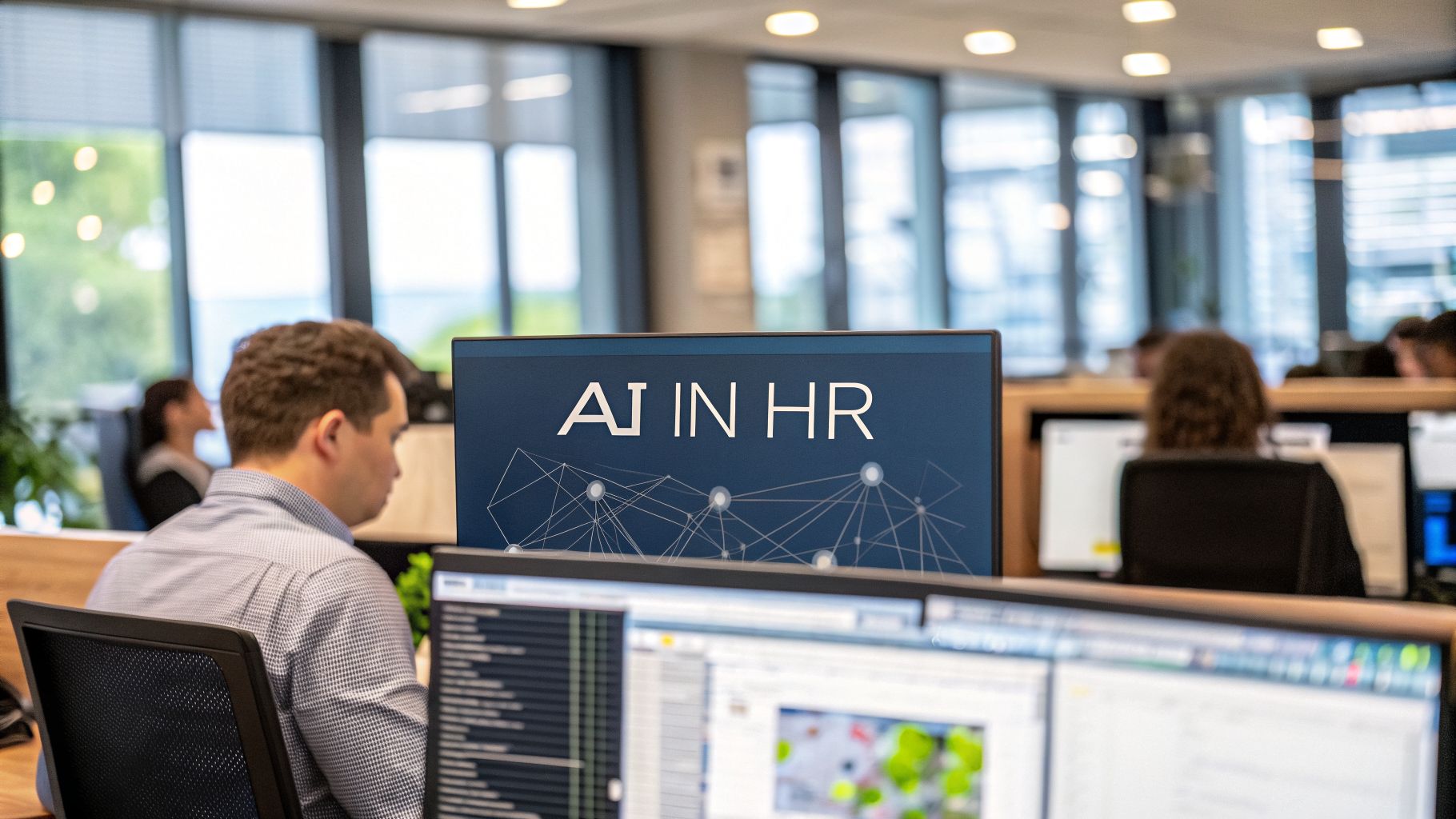
When people hear "AI in HR," they often picture a robot making hiring and firing decisions. The reality is less dramatic and more practical.
AI in HR is a collection of software tools built to handle specific, often tedious, human resources problems. Think of them as assistants—one for sorting résumés, another for answering common employee questions, or one that spots trends in performance data.
The goal isn’t to replace human judgment. It’s to take on the high-volume, data-heavy tasks that eat up an HR professional's time.
What Artificial Intelligence in HR Really Means
This approach lets HR teams shift their focus from administrative work to people-focused functions. It’s about moving from reacting to problems to solving them.
For example, instead of manually sifting through hundreds of applications, a recruiter can use an AI tool to surface the top 10 candidates whose skills match the job description. The recruiter still connects with the candidates, runs the interviews, and makes the final hiring call. The AI handles the initial filter.
How AI Changes HR Functions
The change is a move from manual, reactive processes to automated, analytical ones. Repetitive tasks get automated, freeing up your people for complex issues like culture, conflict resolution, and career development.
This also introduces a new layer of insight. AI can identify patterns in data that a person might miss. You can learn more about how data is transforming HR decisions in our guide to human resource analytics.
An AI tool might analyze aggregated onboarding feedback and discover that new hires in the engineering department consistently struggle with a specific software tool. That's a clear signal for HR to update that part of the training.
The purpose of artificial intelligence in HR is to manage the machine-scale tasks of data processing, which allows humans to focus on the people-scale tasks of connection, strategy, and culture. It is about augmentation, not replacement.
This table shows the difference between traditional and AI-assisted approaches across common HR functions. The work shifts from manual to a blend of automation and analysis.
Traditional HR Tasks vs AI-Assisted HR Tasks
| HR Function | Traditional Approach (Manual) | AI-Assisted Approach (Automated & Analytical) |
|---|---|---|
| Recruitment | Manually screening every résumé and scheduling interviews by email. | Automatically screening and ranking candidates based on skills; chatbots handle interview scheduling. |
| Onboarding | Delivering standardized orientation sessions and providing a static employee handbook. | Providing personalized onboarding paths and 24/7 AI chatbots to answer new hire questions. |
| Performance | Conducting annual reviews based on manager observation and limited feedback. | Continuously analyzing sentiment from peer feedback and project data to identify performance trends. |
The AI-assisted approach doesn't remove the HR professional. It equips them with better tools and deeper insights, allowing them to do more meaningful work.
The term "AI in HR" can feel vague. In practice, it’s about solving real problems that bog down HR teams. These tools are already working in many companies, changing how we find, onboard, and support people.
The idea is simple: let software handle the repetitive tasks and analyze data to spot patterns we might miss. This frees up HR professionals to focus on the human side of their work.
The diagram below gives an overview of how this works, breaking the technology's role into three core areas.

It’s about automating routine work, making sense of complex data, and helping your team make smarter decisions.
Recruiting and Talent Acquisition
Recruiting is where AI made its first big impact. Before these tools, recruiters could spend most of their day sifting through hundreds of CVs for one open role. It was slow and prone to error.
Now, an AI-powered Applicant Tracking System (ATS) can do that initial review in minutes. It scans applications for the specific skills and experience in the job description, then gives the recruiter a ranked shortlist. This doesn't replace the human touch; it just gives them a better starting point.
AI chatbots are another common tool. Instead of back-and-forth emails to schedule an interview, a bot can chat with candidates, find a time that works for everyone, and send calendar invites. It even handles rescheduling.
The result is a faster hiring process. Some studies have found that AI can reduce the time-to-hire by up to 40%. That’s time your recruiters can spend building relationships with the best candidates.
Employee Onboarding and Training
A new hire’s first few weeks are often make-or-break. A confusing or impersonal onboarding experience can lead to early turnover. The old standard was a thick employee handbook and generic presentations.
AI platforms change that by making onboarding a personal journey.
- Personalised Learning Paths: An AI can build a custom schedule for each new hire. A software engineer gets a different plan than a sales rep, with role-specific training modules, key documents, and introductions delivered at a comfortable pace.
- 24/7 Support Chatbots: New starters always have questions. Instead of waiting for their manager to be free, they can ask a chatbot. These bots are trained on company policies and IT setup guides, providing instant answers.
This approach helps new employees feel supported and get up to speed faster. They get the right information at the right time.
Performance Management and Employee Experience
The annual performance review is a flawed system, often based on a manager's most recent memories rather than a full year of work.
Modern artificial intelligence hr tools are built for continuous feedback. These systems can analyze sentiment from peer reviews, project updates, or even public channels like Slack. They can help identify morale trends, spot top performers, and flag disengagement risks without feeling intrusive.
For example, if a tool notices a sudden spike in negative language within a team's feedback, it can alert an HR manager. This creates an opportunity for a conversation before a small frustration becomes a major problem.
The aim isn't to spy on people. It's to get a high-level, anonymized pulse on team health. This data helps managers become better coaches and gives HR the insight to tackle issues like burnout or resource gaps. To go deeper, exploring resources that offer the latest insights on AI in HR can provide valuable, real-world examples.
Navigating AI Risks in Bias and Privacy
Bringing **artificial intelligence hr** tools into your workflow is more than just an efficiency boost. You have to look at the risks, especially around fairness and data privacy. The value of these systems depends on how well you manage them.The most immediate danger is algorithmic bias. An AI tool trained on your company's historical hiring data might learn and amplify past mistakes. If your company has historically hired fewer women in engineering, the AI could start thinking male candidates are a better fit, automatically filtering out qualified women.
This isn't hypothetical. In the case of Mobley v. Workday, Inc., plaintiffs argued that an AI screening tool was unfairly disqualifying applicants over the age of 40. A biased algorithm can scale up a mistake far faster than any single manager could.
Confronting Algorithmic Bias
You can't just plug in an AI hiring tool and trust it to be fair. Fighting bias is an active job. If you don't stay on top of it, you could violate laws like Title VII or the Age Discrimination in Employment Act (ADEA).
The solution is a mix of technical oversight and human judgment.
- Regular Audits: Audit your AI tools regularly. Compare the demographics of the candidates your AI shortlists against your total applicant pool. If you spot a statistical imbalance where the tool rejects a protected group at a higher rate, it's time to recalibrate.
- Demand Transparency: When you're looking at vendors, ask them how they test for and reduce bias in their models. A good partner will have clear, straightforward answers. If they get defensive or can’t explain it, that’s a red flag.
- Keep a Human in the Loop: Use AI as an assistant, not the final decision-maker. Let the AI build a shortlist, but always have a human recruiter review it and make the final call. This keeps crucial context and judgment in the process.
A core problem with many AI systems is their "black box" nature—it can be tough to see how a decision was made. That's why explainable AI (XAI) and consistent human oversight are so essential.
Protecting Employee Privacy
Artificial intelligence hr systems are fueled by data. They look at everything from keywords on a résumé to performance reviews to find insights. This puts a heavy responsibility on you to protect your employees' privacy. One misstep can erode trust.
The answer is to be transparent and stick to established privacy principles, like those in the GDPR. This means telling employees what data you're collecting, why you need it, and how you plan to use it. For example, explaining that sentiment analysis on team channels is used for big-picture morale trends—not to spy on individual DMs—can build trust.
When picking a vendor, you need a privacy-first mindset.
- Make sure they are compliant with regulations like GDPR.
- Check their data security practices, like encryption and access controls.
- Confirm that you have the right to access and delete your company's data whenever you need to.
Getting a handle on how AI vendors treat data privacy is non-negotiable. You can see what this looks like by reviewing Parakeet AI's privacy policy. This kind of document shows a vendor's commitment to protecting your data. If you want to go deeper on managing employee information, our complete guide to human resources data is a great place to start. You can't have a successful AI rollout without building trust first.
How to Get Started with AI in Your HR Department

Rolling out new technology is rarely a smooth ride. Bringing artificial intelligence hr tools into the mix is no different, but a measured approach can help you sidestep common pitfalls. It’s tempting to grab an AI tool just to say you have one, but a clear roadmap that solves a real problem is a better starting point.
The process begins by finding a specific, high-friction spot in your HR operations. Is your time-to-hire dragging on for months? Are you losing new starters in their first six months? Pinpoint a concrete business headache that a new tool could help with.
Once you have your target, you can build a business case. You'll need to explain the problem, how the proposed AI solution works, and what success looks like in clear, measurable terms. This is a key step for getting buy-in from leadership and finance.
A Phased and Deliberate Rollout
Diving headfirst into a company-wide AI implementation is risky. The most successful adoptions follow a phased approach, letting you test, learn, and build confidence before going all-in.
Start with a Pilot Project: Kick things off with a small, low-risk project to test the new tool. For instance, you could use an AI scheduling bot for interviews in a single department or an onboarding chatbot for one specific role. This contains the blast radius if things don’t go to plan.
Measure the Impact: Before you begin, know your starting line. If your pilot focuses on recruiting, track your current time-to-hire and cost-per-hire. After a set period—say, three to six months—compare the new metrics against your baseline. This hard data proves the tool's worth.
Gather Feedback: A pilot isn't just about the numbers; it’s also about the human experience. Talk to the recruiters, managers, and employees who used the tool. Was it straightforward? Did it save them time? Their feedback is gold for fine-tuning the process.
Scale and Expand: With a successful pilot and clear ROI, you now have a strong case for a wider rollout. You can expand the tool’s use to other departments or start looking for the next HR problem technology can help solve.
This pilot-to-scale strategy reduces the risk and helps you make smarter investment decisions based on actual performance, not just a vendor's sales pitch. It also gives your team a chance to get comfortable with the new tech in a controlled environment.
How to Choose the Right AI Vendor
Your choice of vendor is one of the most critical decisions you will make. A good partner will be transparent about their technology and committed to ethical practices. A bad one can create security risks and operational chaos.
A vendor that can't clearly explain how their algorithm works or how they tackle bias is a major liability. Their lack of transparency will become your problem during an audit or legal challenge.
Use a detailed checklist to size up potential partners. Your due diligence should cover their technical capabilities, security protocols, and their philosophy on responsible AI.
Data Security and Privacy: Ask where your data will be stored and what encryption standards they use. Make sure they are compliant with regulations like GDPR. The vendor should have a clear, documented policy for data access, control, and deletion.
Integration with Existing Systems: The new tool has to work with your current Human Resources Information System (HRIS). A clunky integration can create data silos and more manual work, cancelling out any efficiency gains.
Commitment to Ethical AI: Don't be shy about pressing vendors on how they address algorithmic bias. Ask for proof of their bias auditing processes and what steps they take to ensure fairness. Reputable vendors will welcome these questions.
Building Trust Through Change Management
Even the best tool will fall flat if your employees don’t trust it. Introducing artificial intelligence hr demands clear and consistent communication. From the start, explain to your team why you're bringing in the technology, what it will do, and—just as importantly—what it won't do.
Be upfront that the goal is to cut down on tedious admin, not to replace people. Frame the AI as a new assistant for the HR team—one that frees them up to focus on more strategic, people-focused work. Providing training and being open to questions will help calm anxieties and build the trust you need for a successful transition.
Measuring the Real ROI of Your HR AI

Talking about the return on investment for artificial intelligence hr tools can feel like chasing fog. Vendors will promise incredible efficiency, but if you can’t connect those promises to hard numbers, it’s just noise.
To prove the value, you have to move beyond abstract benefits and track specific, measurable changes in your HR operations.
The rule is to always start with a baseline. Before you flip the switch on any new AI system, you need a clear snapshot of your current performance. Without that "before" picture, you have no way of proving the "after" is any better.
Connecting AI to Recruitment Metrics
For recruiting, the numbers are usually direct and tied to time and money. AI tools for hiring are designed to speed up the top of the funnel, so your KPIs should reflect that.
Before you start, track these core metrics for at least one quarter to get a reliable average:
- Time-to-Fill: How many days does it take to fill an open role, from posting the job to a signed offer? AI screening and scheduling bots are built to shorten this cycle.
- Cost-per-Hire: Add up everything—ad spending, agency fees, and your recruiters' time. If AI is handling the grunt work, this number should go down.
- Quality-of-Hire: This one is trickier. Look at the performance ratings of new hires after 6 or 12 months, or track their retention rates. If your AI is finding better-matched people, the quality should improve.
Once the new tool is live, keep tracking those same numbers. A 20% reduction in time-to-fill or a 15% drop in cost-per-hire gives you a powerful, data-backed case for the investment.
Gauging the Impact on Employee Experience
When you get to tools for employee experience—like AI onboarding platforms or support chatbots—measuring ROI becomes more nuanced. The value isn’t just in saved hours; it’s in happier, more engaged people who stay.
A common mistake is to only focus on hard cost savings. If an AI-powered chatbot reduces employee frustration and cuts attrition by a few percentage points, the ROI can dwarf simple efficiency gains.
To put a number on this, you need to track metrics that serve as a proxy for employee satisfaction and organizational friction.
- Employee Net Promoter Score (eNPS): Regularly ask your people, "How likely are you to recommend our company as a place to work?" A rising score, especially among new hires, can show the impact of a smoother onboarding.
- Attrition Rates: Keep a close eye on voluntary turnover, particularly within the first year. A drop here is a strong signal that your experience-focused tools are working.
- Helpdesk Ticket Volume: If you launch a self-service chatbot, the number of routine questions hitting your HR team should fall. This frees them up for more complex work.
Quantifying Productivity and Focus
Finally, some artificial intelligence hr tools claim to boost productivity by cutting out digital noise. An analytics platform might pinpoint that your team is losing hours each week just switching between too many apps.
To measure this, you need to quantify how work gets done. By analyzing application usage data, you can establish a baseline for how much "focus time" employees have versus time spent in meetings or on admin tasks. After you implement a change—like automating a workflow—you measure again.
Seeing an increase in focus time from 55% to 65% is a concrete result. You can translate that into real business value by showing how that extra focused work is accelerating projects.
To help you get started, we've broken down some of the most important metrics to watch when you introduce AI into your HR functions.
Key Metrics for Measuring HR AI Impact
| HR Area | Metric to Track | What It Measures |
|---|---|---|
| Recruitment | Time-to-Fill, Cost-per-Hire | The speed and financial efficiency of your hiring process. |
| Recruitment | Quality-of-Hire (Performance/Retention) | The long-term success of candidates identified by AI. |
| Onboarding | New Hire Attrition Rate (First 90 days) | How well your onboarding process integrates and retains new staff. |
| Employee Experience | Employee Net Promoter Score (eNPS) | Overall employee satisfaction and loyalty to the company. |
| HR Operations | HR Helpdesk Ticket Volume & Resolution Time | The efficiency gains from AI chatbots or self-service portals. |
| Workforce Analytics | Focus Time vs. Distraction Time | The direct impact of process automation on employee productivity. |
Tracking these before and after gives you the objective data needed to show that your investment is paying off. For a deeper dive into selecting the right metrics, you might find our guide on key human resource KPIs helpful. It provides a solid framework for tracking what matters.
Common Questions About AI in HR
As soon as you start talking about bringing AI into HR, a few key questions always surface. It’s natural. We’re dealing with technology that affects people and careers. Let’s tackle these common concerns head-on.
Will AI Take My HR Job?
This is the big one, but the short answer is no. The goal isn’t to replace HR professionals; it’s to free them from the repetitive tasks that eat up their time. Think of it as augmentation, not replacement.
An AI can sift through thousands of résumés in the time it takes to drink a coffee. But it can’t sit down with someone to gauge their passion, see how they’d fit with the team, or build the relationships that convince top talent to join.
AI is for processing data. Humans are for connecting with people. The HR role is becoming more strategic—focused on culture, employee development, and coaching leaders. These are things where human insight is essential.
How Do We Stop AI from Being Biased in Hiring?
This is a serious risk. You can’t just plug in a tool and hope for the best. Making sure your AI is fair takes a deliberate, hands-on approach.
First, you need to put vendors under a microscope. Ask them directly how they build, test, and audit their algorithms for bias. A reputable company will have clear, transparent answers. If they get vague or defensive, that’s a red flag.
Next, you have to run your own checks. Regularly compare the demographics of the candidates your AI selects against your overall applicant pool. If you spot a trend where a certain group is consistently filtered out, the tool needs immediate attention.
Finally, AI should always be a co-pilot, not the pilot. Use it to build a shortlist, but always have a human make the final call. This blend of tech-driven efficiency and human oversight is the most reliable way to promote fair hiring.
What’s a Realistic AI Budget for a Smaller Business?
You don’t need a massive budget to get started with artificial intelligence hr tools anymore. The costs have come down. The trick is to avoid a complete overhaul and instead focus on solving one specific problem.
Point Solutions: Start with a tool designed for a single purpose. An AI-powered applicant tracking system (ATS) to improve recruiting, or a simple chatbot to answer common employee questions, are great first steps. These can run anywhere from a few hundred to a couple of thousand pounds a month.
Pilot Projects: A smart starting budget for a pilot project is in the £5,000 to £15,000 range for the first year. This lets you test a tool in a controlled setting, prove its value on a small scale, and build a case before you ask for a bigger investment.
Starting small makes the whole process manageable and lets you show a return on investment quickly.
How Does AI in HR Affect Employee Privacy?
This is where trust is won or lost. HR AI tools need data to work, but if your team feels like they’re being watched, the initiative is doomed. You have to be completely transparent.
From day one, be clear about what data you’re collecting, why you need it, and how it will be used. The goal should be to gather aggregate insights that help teams, not to monitor individuals.
Adopt a "privacy-first" mindset when you look at vendors.
- Check for Compliance: Make sure any tool is fully compliant with regulations like GDPR. They should be able to show you exactly how they handle data encryption, access controls, and storage.
- Assess the Impact: Before you roll anything out, it’s worth conducting a Data Protection Impact Assessment (DPIA). This formal process helps you spot and fix potential privacy risks before they become problems.
- Be Transparent: Explain what the tool actually does. For example, sentiment analysis can be used to gauge team morale from public Slack channels, not to read private DMs. This kind of clarity builds the trust you need for these tools to succeed.
At the end of the day, a good artificial intelligence hr strategy is one where the technology serves your people, not the other way around. By getting ahead of these questions, you can build a foundation for using these tools responsibly and effectively.
Gain visibility into how work actually gets done in your organisation. WhatPulse provides privacy-first analytics to help you understand application usage, focus time, and software adoption without compromising employee trust. Turn real data into smarter decisions at https://whatpulse.pro.
Start a free trial