
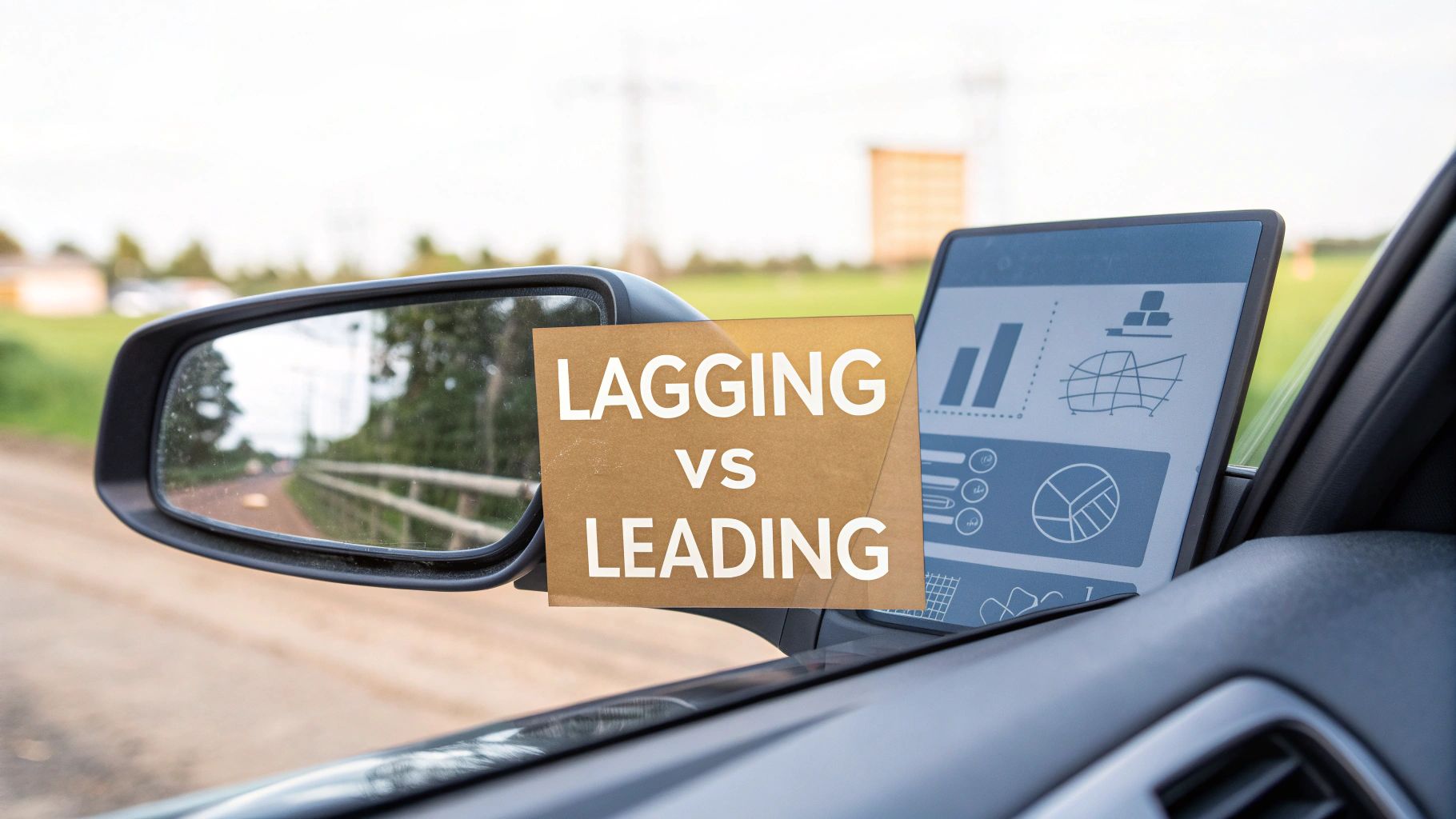
Imagine trying to drive your car by looking only in the rear-view mirror. You'd get a perfect view of where you've been, but you’d have absolutely no idea what’s coming up next. This is the simplest way to understand the difference between lagging and leading indicators: one confirms what’s already happened, while the other helps predict what’s about to.
Seeing The Road Ahead: A Guide To Indicators

To make smart decisions—whether you're managing a tech project, a business, or just your own productivity—you need a clear view of both the road behind and the one stretching out in front of you. Relying on just one gives you a dangerously incomplete picture.
Lagging indicators are your rear-view mirror. They measure outcomes and results that have already happened. These are often the "headline" numbers that get all the attention because they're concrete, easy to measure, and give you definitive proof of what you've achieved.
Leading indicators, on the other hand, are your windscreen. These are the forward-looking metrics that give you clues about where you're headed. Think of them as the inputs and activities you can control today to influence your results tomorrow. They help you spot a curve in the road before you get there.
Why You Need Both Perspectives
Relying only on lagging indicators means you're always reacting. By the time you get the numbers—like quarterly revenue or annual customer churn—the events that caused them are long gone. The chance to influence that specific outcome has vanished.
A classic mistake is managing a team or project exclusively through lagging indicators. It's like trying to steer a ship by watching its wake. You know exactly where you've been, but you have no control over where you're going.
But focusing only on leading indicators is just as risky. You could be busy with all sorts of activities that feel productive but don't actually move the needle on your main goals. The real magic happens when you build a balanced view.
To quickly summarise the key differences, here's a side-by-side look.
Quick Comparison: Lagging vs. Leading Indicators
| Characteristic | Lagging Indicators (The Rear-View Mirror) | Leading Indicators (The Windscreen) |
|---|---|---|
| Focus | Output & results | Input & activities |
| Timing | Measures the past | Predicts the future |
| Measurement | Easy to measure, hard to influence | Harder to measure, easy to influence |
| Purpose | Confirms if a goal was met | Shows progress toward a goal |
| Example | Monthly sales revenue | Number of sales calls made this week |
This table highlights how each type of indicator serves a different, yet equally vital, purpose in giving you a full picture of performance.
Building A Balanced Dashboard
An effective measurement system uses both types of indicators to create a powerful feedback loop. You use lagging indicators to confirm if your strategy actually worked, and you use leading indicators to predict if your current actions are taking you in the right direction.
Here's an actionable way to connect them:
- Set the Goal (Lagging): Define your target outcome. For example, "Reduce the number of critical software bugs per month by 25%."
- Define the Actions (Leading): Identify daily and weekly activities that will drive that goal. For instance, "Increase automated test coverage for new code to 80%" or "Conduct peer code reviews for all major commits."
- Track Both: Monitor your leading indicators in your weekly meetings. Are you hitting your code review targets? Then, at the end of the month, check your lagging indicator. Did the number of bugs go down as predicted?
This creates a dynamic where you're not just reporting on the past; you're actively shaping the future.
Understanding Lagging Indicators for Proven Results
Think about the final score of a football match or the end-of-year financial report. These are classic examples of lagging indicators. They're your official scorecard, measuring the undeniable results of actions that have already happened.
Lagging indicators are, by their very nature, historical. They look backwards, confirming what’s already done and dusted. In a business or IT setting, common examples include customer churn rate, quarterly revenue, or annual employee turnover. Their power comes from the fact that they are concrete, easy to measure, and leave very little room for debate.
This historical certainty is exactly why they're so important for validating strategies and reporting back to stakeholders. When you need to prove a new initiative actually worked, you bring out the lagging indicators. Did that new workflow really cut down on system downtime? The monthly uptime percentage gives you the answer.
What Lagging Indicators Tell You
These metrics are fantastic for spotting long-term trends and digging into systemic issues. A slow but steady rise in support tickets over six months, for instance, is a lagging indicator pointing to a deeper problem, maybe with a new product feature or outdated documentation. You can't change the tickets that were already sent, but you can definitely learn from the pattern.
It's similar to how economists analyse a country's performance. For the Dutch economy, the unemployment rate is a key lagging indicator. It reflects the health of the job market after economic shifts have already happened, tending to rise after a downturn has begun and only falling once a recovery is well underway. It confirms the trend in hindsight. You can dig into more data on Netherlands economic indicators to see how these metrics trail major events.
Lagging indicators are invaluable for learning from your successes and failures. They provide the hard evidence needed to analyse what went right or wrong, turning past performance into future wisdom.
The Inherent Limitation of Looking Backwards
But here's the catch: the greatest strength of lagging indicators is also their biggest weakness. Because they measure outcomes that are already in the history books, they give you zero chance to influence that specific result. By the time you see the number, the game is over.
Here are a few typical lagging indicators and what they really mean:
- Projects Completed This Quarter: This confirms your team's output, but it doesn't help you speed up the project you're working on right now.
- Customer Lifetime Value (CLV): A powerful measure of long-term success, but it's a reflection of years of past customer relationships.
- Net Promoter Score (NPS): Measures customer loyalty based on their past experiences, not what they plan to do next.
Relying only on these metrics is like driving a car while looking exclusively in the rear-view mirror. You get a perfect view of the road you've already travelled, but you’re completely blind to the corners, opportunities, and obstacles just ahead. To navigate effectively, you have to balance this historical view with a forward-looking one. That’s where leading indicators come in.
Using Leading Indicators to Predict Future Success
While lagging indicators tell you a story about your past, leading indicators give you a roadmap to the future. They're the proactive, predictive metrics that act as an early warning system, giving you the chance to make course corrections before it's too late.
Think of them as the drivers of your future results. They are the inputs you can control today to shape your outcomes tomorrow.
This shifts your whole approach from reactive problem-solving to proactive management. Instead of waiting for a quarterly report (a classic lagging indicator) to show a dip in productivity, you could monitor a leading indicator like the number of focused work hours per week. If that number starts to trend down, you've spotted a potential issue long before it hits your final output, and you can step in to fix it.
Identifying Powerful Cause-and-Effect Relationships
The real magic happens when you see the connection between lagging and leading indicators. A well-chosen leading indicator has a direct, cause-and-effect link to a future lagging result. This relationship is what gives you a lever to pull.
The core idea is simple yet powerful: by consistently improving your leading indicators, you create a direct and predictable improvement in your lagging indicators over time. It’s about managing the cause, not just measuring the effect.
This isn't just abstract theory. Consider these practical examples of this powerful link in action:
- Website Traffic (Leading) & Sales Revenue (Lagging): An increase in qualified visitors to your website is a strong predictor of future sales.
- Sales Pipeline Growth (Leading) & Closed Deals (Lagging): A healthy and growing pipeline this month points directly to the number of deals you can expect to close next quarter.
- Employee Training Hours (Leading) & Support Tickets (Lagging): Investing more hours in team training can directly lead to a reduction in future customer support issues.
An Actionable Framework for Your Own Indicators
Figuring out the right leading indicators for your own work doesn't have to be complicated. The trick is to start with the result you want and work your way backwards.
- Define Your Goal (Lagging): First, what’s the ultimate result you want to achieve? A good example would be, "Reduce customer churn by 15%." This is your lagging indicator.
- Brainstorm the Drivers (Leading): Now, what daily or weekly activities directly influence that goal? This could be things like the "Number of proactive customer check-in calls," "Customer satisfaction scores after support interactions," or the "Product adoption rate for new features."
- Select and Track: You don't need to track everything. Just choose two or three of the most impactful drivers. These are your new leading indicators. Start tracking them consistently and see if improvements in these metrics actually correlate with a reduction in churn over time.
- Take Action: If your leading indicator is off-track (e.g., you made fewer check-in calls than planned), take immediate action to correct it. Don't wait for the lagging indicator to confirm a problem.
This proactive approach isn't just for individuals or teams; it's used on a massive scale, too. For instance, a widely recognised leading indicator in the Netherlands is the KOF Economic Globalisation Index, which measures how economically integrated the country is with the rest of the world. Increased trade and investment typically come before domestic economic growth, making this index a powerful tool for anticipating what's next. You can discover more insights about Dutch economic globalisation at TheGlobalEconomy.com.
Putting Indicators to Work in Tech and Productivity
Moving from theory to the real world is where lagging and leading indicators really show their worth. These aren't just abstract ideas for economists; they're powerful, practical tools for managing tech, projects, and even your own daily focus. Get them right, and you can stop reacting to problems and start actively building success.
The connection is easy to spot in day-to-day IT operations. Take server uptime, for example. A report showing 99.9% uptime for last month is a classic lagging indicator. It tells you how you did, which is great, but it does nothing to prevent the next outage.
A leading indicator, on the other hand, might be the percentage of security patches applied on schedule. If your team is consistently hitting 100% on patching (a leading metric), that’s a very strong predictor of future system stability and continued high uptime (the lagging result).
The key insight here is simple: investing in positive inputs like training directly reduces negative outcomes like support tickets. One predicts the other.
Applying Indicators to Personal Productivity
This same logic works perfectly for personal and team productivity. It’s tempting to only measure the finish line, but real, sustainable improvement comes from managing the daily activities that get you there.
Here's an actionable plan:
- Set a Lagging Goal: "I want to finish Project X by the end of the month."
- Choose a Leading Metric: "I will dedicate 2 hours of deep, uninterrupted work to Project X every weekday."
- Track the Input: Use a timer or app to ensure you hit your 2-hour daily goal.
- Adjust in Real-Time: If you miss a day, you know immediately that you're off track and can adjust your plan (e.g., work an extra hour tomorrow) instead of waiting until the end of the month to discover you're behind schedule.
This is where a tool like WhatPulse provides the crucial data you need. Many of its metrics map directly onto this framework, giving you both a rear-view mirror and a clear view through the windscreen of your work habits.
For example, your 'Total Keystrokes' on a project is a lagging indicator—it’s a measurement of work already done. But tracking your 'Average Keystrokes per Minute' during focused work blocks can be a powerful leading indicator of your future velocity and efficiency. By keeping an eye on it, you can spot a dip in focus long before it threatens a deadline.
We dive deeper into turning this kind of raw data into smarter work habits in our guide on making data-driven decisions.
WhatPulse Metrics as Lagging and Leading Indicators
To make this even clearer, here’s how some common WhatPulse metrics fit into this framework. Think of it as categorising your data to see both past results and future predictors.
| Metric (Example) | Indicator Type | What It Tells You |
|---|---|---|
| Total Project Keystrokes | Lagging | The total volume of work already completed for a project. |
| Application Uptime (IDE) | Leading | How much time you're spending in development environments, predicting output. |
| Mouse Clicks per Day | Lagging | A summary of your daily activity after the fact. |
| Keystroke Frequency | Leading | Your real-time typing intensity, which can signal focus and productivity. |
| Network Download (GB) | Lagging | The total data you've already consumed. |
| Real-time Bandwidth Usage | Leading | Your current network activity, which can indicate if you're working or distracted. |
By separating your metrics this way, you start to see a much clearer picture of what drives your results, rather than just measuring the results themselves.
By identifying and tracking the right leading indicators—whether it's proactive patching in IT or focused hours in productivity—you gain direct control over your future lagging results. It's the difference between hoping for a good outcome and actively engineering one.
Of course, tracking these performance indicators effectively depends on having solid data infrastructure. To keep your metrics timely and accurate without getting lost in manual data wrangling, it's worth exploring automated data processing strategies. This ensures the numbers you’re relying on are solid enough to build confident, forward-looking decisions.
How to Choose and Validate Your Key Metrics
Picking the right metrics is where the real work begins. If you get this wrong, you'll end up tracking numbers that look impressive on a dashboard but don't actually move the needle on what matters. It's a common trap.
The secret is to build a clear, logical bridge between the daily actions you can control and the big-picture results you're aiming for. This turns your goals from abstract ideas into a practical, actionable plan. A good framework always starts with your final destination in mind—you have to know where you're going before you can draw the map.
Step 1: Start With Your Core Lagging Indicator
First things first, you need to pinpoint the one outcome that defines success. This is your core lagging indicator. Think of it as the final score of the game. It needs to be a single, measurable number that tells you, without a doubt, whether you've won.
Frameworks like the North Star Metric are built around this exact idea—finding that one crucial metric that captures the most value for your customers and your business.
For example, your core lagging indicator might be:
- Slashing customer churn by 15% this year.
- Growing monthly recurring revenue (MRR) by 20%.
- Shipping one extra project per quarter as a team.
This is your target. Every other metric you decide to track should serve the single purpose of pushing this number in the right direction.
Step 2: Brainstorm Your Driving Leading Indicators
Once your destination is locked in, it's time to figure out how you'll get there. This involves brainstorming all the inputs and activities—your potential leading indicators—that influence that final score.
A practical way to do this is to hold a short team workshop. Ask a simple question: "What are the daily or weekly actions that have the biggest impact on our core goal?"
Let's stick with the goal of reducing churn by 15%. A quick brainstorm might give you a list like this:
- The number of proactive customer check-in calls we make each week.
- How fast we respond to support tickets, on average.
- Customer satisfaction (CSAT) scores after an interaction.
- How many customers start using that key new feature we just launched.
Now, here's the important part: don't try to track all of them. Pick the two or three you genuinely believe will have the biggest impact. Focus is your friend here. Getting a handle on these inputs starts with setting up good baseline metrics for continuous improvement.
Step 3: Test and Validate the Connection
The final step is the reality check. You need to make sure your chosen leading indicators actually predict your lagging indicator. This part takes a bit of patience. You’ll need to track both sets of metrics side-by-side for a meaningful amount of time, like a full business quarter or an entire project cycle.
Validation is where theory meets reality. You're looking for a consistent correlation: when our leading indicators go up, does our lagging indicator improve a short time later?
If you notice that a steady rise in proactive check-in calls (your leading metric) is consistently followed by a dip in customer churn (your lagging metric), you've found a powerful connection. You've validated your hypothesis.
But what if there's no link? No problem. That's valuable information, too. It just means it's time to go back to your brainstormed list, pick a different leading indicator, and start a new test. This loop of testing and refining is what ensures your dashboard is telling you the truth about what really drives results.
Common Mistakes to Avoid When Tracking Performance

Putting a system of lagging and leading indicators in place is a huge step forward, but it's surprisingly easy to get it wrong. Just tracking numbers isn't the goal. The real magic happens when you track the right numbers in the right way.
Avoiding a few common pitfalls can be the difference between a dashboard that drives smart decisions and one that just adds to the noise.
One of the most common mistakes is focusing almost entirely on lagging indicators. Metrics like quarterly revenue are obviously important, but when you only manage by them, you're always looking in the rearview mirror. You’re reacting to results you can no longer influence, which is a surefire way to fall behind.
Another classic trap is chasing vanity metrics. These are the numbers that look impressive on a slide deck but have zero real impact on your actual goals. For instance, celebrating a spike in total website page views feels good, but if those views don't lead to more demo sign-ups (a solid leading indicator for sales), then what's the point?
Overcoming Data Overload
Perhaps the trickiest mistake to spot is creating data overload. In the rush to be "data-driven," it’s tempting to track absolutely everything. This leads to cluttered dashboards where the important signals are completely lost in the noise. It’s a fast track to a state of paralysis.
The goal isn't to measure everything you can; it's to measure everything that matters. A focused dashboard with one core lagging indicator and three to five powerful leading indicators is far more effective than a sprawling report with fifty metrics.
To sidestep these issues, you just need a simple framework. Think of it as a checklist to keep your measurement system lean, effective, and built for real improvement, not just more work.
An Actionable Checklist for Success
- Keep Your Dashboard Focused: Start with your single most important lagging indicator. Then, identify only the handful of leading indicators that directly push that number forward. A clean, simple view makes it much easier to spot what’s happening and why.
- Review Your Metrics Regularly: Business goals change, and so should your metrics. Set a calendar reminder—perhaps quarterly—to ask your team if your indicators are still the best predictors of success. If not, run a new brainstorming session and swap them out.
- Foster a Learning Culture: Use your leading indicators to learn and adapt, not to point fingers. When a leading metric dips, it should spark a conversation about why it happened and what the team can try next, not a hunt for who's to blame.
By steering clear of these common mistakes, you can build a measurement system that actually provides clarity and direction. If you want to dive deeper into this topic, check out our guide on how to avoid getting stuck in analysis by paralysis.
A Few Common Questions About Indicators
Getting your head around metrics can bring up some tricky questions. Let's tackle a few of the most common ones I hear about lagging and leading indicators to help you put these ideas to work with more confidence.
Can a Metric Be Both a Lagging and Leading Indicator?
Absolutely, and this is a really important idea to get comfortable with. A metric’s role isn’t fixed; it all depends on your perspective and what you’re trying to figure out. The same number can tell you about the past and hint at the future.
Take customer satisfaction, for example. On its own, it’s a classic lagging indicator. It tells you how a customer felt about something that has already happened. But that very same score is also a powerful leading indicator for future business. A high satisfaction score today is a strong signal that a customer is likely to stick around.
How Many Indicators Should I Track?
It’s so easy to get buried in data. The aim isn't to measure everything you possibly can—it's to measure what actually matters. A short, focused list of metrics will always beat a cluttered dashboard.
A good starting point is to lock in on one or two core lagging indicators that represent your ultimate goal. From there, pick out the three to five most impactful leading indicators you believe are pushing those results.
This approach keeps you focused. It helps you manage the inputs that have the biggest sway over your outcomes, without getting lost in the noise. You can always swap them out later as you learn which metrics are giving you the best signals.
How Do I Know if a Leading Indicator Is Any Good?
You can't just pick a leading indicator and hope for the best; you have to validate it. You need to see for yourself that it reliably predicts your lagging outcome. The best way to do that is simply to watch how they move together over time.
Track your chosen leading indicator and its lagging partner for at least one full business cycle or project. You're looking for a clear correlation. If you see that a steady rise in your leading metric is consistently followed by a boost in your lagging one, you know you're onto something. If not, it’s a sign to go back to the drawing board and test a different leading indicator.
Ready to turn your team's activity into clear, actionable insights? WhatPulse provides the privacy-first data you need to identify your own lagging and leading indicators, helping you optimise workflows and drive real results. Start making data-driven decisions today.
Start a free trial