

The concept of beginning with the end in mind is a practical strategy, not a motivational quote. For anyone leading an IT or engineering team, it means shifting focus from deploying tools to achieving specific, measurable business outcomes.
Why a Clear Destination Matters in IT
You don't build a bridge by laying bricks and hoping you reach the other side. You first define the destination, the load it must carry, and its required lifespan. Only then do you work backwards to design the supports and pour the foundation. The same logic applies to technical projects.
Beginning with the end in mind means you define what success looks for a software rollout before buying a single license. This change in perspective prevents wasted money, poor adoption, and failed projects. For more on this, see this guide on aligning IT with your overall business strategy.

From Vague Goals to Tangible Outcomes
Without a clear picture of the 'end', project goals become generic. This unfocused approach leads to deploying tools nobody uses or creating processes that don't improve anyone's workflow.
Here’s how this approach reframes common IT objectives:
- Instead of: "Deploy new CRM software for the sales team."
- The goal becomes: "Reduce manual data entry for the sales team by 20% within six months."
- Instead of: "Roll out a new collaboration platform."
- The goal becomes: "Decrease internal email traffic by 30% and increase project-based chat messages by 50%."
This method forces a conversation about why a project exists. It draws a line from the technical work to a business problem, making sure the final result delivers value, not just a list of completed tasks.
This approach establishes a first step: you must have a documented vision of the desired outcome. That vision becomes your destination and the filter for every decision.
The Strategic Advantage of Defining Outcomes First
Defining clear outcomes at the start is your best defense against project complexity and failure. It flips the project charter from an activity-based plan to a results-driven one. Instead of "deploy a new CRM," the objective becomes "increase sales team focus time by 15% within two quarters."
This specificity acts as a filter for every decision, from software selection to user training. You can constantly ask: does this action get us closer to our stated outcome? This helps when managing software spend and coordinating hybrid work, where proving value is necessary. A clear benchmark for success makes it easier for finance to approve budgets and for managers to see the impact of their initiatives.
In high-stakes projects, this approach is a risk mitigation exercise. It’s about building a solid foundation, something a good CIO's guide to SharePoint migration planning will always cover.
Mirroring Market Sector Success
When you anchor projects to productivity goals, the returns can be large. This approach reflects the stability seen in market sectors with clear, long-term objectives.
Consider the Netherlands. Labour productivity growth in its market sector averaged a steady 1.1% per year from 2013 to 2023. That outpaced the overall economy's 0.4% annual rate over the same decade. The lesson for IT directors and CIOs is that starting with the end in mind can bring that same resilience into your organization. You can review the Dutch labour productivity from Eurostat data for more details.
From Ambiguity to Actionable Goals
When the 'end' is fuzzy, teams guess. This is where scope creep and wasted effort originate. A well-defined outcome creates a shared language of success that gets everyone—from engineering to sales—moving in the same direction.
Look at the difference in clarity:
- Vague Goal: "Improve our remote work setup."
- Outcome-First Goal: "Reduce support tickets for remote access by 25% and hit 99.9% uptime for key apps."
- Vague Goal: "Modernise our internal communication."
- Outcome-First Goal: "Move all project communication to one platform, cutting email status updates by 40%."
This demands a data-informed perspective from the start. You can’t define a meaningful future state until you understand the current one. Our guide on how data-driven insights improve decision-making is a good place to begin.
By articulating the desired business impact, you turn a technical project into a strategic initiative. It’s no longer about implementing technology; it’s about solving a specific, measurable problem that affects the bottom line.
A Practical Framework for Putting This Into Action
Knowing you should begin with the end in mind is one thing. Doing it is another. Shifting from a vague idea to a concrete plan takes structure. This involves adopting an operational framework that forces clarity and connects every task back to a business outcome.
This framework has four straightforward stages. Each builds on the last, turning a high-level goal into something you can measure and achieve.
Step 1: Define the End State
Before anything else, get a clear picture of what success looks like. I'm not talking about project deliverables, like "the new software is installed." I'm talking about the business outcome. Get stakeholders from different departments in a room—sales, operations, finance—and ask them: "What problem are we really trying to solve here?"
Their answers are everything. If you're rolling out a new collaboration tool, the goal isn't just getting everyone to log in. The real goal might be something tangible, like "reduce internal email traffic by 25%," an outcome that directly affects how people work.
This flow shows how a clear action connects to a valuable outcome.
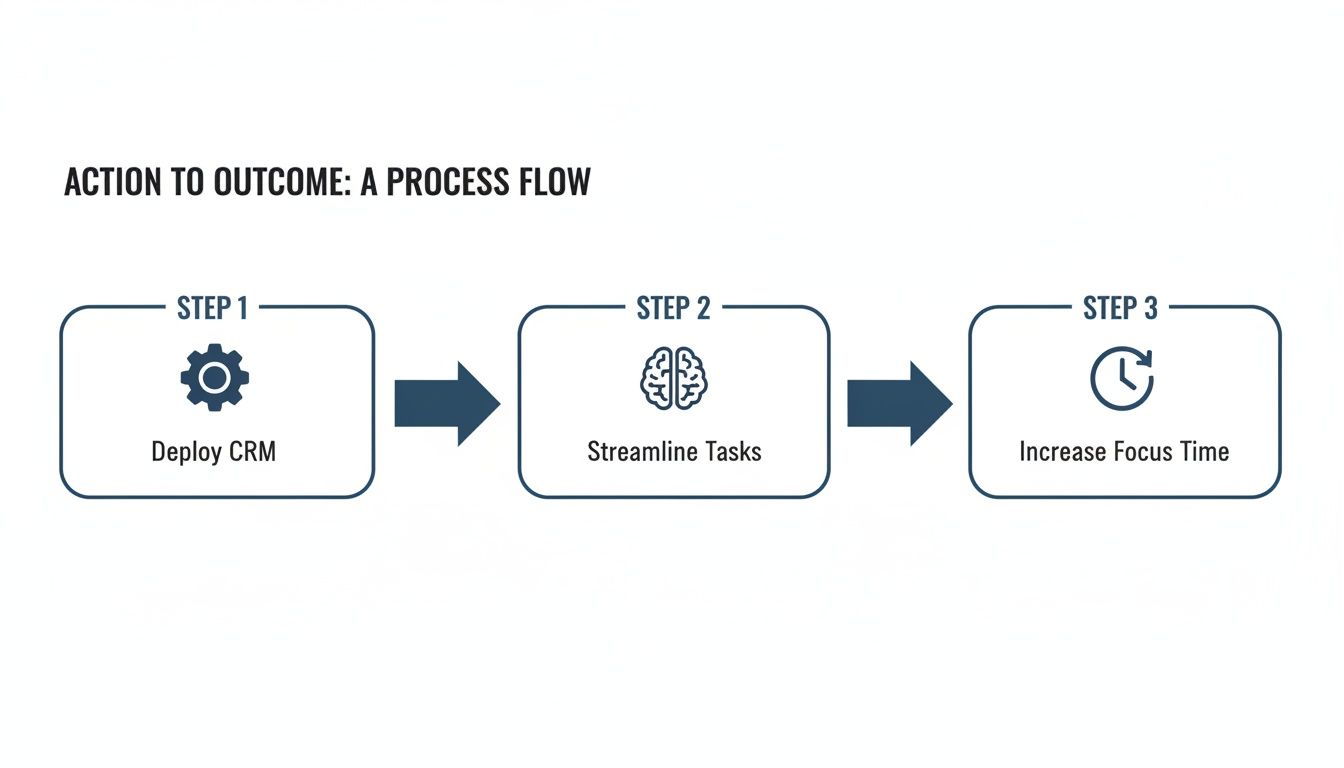
The image shows the core idea: technical deployment is just the first step. The real win is the business result it creates, like giving your team more focused time.
Step 2: Work Backwards to Identify Milestones
Once you know your destination, you can map the journey. By working backwards from that end state, you can spot the necessary steps and milestones.
Let's stick with our goal of reducing email by 25%. Your milestones might look like this:
- Month 1: All users are trained and the platform is fully configured.
- Month 2: It's now mandatory for all project updates to happen in the new tool.
- Month 3: Old email channels are archived, and we start reviewing usage data.
A large goal becomes a sequence of smaller, manageable tasks. Our guide on planning a project from start to finish has more detail.
Step 3: Select Key Performance Indicators
You can't manage what you don't measure. The third step is choosing the right Key Performance Indicators (KPIs) to tell you if you're on track. These metrics must be directly tied to the end state you defined earlier.
Vague metrics lead to vague results. If your goal is to cut down on email, your main KPI must be a number reflecting email volume—not a fuzzy metric like 'user satisfaction'.
Avoid vanity metrics like software logins, which don't tell you much. Focus on data that shows a real change in behavior. For our collaboration tool, good KPIs would be 'daily active users in the new platform' and 'average number of emails sent per user per day'.
Step 4: Establish a Baseline
Finally, you need a starting point. Before you implement any change, measure where things stand right now. This is your baseline. Without it, you have no way of knowing if your project made a difference.
For the collaboration tool deployment, this means using an analytics platform to measure current email volume and application usage before the project begins. That baseline data is the anchor. It's what you'll measure all future progress against, giving you hard numbers to prove your work's value.
Setting and Measuring Success with The Right Metrics
A project without a way to measure success is a road trip without a destination. When you begin with the end in mind, you choose KPIs that tell you if you’ve arrived. This means looking past simple vanity metrics and focusing on data that proves real change has happened.
It’s the difference between tracking logins and measuring average focus time. One tells you people can access a system; the other tells you if they can get work done there.

Differentiating Vanity and Actionable Metrics
Look at the data points available. You could track application adoption rates, monitor keyboard and mouse activity to see engagement, or analyze network traffic to find resource-hogging apps. These are the metrics that tell a story.
Consider these examples:
Vanity Metric: 100% of employees have the new software installed.
Actionable Metric: Use of the old, legacy software has decreased by 85%.
Vanity Metric: 5,000 total daily logins to the new platform.
Actionable Metric: Average time spent in the new platform is 90 minutes per day, up from 15 minutes in the legacy system.
This data-driven approach removes guesswork. Say an operations manager is aiming for a 20% efficiency gain. The process is straightforward: first, measure the time spent on that workflow before any changes. After implementation, measure it again to see if the goal was met. This requires tools that give you clear, objective numbers. Our guide on using baseline metrics for continuous improvement offers a deeper look.
Connecting Metrics to Broader Goals
Individual project metrics should also connect to larger organizational goals, like productivity. Dutch productivity levels reached 102.90 points in Q3 2025, a slight increase from Q2 but still showing recent vulnerabilities. For system administrators, it's a reminder that efficiency is fragile. Beginning with the end in mind means launching analytics platforms with predefined KPIs to measure hybrid work effectiveness from day one, turning data into a defense against productivity dips.
WhatPulse Professional is designed for this. It aggregates lightweight client data from Windows and macOS devices, exposing things like meeting loads and process bottlenecks from the moment it’s deployed. This gives you immediate visibility into the impact of your IT initiatives.
Real-World Scenarios Where This Approach Works
Abstract principles are one thing, but seeing how a method works makes it stick. Beginning with the end in mind is a practical way to solve specific business problems.
The approach works best when the goal is tangible and the metrics are undeniable. Let’s look at three scenarios with different teams and objectives. In each case, the process is the same: define the desired outcome first, then work backwards.
The DevOps Team
A DevOps team is under pressure to speed up the development cycle. The vague goal is "go faster." By beginning with the end in mind, they get specific: reduce average build times by 10% within one quarter.
This clarity changes everything. The 'end' is a number, not a feeling. Their first step isn't to buy new tools but to establish a baseline. They use analytics to benchmark toolchain performance and measure how long developers spend waiting for builds.
Only with that starting data can they spot the bottlenecks and track progress. The outcome is a faster development pipeline, proven by data.
The Finance Department
A finance department’s objective is to reduce operational waste. Instead of a blanket "cut costs" directive, the team applies this principle to software license bloat.
Their end goal is cutting software license waste by 20% before the next renewal season.
With this target, their first action is clear. They use an analytics tool to get a complete picture of application usage. The data reveals which expensive licenses are unused and which tools have overlapping functions. This targeted approach allows them to make precise, data-backed decisions about what to cut, hitting their 20% reduction goal.
The Digital Transformation Manager
A digital transformation manager is tasked with rolling out a new project management tool. A typical project might measure success by the number of installations. Beginning with the end in mind forces a better question: what business problem is this tool supposed to solve?
The manager defines success with two operational metrics: a 30% decrease in project updates sent via email and a 15% increase in tasks completed within the new platform.
Success is about a shift in workflow, not just adoption. This clarity guides the entire training and implementation process, focusing on changing behaviors, not just installing software.
In the Netherlands, productivity growth is a constant focus. Between 2013 and 2023, the Dutch market sector’s labour productivity grew 1.1% annually, outpacing the total economy’s 0.4%. For product leads, the lesson is that beginning with the end in mind is necessary for this kind of focused growth. You can discover more insights about Dutch business sector productivity from DNB.nl.
Common Pitfalls And How To Avoid Them
Even with a clear destination, the journey can go off course. Thinking backwards from your goal is a solid strategy, but it isn’t foolproof. A few common mistakes can derail a project.
Recognizing these traps is the first step to sidestepping them.
The most frequent error is setting vague goals. "Improve efficiency" sounds good but gives your team no real direction. It's a wish, not a target. Without a specific metric, nobody knows what the finish line looks like.
Another hurdle is failing to get buy-in from stakeholders. If managers and teams don’t agree with the ‘end’ you’ve defined, they won’t be motivated. The project becomes just another top-down directive.
From Vague Goals to Specific Targets
To avoid ambiguity, use a framework that forces clarity. The SMART methodology is a classic for a reason. It ensures every goal is:
- Specific: State exactly what needs to be achieved (e.g., "Reduce ticket resolution time").
- Measurable: Define how you will track progress (e.g., "by 15%").
- Achievable: Make sure the goal is realistic given your resources.
- Relevant: The goal must align with broader company objectives.
- Time-bound: Set a clear deadline (e.g., "within Q3").
Applying this turns "improve efficiency" into "Reduce average ticket resolution time by 15% within Q3." One is an idea; the other is a plan.
Securing Buy-In and Setting Baselines
To get stakeholders on board, connect your project's 'end' to outcomes they care about, like cost savings or faster delivery. Build a simple business case showing how achieving your goal will benefit their department.
Don't forget the baseline. Neglecting to measure your starting point is a critical oversight. Without a pre-implementation baseline, you have no way to prove your project made a difference. It’s like measuring weight loss without ever stepping on the scale at the beginning. You might feel different, but you'll have no data to prove it.
Got Questions? We’ve Got Answers
When you start shifting how your IT team approaches projects, a few questions come up. Here are the most common ones.
How Is This Different From Standard Project Management?
Traditional project management often focuses on delivering on time and on budget.
This approach is different. It starts by locking in the business outcome the project must create. The measure of success isn't a technical hand-off; it's whether that outcome was achieved.
What If Our Goals Change Midway Through a Project?
Change happens. This strategy makes it easier to handle.
Because the team is aligned on the ultimate 'end,' you have a clear yardstick to measure any proposed changes against. You can ask, "Does this change get us closer to our goal, or further away?" This allows for smart adjustments instead of clinging to an obsolete project scope.
Can This Be Applied to Small IT Tasks?
Yes. The principle scales down. Take a minor task, like a server update.
Instead of just doing it, define the 'end' first: "Improve system response time by 5%." This gives every action, no matter how small, a clear and measurable purpose.
You can't define your 'end' state or measure success without the right data. With WhatPulse, you can set baselines, track how applications are actually used, and see the real-world impact of your IT initiatives. Find out more at whatpulse.pro.
Start a free trial