
Working in 25-minute sprints can sharpen your focus. This method, often called the Pomodoro Technique, uses a simple cycle: 25 minutes of uninterrupted work on one task, followed by a 5-minute break.
The goal isn't to work longer hours. It's to break down large projects into manageable chunks you can start and finish. This creates a rhythm that helps you stay on track without burning out.

The Foundation of 25 Minute Focus Sprints
The idea is simple: set a timer for 25 minutes and give one task your full attention. This isn't about adding hours to your day. It’s about drawing clear boundaries around your focus.
This structured cycle of work and rest provides a predictable rhythm, preventing the mental fog that creeps in after hours of continuous effort.
Why It Works
This approach is versatile. It works for coding a feature, drafting a report, or digging into research. It gives you a practical framework for managing your day, leading to better concentration and less mental fatigue.
Here’s why it’s effective:
- It beats procrastination. Committing to just 25 minutes feels manageable. That small commitment lowers the mental barrier to starting a task you dread.
- It minimises distractions. The rule is to focus only on your chosen task until the timer goes off. This trains your brain to ignore the pull of emails, notifications, and the urge to multitask.
- It sharpens your planning. When you think in 25-minute blocks, you get a more realistic picture of how long your work actually takes.
The Pomodoro is an indivisible unit of work. Once that timer starts, you’ve made a pact with yourself to see it through without interruption. New ideas or to-dos get jotted down for later, not handled immediately.
The Standard 25 Minute Work Cycle
The technique is a repeatable pattern built for sustained productivity. Using a physical timer provides a clear, audible signal for when to start and stop.
The table outlines the full cycle, designed to manage your energy for the long haul.
The Standard 25 Minute Work Cycle
| Phase | Duration | Purpose |
|---|---|---|
| Focus Sprint | 25 Minutes | Uninterrupted work on one specific task. |
| Short Break | 5 Minutes | Mental reset; step away from your screen. |
| Long Break | 15-30 Minutes | A longer rest after four consecutive sprints. |
This rhythm keeps your energy levels stable. The short breaks prevent your brain from getting overloaded, while the longer break offers a real chance to recharge.
Your work environment matters as much as the timer. For this technique to work, your physical workspace needs to be as free from distractions as your schedule. For instance, creating optimal cubicle privacy can make a real difference in your ability to concentrate.
When you control both your time and your space, you create the right conditions for productive work.
The Science Behind Why This Method Works
Setting a timer for 25 minutes taps into your brain's natural cognitive rhythm. Our ability to maintain intense, unbroken focus is short. Working in quick sprints sidesteps the mental burnout that comes from long, continuous sessions.
This structure helps you avoid cognitive overload and decision fatigue. By breaking your day into managed intervals of effort and rest, you can keep your performance high.

Defeating Multitasking and Context Switching
One benefit of the 25-minute timer is its power to fight multitasking. When you commit to a single task for a set period, you train your brain to resist distractions. Think of it as an antidote to context switching—the mental toll you pay every time you shift your attention between tasks.
Each time you switch, your brain pays a cognitive penalty. It takes time to disengage from one thing and ramp up on the next. These small moments add up, draining your mental energy.
This is especially true in hybrid work environments. For example, recent findings show that Dutch remote workers report a 40% increase in focus due to fewer office interruptions. With 52% of the workforce in the Netherlands now working remotely, and adoption hitting 76% in ICT sectors, managing focus becomes a clear competitive edge.
The Power of Urgency and Completion
A ticking clock creates a gentle sense of urgency. Knowing you have just 25 minutes pushes you to make real progress instead of getting lost in perfectionism. This artificial deadline makes tasks feel less intimidating and easier to start.
This effect is rooted in Parkinson's Law: work expands to fill the time you give it. By intentionally shrinking the time, you force yourself to be more efficient.
Each completed 25-minute block delivers a small hit of accomplishment. This cycle of effort and reward releases dopamine, a neurotransmitter tied to motivation, which makes it easier to start the next interval.
Training Your Brain for Deep Work
Using a timer for 25 minutes at a time is a form of mental training. With consistent practice, you build your "focus muscle," making it easier to drop into a state of deep work. You learn to recognize and dismiss internal distractions—like the sudden urge to check email—as well as external ones.
This structured approach turns focus from a fleeting resource into a reliable skill. By mastering these short bursts of concentration, you build the foundation for producing higher-quality work more consistently.
Getting Your Team Started with 25-Minute Focus Sprints
Turning a solo productivity method into a team habit requires more than just starting a timer. It's a culture shift. It needs clear communication and ground rules, because without a shared framework, one person's focus sprint is another person's interruption.
A good way to start is with a visible action. A team lead can schedule shared "focus blocks" in the team calendar. This protects that time internally and signals to others that this time is off-limits for meetings or random requests.
Establishing the Ground Rules
Once focus time is on the calendar, the next step is agreeing on the rules. These don’t need to be complicated.
The point is to build a predictable environment where everyone knows how to communicate without derailing deep work.
- Slack and Teams Etiquette: Agree to hold non-urgent messages until a sprint is over. For something that truly can't wait, create a clear protocol, like a direct @mention or a specific emoji, to signal that a disruption is necessary.
- Physical Space Norms: For teams in an office, headphones can be the universal sign for "do not disturb." A hand signal or a sticky note on a monitor also works to show you're mid-sprint.
- Handling External Interruptions: Decide as a team how to handle pings from other departments. A unified response like, "Our team is in a focus block until 11:00, can I get back to you then?" helps set boundaries.
These small agreements remove the mental friction of wondering if it’s okay to interrupt a colleague. They make focused work the default, not the exception.
Adapting the Method for Collaborative Work
A timer for 25 minutes isn't just for solo tasks. It's an effective tool for structuring collaborative work and avoiding long, aimless meetings.
Instead of a single two-hour brainstorming session, try breaking it into three 25-minute sprints with short breaks in between. This keeps energy levels high and encourages more focused contributions.
A 25-minute timer turns a vague "let's brainstorm" meeting into a series of targeted efforts. The first block could be for silent idea generation, the second for grouping them, and the third for defining next steps. Each segment has a clear goal and a finish line.
This approach works well for technical teams. Pair programming or code review sessions can be organized into these focused intervals. The structure keeps both people engaged and stops one person from dominating the keyboard.
Overcoming Resistance and Building Momentum
Not everyone will like this new structure right away. Some might find it too rigid; others will struggle to disconnect from messages. The key is to address those concerns directly.
Start by explaining the "why." Don't frame the 25-minute sprints as a way to micromanage time. Present it as a strategy to protect the team's attention. You can share data on the cost of context switching.
- Start with a pilot. Run a one-week experiment with a few willing team members. Let them be the champions who share their experiences with everyone else.
- Gather feedback. After the pilot, ask for specific input. What worked? What felt clunky? Use that to tweak the rules. Maybe your team finds 45-minute blocks work better.
- Lead by example. If you're a manager, you have to live by the system. Don't send messages during focus blocks or book meetings over them. When your team sees you respecting the process, they are more likely to buy in.
By introducing the timer 25 minutes technique as a team, you can build a shared ritual. It gives you a practical way to create a culture where deep work is a daily, predictable reality.
How to Measure the Impact of Focused Work
Rolling out a timer 25 minutes technique for your team is one thing. Knowing if it’s working is another. To move beyond gut feelings, you need objective data that shows real changes in how your team works.
The goal is to turn a productivity tip into a measurable process. This is how you validate its return on investment and find where your team might need more support.
Establishing a Performance Baseline
Before your team starts using 25-minute sprints, you need a starting point. Without a baseline, you have nothing to compare your results against. Track your team’s normal work patterns for a week or two to get a clear picture of their current habits.
Here are key things to measure:
- Total 'focus time': How much time is spent in core work applications (like a code editor) versus communication tools?
- Context switching frequency: How often do people jump between different apps per hour? A high number is a sign of fractured attention.
- Application usage trends: Are specific, non-essential apps consistently breaking deep work sessions?
This initial data gives you a snapshot of productivity before you've changed anything.
A common mistake is to jump straight into a new method without measuring the 'before' state. This makes it impossible to prove whether the change had a positive, negative, or neutral impact.
In today's hybrid work world, collecting this data requires a privacy-first mindset. This is especially true in the Netherlands, a European leader in remote work. In 2023, 52% of the Dutch labour force—over 5 million people—worked from home. For IT directors, this new reality demands analytics that respect employee privacy while delivering useful insights.
Tracking Progress with Objective Data
Once the 25-minute sprints are in motion, keep tracking the same metrics. Privacy-conscious tools like WhatPulse can provide aggregated, anonymous data without capturing screen content or keystroke order. This approach helps build trust while giving you the insights you need.
With such a tool, you can see if focus time in core applications is increasing and if time spent in distracting apps is going down.
What you're looking for is a noticeable drop in context switches per hour. It’s a strong indicator that focus is improving. A team that switches apps less is a team that's protecting its attention. For a deeper look at this idea, it's worth exploring the differences between tracking and measuring work.
This diagram shows a simple flow for putting team focus into practice.
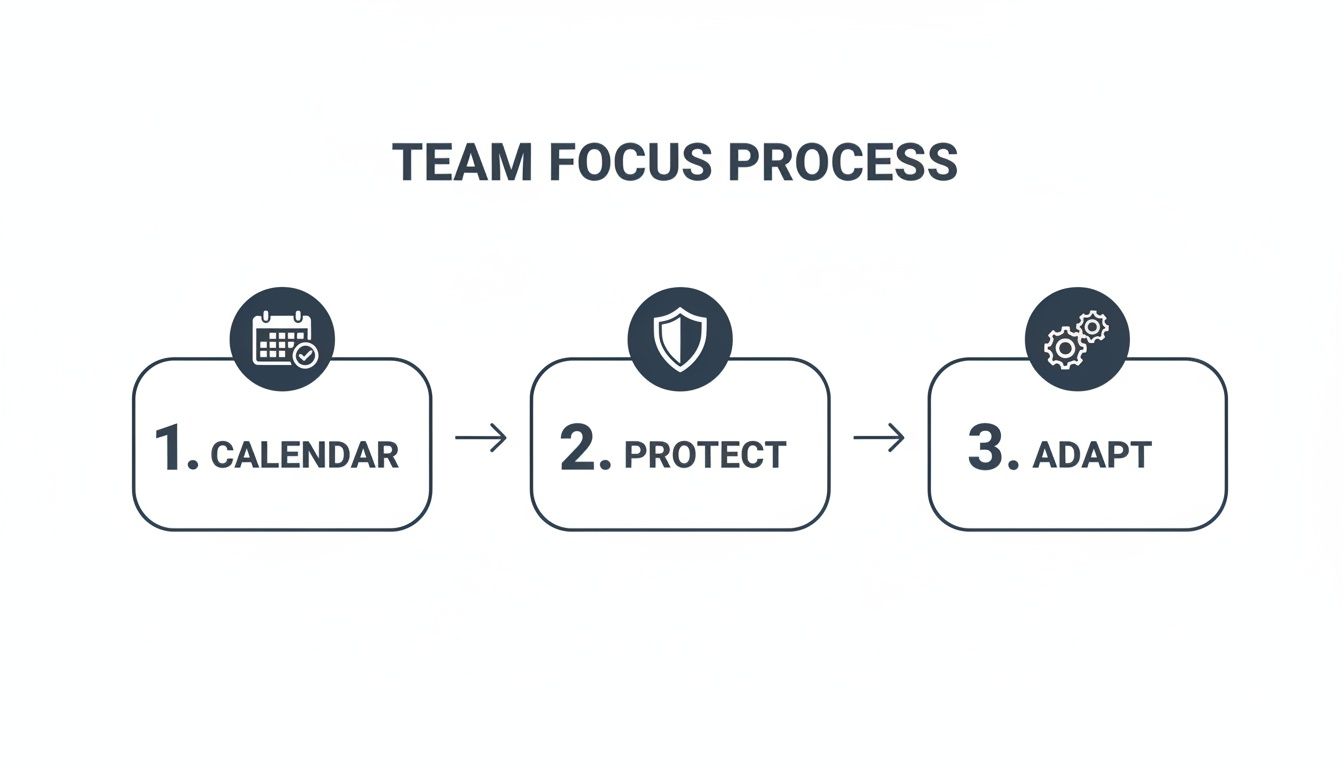
The process is clear: scheduling focus time (Calendar), shielding it from interruptions (Protect), and adjusting based on feedback (Adapt) are the key steps.
Using real numbers allows for objective, constructive conversations about what’s working. The data can reveal hidden challenges, like a specific tool causing interruptions or a team member who might need more support. This data-driven approach elevates the timer 25 minutes method from a personal habit to a scalable team strategy.
Avoiding Common Pitfalls with This Technique
The 25-minute timer framework is a useful guide, but its rigidity can be a weakness. Many people try this method only to abandon it when the reality of their workday doesn't fit into neat 25-minute boxes. The system breaks down if you treat it like an unbreakable law instead of a flexible tool.
Common mistakes include ignoring the timer, skipping a break to "just finish one more thing," or letting one interruption derail a focus session. These might seem like minor slips, but they break the rhythm, which is the whole point.

Making the System Stick
To prevent these problems, you need a few practical tactics. Using a physical timer, for instance, gives a stronger mental and sensory cue than a silent notification. The act of reaching over to start and stop it makes your commitment more tangible.
What about interruptions—a colleague with an "urgent" question or a random idea for another project? The trick is to have a notepad or a simple text file open nearby.
Your goal is to capture the interruption, not engage with it. Jot down a quick note like "Follow up with Sarah on Q3 numbers" and immediately get back to your task. This acknowledges the distraction without surrendering your attention to it.
This "capture and release" method is effective. It reassures your brain that the thought won't be forgotten, freeing you to finish your 25-minute interval. It works just as well for internal distractions.
Customising Your Intervals
Flexibility is what makes this a long-term win. While the standard 25-minute timer is a good starting point, it's not a one-size-fits-all solution. Forcing yourself to stick to it when it doesn’t fit your workflow leads to frustration.
If you're deep in a state of flow while debugging code, a ringing timer can feel like a splash of cold water. In those moments, it makes more sense to finish your thought, maybe extend the session by another 10-15 minutes, and then take a slightly longer break.
On the other hand, for simple tasks like clearing your inbox, a shorter interval can be more effective. A 15-minute sprint is often enough to make a dent without feeling like a drag. If you consistently feel unfocused during work intervals, it could be a sign of other issues, and it might be helpful to learn about tackling brain fog in the workplace.
You need to adapt the system to fit your work, your energy levels, and the demands of the task. The table below offers a few ideas for adjusting your timer lengths.
Adapting Timer Lengths for Different Tasks
| Task Type | Suggested Interval | Rationale |
|---|---|---|
| Creative or Deep Work (e.g., coding, writing) | 45-50 minutes | Allows for deeper immersion and reaching a flow state without abrupt interruptions. |
| Administrative Tasks (e.g., email, scheduling) | 15-20 minutes | Short bursts maintain momentum and prevent boredom on repetitive, low-focus work. |
| Standard Tasks (e.g., research, planning) | 25 minutes | The classic interval provides a balanced blend of focused effort and frequent recovery. |
By customising the system, you move from following a rigid method to creating a personal productivity framework that works for you. This adaptability is what will make you stick with it.
Got Questions? We've Got Answers.
Here are straightforward answers to questions that come up when you start working in 25-minute sprints. This is about making the method work for you and your team.
What If My Task Takes Longer Than 25 Minutes?
This is a common question. The 25-minute interval is a starting point, not a hard rule. If you’re deep in a flow state, the last thing you want is to stop because a timer went off.
Instead, finish your current thought or the small chunk you’re working on, then take your break. The real goal is the rhythm of focused work followed by intentional rest, not slavish devotion to a number.
Many people find they hit their stride with longer intervals. Don't be afraid to experiment.
- Try a 50-minute work session followed by a 10-minute break.
- For deep creative or technical tasks, a solid 90-minute block might be what you need.
The point is to find a rhythm that feels sustainable for your work.
How Do I Handle Interruptions From My Team?
Managing interruptions is where this technique either succeeds or fails, especially on a team. You need a plan for digital pings and people tapping you on the shoulder.
For digital noise, use your computer’s "focus mode." Mute notifications. It's also a good habit to update your status in Slack or Microsoft Teams to something like "Focusing - back in 20 mins." It sets a clear boundary.
For in-person interruptions, a pair of headphones is the universal "do not disturb" sign. If someone does approach you, it’s fine to say, "I'm in a focus block right now, can I find you in 15 minutes?"
This all works better when the whole team is on board. Try scheduling shared "focus blocks" in a team calendar. It helps build a culture where deep work is protected, shifting the responsibility from just you to a shared team commitment.
What Should I Actually Do During the 5-Minute Breaks?
The purpose of the short break is to give your brain a real rest. So, avoid anything that demands heavy thinking. That means no checking work email, no scrolling through a dense news feed, and no jumping into a work debate on a messaging app.
The best breaks are physical and screen-free. You want to detach from the task so you can come back to the next 25-minute session feeling reset.
Here are a few simple ideas:
- Get up and stretch your back, neck, and shoulders.
- Walk to the kitchen for a glass of water.
- Look out a window and let your eyes focus on something far away.
- Do a few quick bodyweight exercises like squats or push-ups.
This mental reset prevents burnout and keeps your performance high all day. It gets you ready to dive back in when the next timer starts.
Can This Method Work for Meetings or Group Work?
Yes. The core ideas of timeboxing and structured focus translate well to collaborative work. For meetings, you can use a 25-minute timer to structure the agenda. Dedicate one block to a specific topic, take a quick pause, and then move to the next item.
It’s a simple way to keep discussions on track and stop meetings from sprawling. It forces the group to be concise.
For collaborative work like brainstorming or pair programming, working in 25-minute sprints is also effective. It keeps everyone engaged and prevents the session from becoming a long, draining slog.
- Brainstorming Session: Use the first 25-minute block for silent, individual idea generation. Use the second to group and discuss what everyone came up with.
- Pair Programming: The timer offers a natural cue to switch roles between the person driving (writing code) and the person navigating (observing and planning).
This rhythm makes group work feel more energetic and productive.
Ready to turn these principles into measurable improvements for your team? WhatPulse provides the privacy-first analytics you need to understand focus time, reduce context switching, and see the real impact of your productivity initiatives.
Discover how your team works with WhatPulse Professional
Start a free trial