

Scrum is often misunderstood. People see daily stand-up meetings and sticky notes and think that's all there is to it. But those are just the visible parts of a framework designed to manage complex, unpredictable work.
Scrum isn't a rigid, step-by-step methodology. It’s a lightweight guide. It helps teams deliver real value in short, focused cycles called Sprints, allowing them to adapt as they learn. The approach is built on empiricism—making decisions based on what you can see and prove, not on a plan made months ago.
What Scrum Project Management Really Means

Scrum is a strategy for tackling uncertainty. Instead of trying to create a perfect, long-term plan from the start, Scrum teams work in short, consistent bursts.
This structure forces them to regularly check their progress and adjust their course based on what they’ve learned. The aim is to have something usable—a tangible piece of the product—at the end of each cycle. This gets feedback flowing early and often, which helps in building the right thing. To get a handle on this, it helps in understanding the differences between Agile, Waterfall, and Scrum.
Beyond Software Development
While Scrum was born in software development, its core ideas are versatile. Marketing teams use Sprints to launch and test campaigns. HR departments manage recruitment cycles. Even finance teams close their books with it.
The common thread is complexity. If your work is simple and repetitive, Scrum is probably overkill. For any project where requirements are fuzzy or likely to shift, it provides a solid structure for navigating the unknown.
Principles Over Practices
Getting Scrum right is about embracing its principles, not just going through the motions. The framework is designed to shine a light on problems quickly, forcing teams to confront roadblocks, inefficiencies, or fuzzy goals. Holding a daily stand-up without understanding its purpose—to align for the next 24 hours—misses the point.
When teams get it, the benefits are clear:
- Faster Value Delivery: You get working features into the hands of users much sooner.
- Increased Adaptability: New information or a change in direction won't derail the entire project.
- Greater Transparency: Everyone, from the team to stakeholders, can see what’s being worked on and what’s getting in the way.
Mastering scrum project management is about shifting how a team thinks and operates. Adopting an effective way of working isn't just a process change; it's a foundational step for any organization serious about improving its project outcomes.
Understanding The Three Pillars of Scrum
Scrum is a lightweight framework built on three pillars: Roles, Events, and Artifacts. Think of them as the who, the when, and the what of your project. When you understand how these three pieces connect, you're on your way to making Scrum work.
The Three Scrum Roles
One of the first things people notice is that Scrum doesn't have a traditional project manager. It splits that responsibility across three distinct roles. This creates a natural system of checks and balances that keeps everyone focused.
Here’s a quick look at the core roles and what they’re accountable for.
| Role | Primary Responsibility | Key Activities |
|---|---|---|
| Product Owner | Maximizing the value of the product resulting from the work of the Developers. | Manages and prioritizes the Product Backlog, represents stakeholder interests, defines user stories, and makes the final call on what gets built next. |
| Scrum Master | Ensuring the team understands and follows Scrum theory, practices, and rules. | Acts as a coach, facilitator, and impediment-remover. Protects the team from distractions and helps improve their processes. |
| Developers | Creating any aspect of a usable Increment each Sprint. | A cross-functional group that plans the work for the Sprint, builds the product, ensures quality, and holds each other accountable. |
Getting these roles right is essential. The Product Owner is the voice of the business, deciding what is most valuable to build. The Scrum Master is the guardian of the process, focusing on how the team can work better. The Developers are the experts who build the product, deciding how much they can realistically deliver.
A classic mistake is to have one person wear both the Product Owner and Scrum Master hats. It creates an impossible conflict of interest. The Product Owner is naturally driven to push for more features, while the Scrum Master's job is to protect the team and the process from being overloaded. One person cannot serve both masters.
The Five Scrum Events
Scrum events, often called ceremonies, create a consistent rhythm for the team. Each one is a formal opportunity to inspect and adapt something, keeping the project on track and preventing wasted effort. They are all time-boxed to keep them efficient.
The Sprint: This is the heartbeat of Scrum. It’s a fixed-length period, usually between one and four weeks, that contains all the other events. As soon as one Sprint ends, the next one begins.
Sprint Planning: At the beginning of a Sprint, the whole team gets together to figure out what they can deliver and how they'll do it. They pull high-priority items from the Product Backlog and create their game plan for the upcoming Sprint.
Daily Scrum: Don't call it a status update. This is a quick, 15-minute daily sync-up for the Developers. It's their chance to align on the day's work and flag any blockers.
Sprint Review: At the end of the Sprint, the team shows what they’ve built. This isn't a stuffy presentation; it's a hands-on session with stakeholders to gather feedback on the actual working product. That feedback goes straight into the Product Backlog.
Sprint Retrospective: This is the final event, where the team pauses to look inward. They talk about what went well, what could have been better, and agree on one or two concrete improvements to try in the next Sprint. It’s the engine of continuous improvement.
This cycle ensures the team is constantly learning—not just about the product they're building, but about their own process for building it.
The Three Scrum Artifacts
Artifacts are the tools Scrum uses to represent work and value. They are designed to be transparent, giving everyone a clear, shared understanding of what's going on.
The Product Backlog
This is the master list for the entire project. It's a single, ordered collection of everything the product might need, from big features to bug fixes. The Product Owner owns this list, constantly refining and reprioritizing it to make sure the most valuable work is always at the top.
Think of it like a restaurant's entire menu. It has every dish the kitchen could possibly make.
The Sprint Backlog
During Sprint Planning, the Developers pull items from the top of the Product Backlog to work on. That selection of items, plus their plan for getting it done, becomes the Sprint Backlog. It's their commitment for the Sprint.
If the Product Backlog is the full menu, the Sprint Backlog is the specific order ticket for a single table. It's what the chefs have agreed to cook right now.
The Increment
The Increment is the real result of a Sprint. It’s the sum of all the Product Backlog items completed during the Sprint, fully integrated with all the work from previous Sprints. At the end of every Sprint, the Increment must be "Done"—meaning it's in a usable state and meets the team's agreed-upon quality standards. This ensures that real value is being delivered with every cycle.
How to Adopt Scrum in Your Organization
Shifting to Scrum isn’t like flipping a switch. It’s a deliberate process that requires starting small to prove the concept before you think about a company-wide rollout. The goal is to create a success story that pulls the rest of the organization along.
Start with a Pilot Project
First, pick a pilot project. You’re looking for something visible enough that its success will get noticed, but not so mission-critical that a few bumps will cause a crisis. This project is your testing ground.
Select a single, cross-functional team to run this pilot. That means pulling together everyone needed to deliver the product—developers, designers, testers, analysts—into one dedicated unit. This structure alone eliminates many of the handoffs and delays that plague traditional projects.
Appoint the Key Roles
With your team and project chosen, fill the Product Owner and Scrum Master roles. More often than not, these people are already in your organization.
- Product Owner: Look for someone who understands the business and what customers need. A business analyst or a product-focused project manager is often a good fit.
- Scrum Master: This person needs to be a facilitator and a coach, not a commander. A project manager with strong people skills or an experienced team lead can step into this role, as long as they get the right training.
That training part is essential. Don't just hand them a book; invest in formal training to make sure they understand the principles behind the practices. A poorly informed Scrum Master can do more harm than good.
Secure an Early Win
The point of the pilot is to get an early, tangible win. This is how you build momentum. The team should focus on delivering a small but genuinely valuable piece of working software within the first couple of Sprints. When stakeholders see a real result, not just another status report, skepticism starts to fade.
This is especially true in risk-averse cultures. According to KPMG’s Tech Report NL 2023, 44% of Dutch companies see a risk-averse culture as a roadblock to digital transformation. The same report found that 57% of businesses say employee resistance gets in the way of technology investment. You can find more details in the full report on technology trends.
The process shown below makes these tangible results possible. It’s a simple, repeatable flow connecting the roles, events, and artifacts.
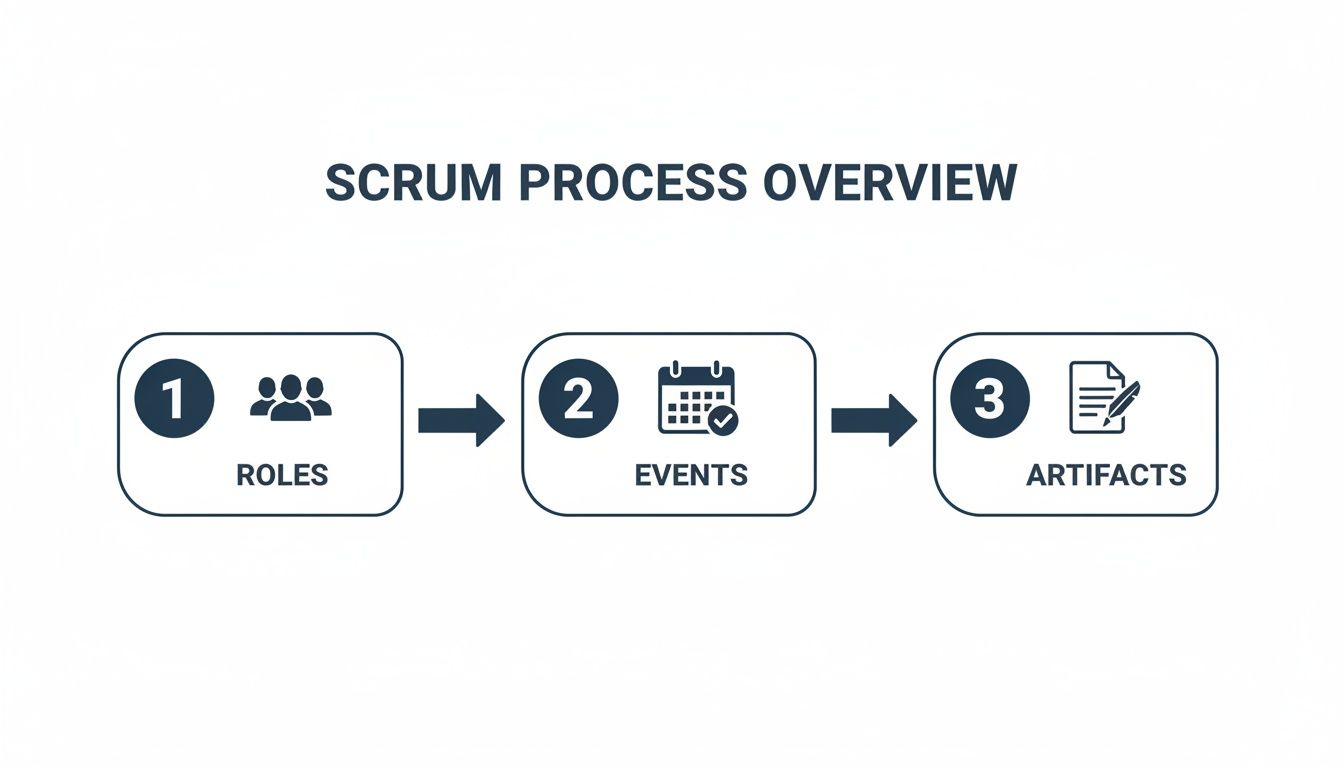
This cycle creates a feedback loop that drives continuous improvement and demonstrates real value, sprint after sprint. It's your single best tool for winning over the doubters.
Shift the Culture
Adopting Scrum is as much about changing your culture as it is about changing your process. The framework is built on trust and autonomy, which can be a tough adjustment for organizations used to a top-down, command-and-control style.
Management's job is not to direct the team's daily work. Their job is to provide the team with a clear mission, give them the resources they need, and then get out of their way.
Leaders have to actively support this shift by empowering the Product Owner to make real decisions about the product's direction. They also need to protect the team from the constant distractions and side-requests that can derail a Sprint. Documenting these new ways of working, much like a standard operating procedure, can help clarify who is responsible for what.
As you look to adopt Scrum, especially on a budget, finding the best cheap project management software for teams can make a huge difference in supporting these new workflows. Success comes down to leadership modeling the behavior they want to see.
Measuring Performance in Scrum Projects

You can't improve what you don't measure. In Scrum, measurement isn’t about clocking hours or peering over people’s shoulders. It’s about getting insights that help the team deliver value. Good metrics don’t judge; they expose reality, kick-start conversations, and point the way to improvements.
Most teams get started with two core metrics: Velocity and a Burndown Chart. Think of these as the basic health check for a Sprint.
Velocity is a measure of how much work a team gets through in a single Sprint, usually tallied in story points. Over time, it helps a team figure out how much work they can realistically take on in future Sprints. It’s a measure of capacity, not a productivity score.
Burndown Charts give you a simple picture of work left versus time remaining. A steady downward line means things are on track. If the line goes flat or drops suddenly, it’s a signal that the team needs to talk.
These are great for a team’s internal huddles. They help answer the question, "Are we on track to hit our Sprint goal?"
Looking Beyond Basic Scrum Metrics
While Velocity and Burndown charts are a solid start, they only show part of the picture. They track output—what got done—but they don't tell you much about the process or the outcomes. To get a sharper view, you need to look at metrics that reveal flow, friction, and the speed of delivery.
This is where metrics like Cycle Time and Lead Time come in. They shift the focus from how much you did to how fast you delivered it.
- Cycle Time measures the time it takes to finish a task from the moment someone actively starts working on it.
- Lead Time tracks the total time from when a request is first made until it’s fully delivered.
These numbers are brilliant for spotting where work gets stuck. If you're curious, our guide on Cycle Time vs Lead Time explains the key differences and why they matter for smoothing out your workflow. A long cycle time, for instance, could be a red flag for technical debt or a team that’s constantly being interrupted.
Connecting Scrum Activity to Business Outcomes
For leaders in IT and finance, the conversation gets interesting when you can connect what a Scrum team is doing to business results. This is where real usage analytics change the game. Instead of just counting story points, you can see how work happens across the tools your teams use every day.
Take a tool like WhatPulse, for example. It gathers privacy-first data on application usage, giving you anonymous, aggregated insights that typical agile metrics can't provide.
Are we getting enough deep work done? A team spending 70% of its day in Slack and Outlook but only 30% in their development environment is a team drowning in context switching. This data makes the true cost of meeting overload impossible to ignore.
Suddenly, you have objective evidence to back up your process improvements. Conversations shift from, "I feel like we have too many meetings," to, "Our team spent 15 hours in meetings last week, which lines up with the drop in completed work."
Using Real Data to Answer Tough Questions
With real usage analytics, you can start measuring things that directly affect the budget and overall efficiency. This creates a powerful link between your Scrum team’s work and the company's bottom line.
Think about these practical applications:
- Tool Adoption: You just rolled out a new CI/CD platform. Are people using it? Usage data shows you if adoption is weak, letting you focus training where it’s most needed instead of guessing.
- Software Waste: Is the team clinging to expensive, outdated software licenses nobody uses anymore? Identifying unused applications can lead to quick cost savings.
- Workflow Bottlenecks: Is the team constantly bouncing between five different apps just to complete one task? This points directly to snags in your toolchain.
By moving beyond classic Scrum metrics, you gain a richer view of performance. You can see not just what the team is producing but how they're working and whether those efforts are paying off. This is the kind of insight that turns project management from a process into a strategic advantage.
Scaling Scrum and Avoiding Common Pitfalls
Managing a single Scrum team is one thing. Coordinating ten is a completely different beast.
As you grow from one team to several working on the same product, the informal chats that kept everyone in sync start to fall apart. This is the point where scaling Scrum has to become a deliberate effort.
If you just add more teams without a plan, you're heading for chaos. Dependencies get tangled, different teams pull the product in conflicting directions, and the clarity of Scrum gets lost. You need a structured way to keep everyone aligned.
Frameworks for Scaling Scrum
When you have multiple teams building one product, you need a way to coordinate their work. Scaling frameworks provide a structure for multiple teams to plan, build, and deliver together, creating a "team of teams."
You'll most likely run into two common frameworks: LeSS and SAFe.
LeSS (Large-Scale Scrum): This framework tries to keep things simple. It takes the principles of single-team Scrum and applies them to a larger group with as few new processes as possible. It is a minimalist approach focused on keeping the spirit of Scrum alive at scale.
SAFe (Scaled Agile Framework): SAFe is a much more detailed framework. It introduces extra roles, events, and artifacts designed to connect teams with the bigger business strategy. This makes it popular in large, complex companies that need more structure.
The choice often comes down to your company culture. LeSS is lighter and more agile, while SAFe provides more guardrails, which can help in highly regulated or traditional environments. The key is to pick a starting point and be ready to adapt it to what actually works.
Common Pitfalls and How to Sidestep Them
As companies adopt and scale Scrum, they often fall into the same traps. These problems usually pop up when you try to layer Scrum practices on top of an old way of working, instead of changing the underlying mindset. Knowing these pitfalls is the first step to avoiding them.
The most dangerous mistake is what’s often called “Scrum-but.” This is when a company says, “We use Scrum, but we don’t do retrospectives,” or “We do Scrum, but our managers still assign all the tasks.” This cherry-picking of practices while ignoring the core principles of self-management and learning from experience undermines the whole point of the framework.
Here are a few of the most frequent mistakes in scrum project management:
The Daily Scrum as a Status Report: The Daily Scrum is a planning meeting for the Developers, not a status update for managers. When a manager stands in the circle and asks each person, "What did you do yesterday, and are you on track?" it changes the dynamic. The meeting stops being a collaborative planning session and turns into a performance for the boss.
Role Confusion: Many organizations struggle with what to do with their traditional project managers. They might get a new title like "Scrum Master" without any real change in behavior, leading them to direct the team instead of coaching it. True Scrum demands clarity: the Product Owner owns the "what," the Developers own the "how," and the Scrum Master owns the process.
Adapting to Bureaucracy: In large, rule-driven organizations, agile teams can feel like they're on an island. A study of European government bodies found that teams often invent a "proxy product owner" role. This person acts as a go-between, connecting the agile team with traditional departments and helping them navigate the bureaucracy. You can discover more about these findings on adapting agile. It's a great example of how practical adaptations are sometimes necessary to make things work in the real world.
Common Questions About Scrum
Even once you get the hang of the roles, events, and scaling strategies, a few key questions always seem to pop up. These are the ones we hear most often from leaders and teams who are either just starting with Scrum or trying to smooth out the bumps in their process.
What Is the Difference Between Scrum and Agile?
People tend to use these terms as if they mean the same thing, but they don’t. It’s a crucial distinction.
Agile is a mindset. It’s a collection of principles and values, best captured in the Agile Manifesto, that prioritize things like customer collaboration and responding to change. Think of Agile as a philosophy for how you approach your work—like deciding you want to eat healthier.
Scrum is a specific framework you use to put that philosophy into action. It gives you the structure—the roles, events, and artifacts—to actually get the work done. If Agile is the decision to eat healthier, Scrum is a specific meal plan like Keto or Mediterranean. It provides the rules and routines to follow.
Can You Use Scrum for Non-Software Projects?
Absolutely. Scrum got its start in software development, but its structure is useful for any complex project where you don’t have all the answers on day one. We’ve seen it work for marketing, research, human resources, and even construction planning teams.
For example, a marketing team might run a two-week Sprint to launch and test a new ad campaign. Their Product Backlog would be filled with campaign ideas, content pieces to create, and A/B test hypotheses. The goal is the same as in software: deliver a small, testable piece of value, get real feedback, and adapt the plan for the next cycle.
What Happens to a Traditional Project Manager in Scrum?
The official Project Manager title doesn't exist in the Scrum framework. That doesn't mean the person is redundant, but it does mean their responsibilities get distributed among the three core Scrum roles.
- The Product Owner takes on the "what"—they manage product priorities and communicate with stakeholders.
- The Developers handle the "how"—they plan and execute the work needed to build the product.
- The Scrum Master focuses on the "process"—coaching the team, removing obstacles, and making sure Scrum is working as it should.
A traditional project manager often finds a new home in one of these roles. If their strength is in business strategy and client communication, they can make a fantastic Product Owner. If they excel at facilitation, coaching, and process improvement, they're a natural fit for the Scrum Master role.
The real insight here is that one person can't effectively do it all. Splitting these duties creates a healthy tension and focus. The Product Owner champions the product's value, while the Scrum Master protects the team’s ability to deliver that value sustainably.
Is the Scrum Master a Full-Time Role?
For any team that's new to Scrum, or for a team working within a complex organization, the answer is almost always yes. A great Scrum Master does far more than just schedule meetings.
Their time is spent on vital, often invisible, work:
- Coaching the Team: Helping everyone understand and live by the Scrum principles, not just go through the motions.
- Facilitating Events: Making sure that Sprint Planning, Retrospectives, and other ceremonies are productive and achieve their goals.
- Removing Impediments: This is huge. They chase down answers from other departments, clear organizational roadblocks, and shield the team from outside distractions.
For a very mature, self-sufficient team, the Scrum Master’s direct involvement might lessen over time. But in most companies, there are always bigger systemic issues to tackle and new ways to improve the process. In those cases, a dedicated Scrum Master serving one or two teams is a full-time job—and a necessary investment for making scrum project management successful.
Effective Scrum requires visibility into how your teams actually work. WhatPulse provides privacy-first analytics to show you where time is spent, helping you spot workflow bottlenecks, measure tool adoption, and protect your team’s focus time. Turn real usage data into better decisions at https://whatpulse.pro.
Start a free trial