
The strategic alignment model is a framework for connecting an organisation's technology with its business goals. The idea is simple: if your IT department builds things that don't support business objectives, you are wasting money and effort.
This model makes sure that technology isn't just an isolated function but a fully integrated part of the business strategy.
What Strategic Alignment Actually Means
Most companies have a business strategy—what they want to achieve—and an IT strategy—the technology they'll use to get there. The strategic alignment model connects these two worlds. It forces leaders to ask tough questions, like: does our new software investment actually help us enter a new market, or is it just a technical upgrade for its own sake?
Think of it like a rowing team. The business strategy is the finish line. Every department, from marketing to IT, is a rower. If the IT team rows in a different direction, the boat just goes in circles. Alignment means everyone pulls in the same direction, at the same time.
This framework is built on four parts that have to work together:
- Business Strategy: The specific goals, market position, and competitive advantages the organisation is chasing.
- IT Strategy: The plan for how technology will support and enable that business strategy.
- Organisational Infrastructure: The people, skills, processes, and culture that make up the business.
- IT Infrastructure: The actual hardware, software, networks, and data the company uses.
A mismatch in any of these areas creates friction and waste. A brilliant mobile banking app (IT Strategy) is useless if the customer service team isn't trained to support it (Organisational Infrastructure).
A strategy without alignment is just an idea. When organisations connect goals with execution, ambitious plans can translate into measurable success. Research shows that enterprises with strong alignment outperform competitors by 30% in profitability.
The goal is to move beyond simply having technology to using it with purpose. It provides a structured way to evaluate decisions, ensuring every pound spent on tech pushes the business forward. To grasp the wider landscape of strategic planning, consider how a robust digital transformation strategy can drive organisational change.
By understanding how these elements connect, businesses can gain a genuine competitive edge. This is especially true in fast-moving industries like finance or healthcare, where technology and business goals must evolve together to succeed. For a deeper look into a structured method, our guide on establishing a clear way of working offers practical insights.
Understanding the Four Core Components
The Henderson and Venkatraman strategic alignment model is built on four distinct but interconnected quadrants. Think of it like a four-legged stool: for it to be stable, every leg needs to be the same length and firmly planted. If one is out of sync, the entire structure wobbles, leading to wasted resources and failed projects.
The model gives you a way to analyse how choices in one area ripple through the others. A change in business goals isn't an isolated event; it must trigger a corresponding shift in IT planning, team skills, and the technology you use every day.
This map shows how the four pieces fit together.
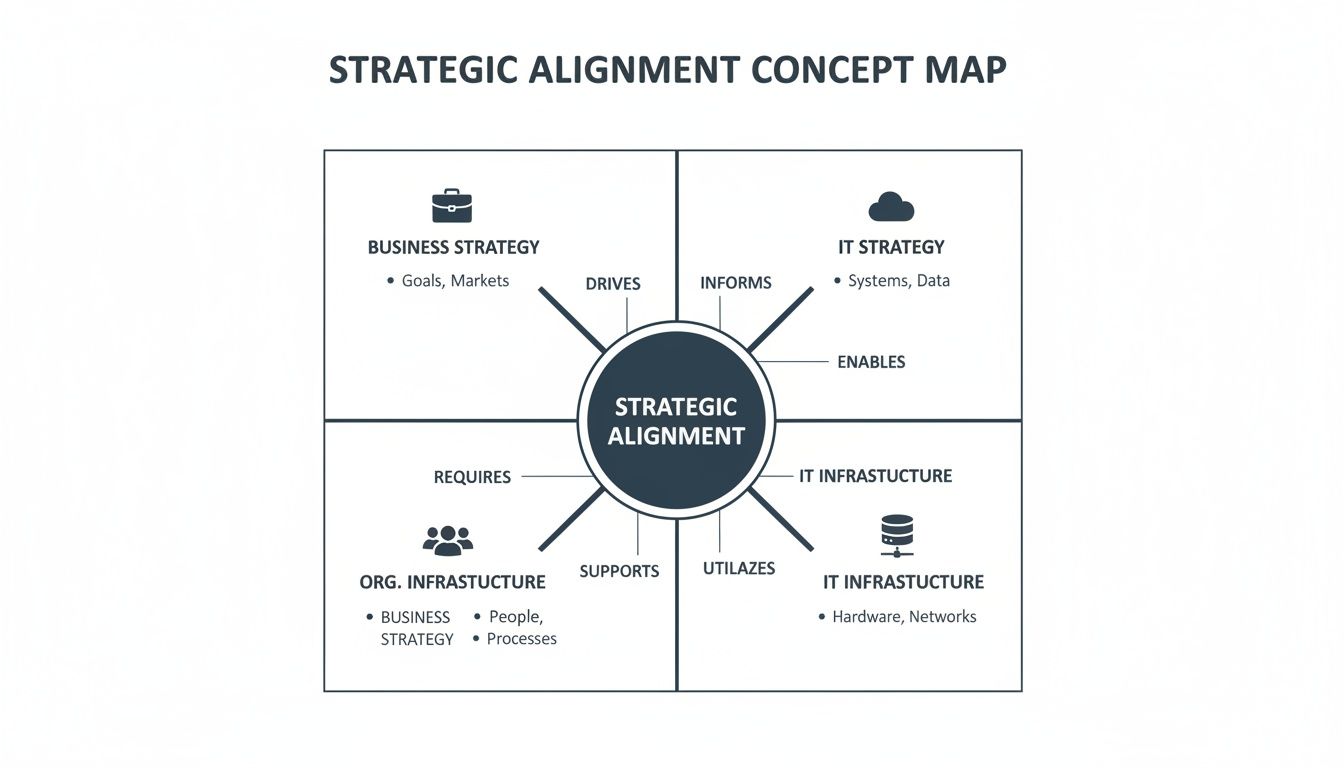
As you can see, strategy (both business and IT) drives execution. At the same time, infrastructure (both organisational and IT) makes that execution possible. It's a balance.
Business Strategy and IT Strategy
Business Strategy defines what the company is trying to achieve. It covers your market position, what makes you different from competitors, and your big-picture goals. This is the "why" behind every action your team takes.
For example, a Dutch bank decides its primary business goal is to capture a larger share of the millennial and Gen Z market. That single objective should now dictate every subsequent decision.
IT Strategy outlines how technology will help achieve those business goals. This isn't about chasing the newest tech; it's about making deliberate choices that directly support the business plan.
Sticking with the bank example, its IT strategy might be to build a mobile-first banking app with features young users want—like instant payments, slick budgeting tools, and a simple interface. The technology choices are a direct response to the business need.
Organisational and IT Infrastructure
Organisational Infrastructure is the human side of the business. This includes your team's skills, the company culture, day-to-day processes, and how decisions get made. A brilliant plan is useless without the people and processes to bring it to life.
For our Dutch bank, this means training customer service staff to handle queries specifically about the new app. It also means changing internal processes to support digital-only account opening, which is a massive shift from traditional, branch-based paperwork.
A great idea is worthless if your organisation isn't structured to deliver it. The strategic alignment model forces a realistic look at whether your teams, skills, and processes can support your ambitions.
IT Infrastructure is the tangible tech foundation. It's the hardware, software, networks, and data centres that power everything. This is the actual "stuff" that makes your IT strategy work.
The bank’s mobile app needs a rock-solid IT infrastructure. This includes secure cloud servers to handle user data, a scalable network to manage transaction volumes, and the right software development platforms. Having a great app idea means nothing if your developers don't know the programming language or the servers crash under pressure.
A mismatch in any of these quadrants leads to failure. What if the bank builds a fantastic app (strong IT strategy and infrastructure) but fails to retrain its staff (weak organisational infrastructure)? Customers will call with problems, and the support team won't have answers, completely ruining the user experience.
Real-world data from the Netherlands' financial sector proves this. A study of five large organisations found that 75% reported only moderate alignment scores, averaging just 6.2 out of 10. One bank that tightly linked its IT investments to digital banking goals hit a high score of 7.8, which reduced its project overruns by 22%. In contrast, another scored 5.1 due to siloed IT departments, resulting in €15 million in misaligned tech spending in a single year. You can explore the full findings on Dutch financial sector alignment. Getting alignment right has a direct and measurable financial impact.
How to Implement the Strategic Alignment Model
Moving the strategic alignment model from a diagram on a slide to a working part of your organisation is a structured, deliberate process of diagnostics, gap analysis, and focused execution. The goal isn't just to write a plan; it's to build a system that keeps the business and its technology in sync.
This is not a one-and-done project. Think of it more like installing an operating system for strategic decision-making. These next steps offer a practical framework for getting it done.
Step 1: Assess Your Current State
Before you can map out the future, you need an honest look at where you are right now. This means getting a clear picture of your existing business strategy, IT strategy, organisational setup, and IT infrastructure. The first step? Get leaders from both sides of the house in the same room.
Start asking some direct questions to uncover where things aren't lining up:
- What are our top three business objectives for the next year?
- Which IT projects are currently funded, and which specific business objective does each one support?
- Do our teams have the right skills to pull off our strategic plan?
- Can our current tech support our growth plans, or is it holding us back?
The point here is to create a shared, unfiltered picture of reality. You'll probably find gaps almost immediately—like a major IT project that no one can connect to a clear business goal.
Step 2: Define the Future State
With an understanding of your starting point, it's time to decide where you want to go. This requires business and IT leaders to work together, creating a unified vision for the future. This is where the real strategic choices are made.
For example, if the business strategy is to expand into a new European market, the IT strategy might be to roll out a multi-language e-commerce platform. The organisational structure would need a customer service team fluent in those languages, and the IT infrastructure would have to be scalable and compliant with data laws like GDPR.
Step 3: Identify and Analyse the Gaps
Now, compare your current state from Step 1 with your desired future in Step 2. The differences between the two are your strategic gaps. This is the most critical part of the analysis.
A gap might be technical, like needing a new CRM. It could be a skills gap, like not having enough data scientists to back a new analytics push. Or it could be a process gap, where your project approval process is just too slow to keep up with the market. Strategic alignment also trickles down to individual teams; you can explore actionable sales enablement best practices to see how this works at a departmental level.
Step 4: Create a Prioritised Roadmap
You can't close every gap at once. The next move is to build a prioritised roadmap of initiatives, where each initiative is designed to close a specific gap you've identified.
Prioritisation should be a straightforward calculation of business impact versus feasibility.
- Develop Initiatives: Define clear projects with owners, timelines, and budgets.
- Score and Prioritise: Rank these projects based on return on investment, strategic importance, and the resources they’ll consume.
- Sequence the Work: Lay out the projects on a timeline, paying close attention to any dependencies between them.
This roadmap becomes your game plan for execution. You need a transparent and fair process for deciding what gets done first. You can dive deeper into this in our article on the effective allocation of resources.
Step 5: Measure and Govern
Finally, making this stick requires ongoing measurement and governance. Set up key performance indicators (KPIs) to track progress against your roadmap. These metrics should give you a clear, honest view of whether your initiatives are delivering the results you planned for.
Establish a cross-functional steering committee with leaders from both business and IT. This group should meet regularly—perhaps quarterly—to review progress, resolve roadblocks, and adjust the roadmap as business conditions change.
This governance process makes sure strategic alignment stays a continuous discipline, not a document that gathers dust. It keeps everyone accountable and focused on the shared direction.
Strategic Alignment in Dutch Industries
Abstract models are tested in the messy, practical world of running an organisation. Here in the Netherlands, sectors like education and healthcare give a clear look at how the strategic alignment model translates into actual results. The success or failure of multi-million euro projects often boils down to a single question: did the technology investment really support the organisation's core mission?
When it works, the payoff is huge—faster tech adoption, lower costs, and better services. But when it fails, the consequences are just as real, leading to blown budgets and frustrated staff.

Vocational Education: A Case of Successful Alignment
Dutch vocational education colleges (mbo institutions) are in a constant balancing act. They have to keep their curriculum relevant to the modern job market while wrestling with tight operational budgets. For these schools, IT isn't just an admin tool; it's a fundamental part of the learning experience. This makes strategic alignment between educational goals and technology investments non-negotiable.
A detailed analysis of Dutch mbo institutions uncovered a direct link between their alignment and performance. The study found an average alignment maturity of 56% across the sector. The real insight? The top-performing colleges were the ones that deliberately connected their IT strategy with their curriculum goals.
These institutions saw 23% better student outcomes and adopted new educational technologies 35% faster than their less-aligned peers. One vocational college in Eindhoven, for example, aimed its IT investments at streamlining administrative processes tied directly to student enrolment and training schedules. This tight alignment cut their administrative costs by 27%, saving the institution €1.1 million between 2014 and 2015 alone. You can dig deeper into the research on Dutch vocational education alignment yourself.
The lesson is simple: when the IT department's goals are the same as the teaching department's goals, everyone wins.
The correlation between strategic alignment and institutional performance was measured at 0.76—a statistically strong relationship. This proves that alignment is a measurable driver of success in education, not a vague business-school concept.
This success wasn't an accident. It came from treating technology not as a separate cost centre but as a strategic partner in the school's primary mission: educating students.
Healthcare: The Cost of Misalignment
The Dutch healthcare sector tells a different, more complicated story. It’s a highly regulated world where patient data security, ancient legacy systems, and rigid clinical workflows create a lot of friction. Here, the consequences of poor alignment aren't just financial—they can directly affect the quality of patient care.
Many Dutch hospitals struggle to get their IT projects in sync with their clinical and business objectives. A classic failure pattern emerges when implementing a new electronic patient record (EPR) system. On paper, the business strategy is clear: improve patient care and create administrative efficiencies. The IT strategy is equally clear: deploy a state-of-the-art EPR platform.
But the organisational infrastructure often gets left behind.
- Skills Gap: Doctors and nurses don't get enough training on the new system, which leads to slow adoption and clunky workarounds that defeat the whole purpose of the investment.
- Process Mismatch: The new software forces clinicians to change long-standing workflows, but these process changes aren't managed properly, causing frustration and resistance.
- Cultural Resistance: Departments operate in their own silos, viewing IT as an external vendor instead of an internal partner in improving patient care.
One Dutch hospital group attempted a large-scale rollout of a new patient management system. The project was driven almost entirely by the IT department, with very little input from clinical staff. The result was a system that was technically perfect but operationally a disaster.
Doctors found it took more clicks just to access patient histories, and nurses ended up spending more time on data entry than with their patients. The promised efficiency gains never showed up, the project went wildly over budget, and staff morale hit rock bottom. This is a textbook example of strong IT infrastructure crashing head-first into a misaligned organisational infrastructure, proving just how expensive it is to get this wrong.
Comparing Strategic Alignment Frameworks
The Henderson and Venkatraman model gives you a solid blueprint, but it’s not the only way to look at strategic alignment. Over the years, other frameworks have appeared, each with its own angle on the problem. Knowing the alternatives helps you pick an approach that actually fits your company’s real-world challenges, whether you need better metrics or just more room to pivot.
The classic model is fantastic for stable, process-driven organisations where the lines between business and IT are drawn clearly. But for a tech startup in a chaotic market, its four-quadrant structure can feel too rigid. The goal isn’t to find the "best" model—it’s to find the one that mirrors how your business truly operates.
The Luftman Model: Measuring Maturity
Jerry Luftman’s framework takes the Henderson and Venkatraman model and adds a critical question: it doesn't just ask if you're aligned, but how well you're aligned. His model introduces six criteria to measure the real depth of the partnership between your business and IT teams.
These aren't just about strategy documents; they get into the human side of things:
- Communications: Do business and IT leaders speak the same language? Is there a shared understanding?
- Competency/Value Measurement: How is IT’s contribution measured? Is it just a cost centre, or is it seen as a driver of value?
- Governance: Who gets to make the big IT decisions, and what’s the process?
- Partnership: Is the relationship between business and IT a true collaboration, or is it filled with friction?
- Scope & Architecture: Does your tech stack give you the agility to grow, or does it hold you back?
- Skills: Do your people—on both sides—have the skills they need to make the strategy a reality?
This model is a perfect fit for companies that feel they have a basic alignment but want to prove its value and make it stronger. It shifts the conversation from just linking plans to improving the actual quality of collaboration. To track this effectively, you need solid metrics. It's helpful to understand the difference between lead and lag indicators to make sure you're measuring both future potential and past results.
The Baets and MacDonald Model: Built for Change
The Baets and MacDonald model was designed for a much faster world. It pushes back on the idea that a perfect, long-term alignment is always possible—or even a good idea—especially in volatile markets. This framework is all about building an agile organisation that can adapt on the fly.
Its core principle is that strategy isn’t something you just write down; it emerges from how your organisation interacts with its environment. It prioritises learning and flexibility over rigid, top-down planning. A company using this approach would lean into short development cycles, constant customer feedback, and a modular IT architecture that can be tweaked without bringing the whole system down.
This model is a natural fit for software companies, digital marketing agencies, or any business where the ground can shift under your feet in a matter of months. It accepts that the "perfect plan" is a myth and focuses instead on building a company that can react intelligently to whatever comes next.
The right strategic alignment model isn't a one-size-fits-all solution. It's a tool that should match your company's culture, industry, and pace of change. A mismatch here is the first sign of misalignment.
To help you see the differences more clearly, here's a quick comparison of the three frameworks we've discussed.
Comparison of Strategic Alignment Frameworks
This table breaks down the classic Henderson & Venkatraman model against the others, showing their main focus and where they work best.
| Framework | Primary Focus | Key Dimensions | Best For |
|---|---|---|---|
| Henderson & Venkatraman | Structural linkage | Business Strategy, IT Strategy, Organisational Infrastructure, IT Infrastructure | Stable, large organisations needing a clear, foundational structure for planning. |
| Luftman Maturity Model | Relational depth & measurement | Communications, Governance, Partnership, Skills, Metrics, Architecture | Organisations looking to improve and quantify the quality of their existing business-IT partnership. |
| Baets & MacDonald | Agility & adaptability | Emergent strategy, environmental interaction, organisational learning | Startups and businesses in fast-changing, volatile markets that require constant adaptation. |
Picking the right framework starts with an honest look at your organisation. Are you a large, steady ship that needs a clear map, or are you a nimble speedboat that needs to react to changing currents? Answering that question will point you toward the model most likely to get you where you need to go.
Common Pitfalls in Strategic Alignment
Getting strategic alignment right is a marathon, not a sprint. A lot of organisations fall into the trap of treating it like a one-off project—they draft a plan, tick the box, and let it gather dust. But that "set it and forget it" mindset is the fastest way to see your efforts fail. Your business, your tech, and your customers are constantly shifting. True alignment needs constant care.
Even with the best intentions, putting a strategic alignment model into practice is tougher than it looks. Costly mistakes often trip teams up before they have a chance to see results. These aren't abstract, theoretical problems; they're the everyday, practical breakdowns in how we talk, work, and focus.

Poor Communication and Inconsistent Language
One of the most common failure points is the communication gap between business leaders and their IT counterparts. It's like they're speaking different languages. The business side is focused on market share and revenue, while IT is talking about uptime and development cycles.
This disconnect creates a void where misalignment thrives. IT might build a technically brilliant system that solves the wrong business problem, all because the two sides never truly understood what the other was trying to achieve. Often, the barrier is social, not technical.
A 2019 study of Dutch hospitals revealed that only 42% had managed to achieve strategic alignment, costing an extra €1 billion on IT projects across the country. A major issue was social alignment—a staggering 67% of stakeholders said inconsistent language between departments slowed everything down. You can dig into the full report on alignment in Dutch healthcare.
Actionable Fix: Create a joint steering committee with people from both business and IT. Make them meet regularly to go over progress, using a shared dashboard with metrics that everyone has agreed on. This forces a common language and creates shared accountability.
Focusing Only on Technology
Another classic trap is getting tunnel vision on the technology quadrant of the alignment model. Leaders get excited about shiny new software or a big infrastructure upgrade but completely ignore the people and process side of the equation. They forget that technology is just a tool; it's the people who use it and the processes that guide them that create real value.
This mistake leads to some very familiar headaches:
- Skills Gaps: A fancy new analytics platform is worthless if nobody on the team knows how to read the data it produces.
- Process Clashes: The new tool demands a new way of working, but old, clunky processes are left in place, creating friction and frustration.
- Cultural Resistance: Employees see the new tech as just another burden forced on them by management, not a solution to their problems. The result? Rock-bottom adoption rates.
For alignment to work, you have to invest just as much in training, process redesign, and change management as you do in the technology itself.
Treating Alignment as a One-Time Project
Strategic alignment isn't a destination you arrive at. It’s a discipline you practice. Markets pivot, new competitors show up, and business priorities evolve. The perfectly aligned plan you created last year might be completely useless today. Companies that treat alignment as a one-and-done initiative will quickly find themselves out of sync all over again.
Actionable Fix: Build alignment checks into the rhythm of your business.
- Annual Review: As part of your yearly strategic planning and budgeting, do a deep-dive assessment of your alignment.
- Quarterly Check-ins: Use your quarterly business reviews (QBRs) to track progress on alignment goals and make small adjustments.
- Trigger-Based Reviews: Re-evaluate your alignment whenever something big happens—a merger, a major product launch, or a sudden market shift.
By embedding these checkpoints into your operations, you make sure alignment stays a living part of your company culture.
Got Questions? We’ve Got Answers
When you first start thinking about strategic alignment, a few practical questions always come up. Let's tackle the most common ones.
How Often Should We Review Our Strategic Alignment?
Think of strategic alignment as a living document, not a one-and-done project. It needs regular attention to stay relevant.
Most organisations find that a full, deep-dive review works best once a year, usually timed with their main strategic planning and budgeting cycles. But don't just set it and forget it. You’ll want to do lighter quarterly check-ins to make sure you’re still on track.
You also need to revisit your alignment any time something big happens—a major shift in the market, a merger, or a game-changing new technology. This keeps your strategy sharp and stops it from going stale.
What Is the Biggest Challenge in Achieving Strategic Alignment?
The biggest hurdle is almost always cultural, not technical. The real challenge is getting your business and IT departments to stop acting like separate entities and start communicating like true partners.
These teams often speak different languages, chase different goals, and are measured by entirely different metrics. Bridging that gap is tough.
Overcoming it takes serious commitment from the top. You need strong executive leadership pushing a single, unified vision. It also requires open communication channels, shared goals, and a governance structure that basically forces everyone to collaborate. If you don't get the people part right, the best-laid tech plans are doomed to fail.
The most sophisticated IT strategy is useless if the people meant to execute it are working at cross-purposes. True alignment starts with shared understanding and mutual respect between departments.
Can Small Businesses Use the Strategic Alignment Model?
Absolutely. The model might look complex at first glance, but its core principles work for a business of any size. A small business can simplify the whole process.
Forget the formal, multi-page documents for each quadrant. Instead, the leadership team can just grab a whiteboard and map out the four key areas. What are our main business goals for this year? What technology do we absolutely need to hit them? Does our team have the right skills? Are the systems we’re using now holding us back?
The goal is the same whether you’re a startup or a global enterprise: make sure every pound spent on technology directly pushes a clear business objective forward.
Endpoint analytics gives you the hard data you need to check if your strategic alignment is actually working. With WhatPulse, you can see exactly which tools your teams are using, measure software adoption, and spot process roadblocks in real time. See how WhatPulse can support your strategy.
Start a free trial