
What is "Deep Work"? Cal Newport's book defines it as: professional activity performed in a state of distraction-free concentration that pushes your cognitive capabilities to their limit. It's the kind of work that creates real value and sharpens your skills—the stuff someone else can't easily replicate.
What Cal Newport’s Deep Work Actually Means
The easiest way to understand deep work is to look at its opposite: shallow work. This is the logistical busywork we do while juggling distractions. Checking your email every five minutes. Sitting in back-to-back meetings with no clear purpose. Keeping one eye on instant messenger all day. These things feel productive, and they might even be necessary, but they don't move the needle on your skills or create anything significant.
Deep work is the real thing. It’s the programmer finally cracking a complex algorithm, the marketer mapping out a high-stakes campaign strategy, or the consultant digging into a dense financial model. It's the focused, uninterrupted effort that leads to high-quality, tangible results.
The Scarcity and Value Principle
Newport’s central idea is simple. Our workplaces are getting noisier and more connected. Because of this, the ability to disconnect and concentrate is becoming rare. And as with anything rare, it’s also becoming valuable.
Any person or team that can consistently get into a state of deep work has a competitive edge. It allows them to learn difficult things fast and produce work at an elite level.
Deep work is not a moral judgement on how you spend your time. It’s an economic argument about what the market values. It’s the skill that allows you to master hard things and produce results that stand out.
This idea has struck a chord globally. Cal Newport's Deep Work, released on January 5, 2016, has sold over 1,500,000 copies worldwide. In the Netherlands, where 68% of knowledge workers in Amsterdam say distraction is their biggest roadblock, the principles fit with cultural trends like 'ontpluggen' (unplugging). The book's influence is clear: 42% of Dutch office workers have reportedly adopted policies like no emails after 6 p.m. You can read more about the book's journey and sales figures on Author Insider.
Key Characteristics of Deep Work
What makes this kind of effort different from just "working hard"?
- Zero distractions. You can't do deep work with notifications popping up. It has to be a closed-door, single-tasking affair.
- It pushes your cognitive limits. The task needs to be challenging enough to demand your full attention. It should feel like a mental workout.
- It creates new value. The result is something that didn't exist before—a new piece of code, a fresh strategy, a solved problem.
- It improves your skills. By regularly pushing your brain this way, you get better at what you do. Each session is like a rep at the gym for your professional abilities.
Why Deep Work Is a Career Superpower
Deep work isn’t just another productivity hack; it's a core career strategy. When you practice it consistently, you build two abilities the modern economy values: the power to master difficult things quickly, and the ability to produce work at an elite level.
The marketplace doesn't reward busyness. It rewards real, high-quality results. The person who's always available on chat is often less valuable than the one who's hard to reach because they're creating exceptional work. This is the economic truth at the heart of Cal Newport’s deep work philosophy.
Mastering Hard Things Quickly
Think about the most valuable skills in your industry. They’re rarely easy to pick up. Learning a new programming framework or developing a marketing strategy demands intense, unbroken concentration.
Deep work gives you an advantage. By shutting out distractions and pointing all your brainpower at a single, hard task, you speed up the learning process. You’re strengthening the neural pathways in your brain tied to that new skill, and you’re doing it fast.
A software developer who carves out protected, four-hour deep work blocks can get proficient in a new coding language in weeks. A colleague trying to learn the same language by squeezing in 30 minutes between meetings might take months—if they ever truly master it.
This accelerated learning adds up. The ability to quickly pivot and learn new skills is what separates professionals who get stuck from those who keep moving forward.
Producing at an Elite Level
High-value work is rarely born from constant interruption. A brilliant legal argument or a creative piece of work demands sustained focus. Shallow work, like answering emails and sitting in status meetings, keeps the lights on, but it doesn’t create breakthroughs.
Deep work is the state where you produce your best stuff.
- Higher Quality: When you stop context switching, your mind processes complex information more effectively. This leads to fewer mistakes and more insightful conclusions.
- Greater Quantity: Someone who manages just two hours of pure, deep work can often produce more tangible value than a person who spends an entire eight-hour day in a state of fractured attention.
A marketing strategist who locks themselves away for a morning can walk out with a fully-formed campaign concept. That single, focused output is more valuable than a week spent fielding minor queries. These abilities lead to better projects, promotions, and professional satisfaction. In any competitive field, deep work is a decisive advantage.
The Four Rules for Cultivating Deep Work
Cal Newport’s book is more than a theory; it’s a practical system built on four clear rules. They are actionable frameworks you can weave into your professional life to structure your time, train your mind, tame your tech, and get rid of low-value tasks.
This hierarchy shows how it works. Deep work becomes a kind of superpower for your career. It allows you to master hard things and produce at an elite level, which leads to tangible rewards.
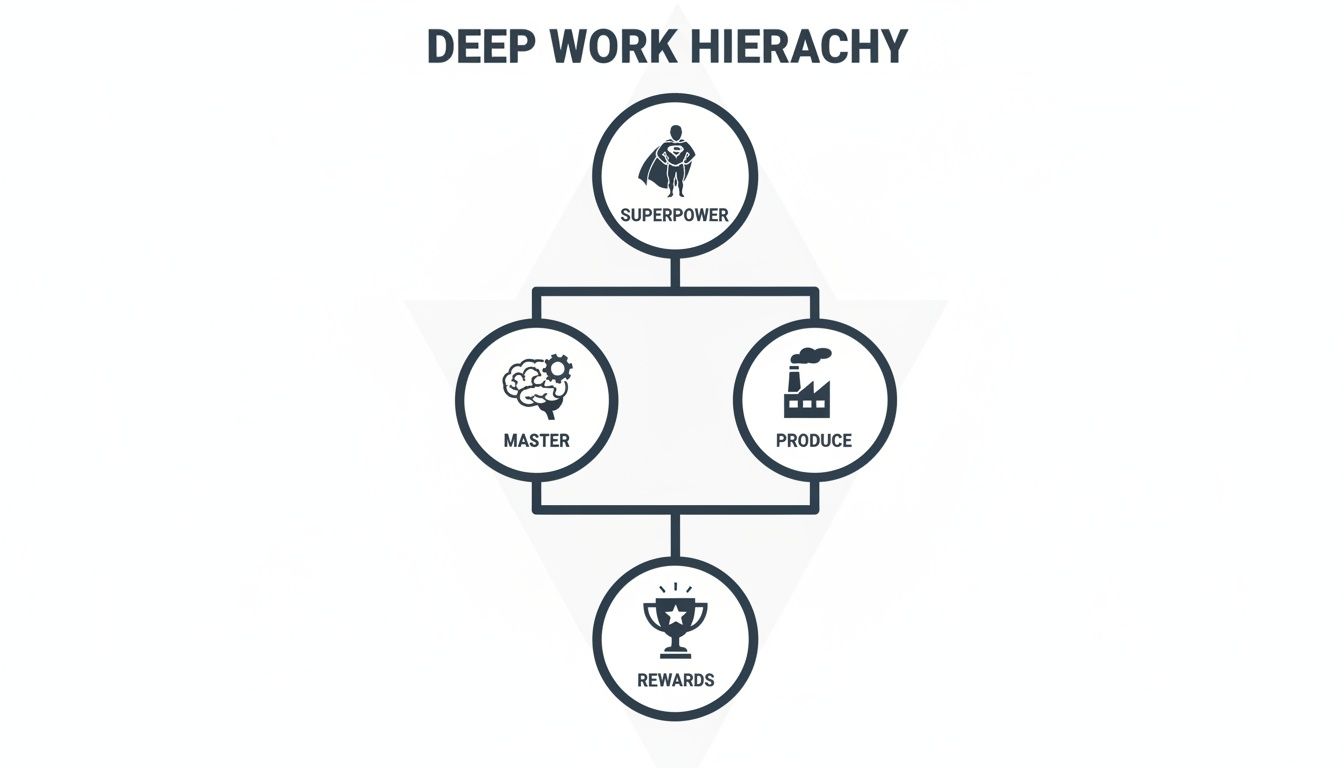
The ability to do deep work directly fuels the two activities that matter most in the modern economy. In turn, that's what builds the career capital you need.
Rule 1: Work Deeply
The first rule is about building routines and rituals. The goal is to make deep work a consistent habit, not something that happens on a rare, lucky day. It starts with choosing a scheduling philosophy that fits your life and job.
Newport lays out four philosophies for scheduling deep work. Each one suits a different profession, personality, and lifestyle.
Choosing Your Deep Work Philosophy
| Philosophy | Description | Best For | Example |
|---|---|---|---|
| Monastic | Radically minimising or eliminating shallow work. You structure your entire life around deep work. | Academics, authors, or anyone whose work requires long, uninterrupted periods of thought. | A novelist who moves to a cabin for six months to write, cutting off most outside contact. |
| Bimodal | Dividing your time into clearly defined deep and shallow chunks. You might dedicate days or weeks to one mode. | Consultants, strategists, or executives who need to switch between intense focus and high-level collaboration. | A professor who spends the academic year teaching (shallow) and reserves the summer for pure research (deep). |
| Rhythmic | Creating a simple, repeatable habit of deep work. You make it a non-negotiable part of your daily or weekly schedule. | Anyone trying to build a consistent habit. Good for developers, designers, and marketers. | A programmer who dedicates the first 90 minutes of every workday to coding before opening email or Slack. |
| Journalistic | Fitting deep work into any open block of time you find in your schedule, on the fly. | Journalists, CEOs, or anyone with a highly unpredictable schedule who can switch into focus mode instantly. | A reporter on a deadline who grabs a spare 45 minutes between interviews to write up their story. |
Choosing a philosophy isn't about picking the "best" one; it's about picking one that is realistic for you. A rhythmic or bimodal approach often works for knowledge teams, as it balances focus with the need for collaboration.
Rule 2: Embrace Boredom
This rule is a mental workout. You can't have laser-like concentration at work if you spend all your downtime in a stream of digital distractions. Your brain loses its ability to sustain focus.
The fix is to consciously retrain your attention span. That means scheduling your internet use and resisting the impulse to pull out your phone every time you feel a hint of boredom—like when you're waiting in line for coffee. The goal is to rewire your brain for focus so that deep concentration feels natural, not forced.
Rule 3: Quit Social Media
Newport’s third rule is often misunderstood. It’s not a blanket command to delete every social media account. Instead, he argues for a "craftsman approach" to your tools.
First, identify your main professional goals. Then, look at each digital tool and ask: does this tool’s positive impact on my core goals substantially outweigh its negative impacts, like fragmenting my attention? This filter forces you to become an intentional user of technology instead of a passive consumer. It also helps identify the best tools to minimise digital distractions that work against your focus.
Rule 4: Drain the Shallows
The final rule is about systematically reducing the shallow work—emails, meetings, busywork—that clogs your schedule. This involves tactics like scheduling your entire day in advance, which makes it harder for low-value tasks to sneak in.
Shallow work is what stops you from getting deep work done. Much of it is unavoidable, but you can reduce its volume with a few clever strategies.
This isn't just theory. A 2022 report found that 37% of Dutch managers who set up 'deep work blocks' saw a 22% jump in project completion rates in finance and tech sectors. Data from freelance platforms showed that 51% of Amsterdam-based creatives who adopted Newport's four-hour deep sessions boosted their output by 35%.
By clarifying communication expectations and making it physically harder to get distracted, you protect your attention.
How to Build a Deep Work Culture for Your Team

Moving deep work from a personal goal to a company-wide advantage takes deliberate leadership. Focus needs to be a shared practice supported by the organisation, not just an individual’s daily battle against pings and requests.
This isn't about telling people to focus more. It's about managers building a framework that protects everyone's time and attention.
Establish Clear Boundaries
The first step is to dismantle the expectation of constant availability. That cultural default is the single biggest enemy of focused work.
You can start with small, concrete policies.
- Implement 'Focus Hours': Block out times—say, 9 AM to 11 AM—when meetings and instant messages are off-limits for certain teams. A creative agency might protect its mornings for client work, while a development team could ban non-emergency pings during coding sprints.
- Set Communication Expectations: Make it official. Clarify the expected response times for email and chat. When people know a three-hour window for a reply is acceptable, they feel less chained to their inboxes.
- Redesign the Space (Digital and Physical): In an office, setting up designated quiet zones can be a game-changer. For remote teams, you can achieve a similar effect by subsidising noise-cancelling headphones or promoting tools that automatically pause notifications.
To make this work, strong internal communication best practices are needed to cut down on noise.
A deep work culture is built on clear rules of engagement that respect everyone’s time and attention. When focus becomes the default, high-value output follows.
Model the Behaviour and Measure the Impact
Leadership buy-in is non-negotiable. If managers send Slacks during focus hours or book meetings over protected time, the initiative will fail. Leaders have to practice the behaviour they want to see.
This approach is catching on. By 2024, 29% of NL professionals were citing Deep Work in their productivity training, coinciding with a 17% national increase in focused work hours. In the Netherlands, this leads to real results: tech firms in Eindhoven reported innovation spikes as high as 26% after bringing in these policies, and Philips has attributed €45M in annual savings to cutting down on shallow tasks. You can find more details in these findings on focused work.
You also need a way to see if your efforts are paying off. Using transparent, privacy-first analytics allows you to optimise work patterns with data transparency without crossing into employee surveillance. It’s how you prove the bottom-line value of giving your team uninterrupted time to think.
Measuring Focus Without Micromanagement
You’ve introduced deep work to your team. How do you know if it’s working? Many managers get this wrong. The temptation is to measure activity—keystrokes, screen time, mouse clicks. That’s a fast track to destroying trust and encouraging performative work, where employees focus on looking busy instead of producing value.
The goal is to measure outcomes, not clicks. There’s a world of difference between invasive employee tracking and productive, privacy-first measurement.
Shifting From Activity to Outcomes
The principle is simple: trust your team to manage their time, and hold them accountable for results. If your deep work initiatives are effective, you won't need a clock-in sheet. It will show up in the quality and quantity of their output.
This means fostering a culture that moves away from celebrating "time at the keyboard" and instead values solved problems, completed projects, and innovative ideas. When a team consistently hits its goals and the work gets better, you have your proof.
The most powerful metric is progress. Are projects moving forward faster? Is the quality of work improving? Is the team less stressed and more engaged? These are the real indicators that your focus-centric culture is succeeding.
Traditional productivity metrics often fail because they measure the wrong things. The amount of time someone spends in an application tells you nothing about whether that time was valuable. It's better to gather objective, system-level data that reveals broad patterns without monitoring individuals.
Using Privacy-First Analytics
This is where the right tools come in. Modern analytics platforms can provide aggregated, anonymised data on how your team uses its software. This approach gives you a high-level view of how work happens across the team, without looking over a single person's shoulder.
For example, you might see that the team now spends 30% less time in distracting email and chat clients during "focus hours." At the same time, you see more time spent in high-value software, like a code editor for your developers or a design application for your creatives.
This kind of report gives you objective proof of a systemic shift. It shows that the team is successfully carving out time for focused work, and it does so while respecting their autonomy. This is the kind of trust-based environment that Cal Newport's deep work philosophy relies on to succeed.
Common Deep Work Pitfalls and How to Avoid Them
Knowing the principles is one thing; practice is another. A common hurdle is deep work procrastination—the art of filling your day with easy, shallow tasks to avoid the heavy lifting of true focus.
A complex report is due, but suddenly, organizing your inbox feels urgent. This isn't laziness. It's your brain defaulting to the path of least resistance.
The Myth of Visible Busyness
Another obstacle is a workplace culture that rewards visible activity over quiet output. Many organizations still run on a bias for "busyness"—constant emails, a flurry of instant messages, back-to-back meetings. In that environment, disappearing for two hours to just think can feel like you’re not pulling your weight.
This pressure forces people to prioritize shallow work simply to appear productive. The way around this is to connect your focus time directly to better results. Don't frame it as, "I need to be offline." Instead, try: "To deliver that high-quality proposal you need, I am blocking off my morning."
Deep work is only sustainable when balanced with rest. Intense focus is a sprint, not a marathon. Trying to maintain it for eight hours a day is a path to mental exhaustion.
Finally, there’s the risk of burnout. The intensity deep work demands can be draining. If you don't balance these periods of intense concentration with proper downtime—unstructured time where your mind can wander—you'll hit a wall.
A practical fix is to build a shutdown ritual. At the end of your workday, create a routine to formally close out tasks, review the plan for tomorrow, and mentally disconnect. This simple act creates a hard boundary between work and rest, giving your brain the recovery time it needs to perform at a high level the next day.
Common Questions About Deep Work
When you start digging into Cal Newport's principles, a few practical questions always come up. Here are some straight answers.
Isn't Deep Work Just for Writers and Programmers?
Not at all. While it's easy to picture someone coding or writing a novel, the core idea applies to any job that requires real thinking.
A manager can use a deep work block to map out a quarterly strategy instead of getting pulled into minor team issues. A salesperson can use it to write a compelling proposal that stands out. A lawyer can use it to prepare a complex case without constant interruptions. It’s about identifying the high-value, mentally demanding activities in your role and carving out protected time to get them done.
How Long Should a Deep Work Session Actually Be?
Newport often mentions 90-minute sessions, which lines up with our natural concentration cycles. But even 30 minutes of pure, uninterrupted focus is a huge win.
The best length is whatever you can sustain without your focus completely falling off. Think of it like a muscle. You can train your ability to concentrate over time, eventually working up to longer blocks, maybe even four hours in a day. Start small.
What if My Boss Expects Me to Be Available 24/7?
This is a tough one, but it comes down to reframing the conversation around results.
Instead of just saying, "I need to be offline," connect your need for focus to the quality of your output. Try something like this: "To deliver that high-quality report you're looking for, I'm going to block off two hours every morning. I'll check all my messages at 11 AM sharp."
When you tie your focus time to better performance and concrete outcomes, the discussion shifts from being about your availability to being about the quality of the work you produce.
Want to see how focused your team really is, without creepy surveillance? WhatPulse gives you privacy-first analytics to understand software use, measure if your focus initiatives are working, and help everyone find better work patterns—all while respecting employee trust. Find out more and start a trial at https://whatpulse.pro.
Start a free trial