
You start the day staring at a to-do list, and one task looms over you. It’s big, complicated, and you’d rather do anything else first. So you do. You clear out a few emails, handle some quick admin, and feel a brief flash of productivity.
But the big task is still there. That's your frog. The "eat the frog" method is brutally simple: do that one thing first. Before anything else. Getting it done creates a sense of accomplishment that sets the tone for the entire day, making everything else feel easier.
What Is the Eat the Frog Method
Eating the frog means tackling your most challenging, high-impact task when your energy and focus are at their peak—right at the start of your day. Your "frog" is the one item on your list you're most likely to procrastinate on, but it's also the one that will push your most important goals forward.
By knocking it out before you glance at your inbox, you guarantee your most critical work doesn't get pushed aside. It's a direct counter-attack against our instinct to chip away at small, easy wins while the important stuff gets delayed. That early victory gives you momentum that can carry you through the rest of your workload.
The Impact of Procrastination on Productivity
Putting off important work has real, measurable costs. In the Netherlands, labour productivity growth has been slowing for the past 50 years. Research points to a cause: in sectors heavy with context-switching, like tech and finance, up to 20% of potential output is lost to putting off difficult tasks. You can dig into these trends yourself over at Statistics Netherlands.
This shows the price of avoiding your frog. Ticking off small items creates a false sense of progress while the work that actually delivers value sits untouched.
The ‘eat the frog’ strategy forces you to confront what matters. It’s less about managing your time and more about managing your energy and priorities. You're aiming your best, freshest energy at your most significant task.
Key Principles of the Method
This approach rests on a few simple ideas:
- Do the worst first: Your frog should be the task you’re dreading. Getting it off your plate eliminates a source of background stress for the rest of the day.
- One frog at a time: If you have several big tasks, you have to pick one. Just one. That's your frog for today.
- Do it completely: The aim is to finish the task in one go. If it's a massive project, your frog becomes the first significant chunk that moves it closer to the finish line.
A Practical Method for Finding Your Frog
Before you can eat the frog, you have to find it. This is a repeatable process for spotting the single most important task of your day. A true frog is high-impact, moves your long-term goals forward, and you probably feel some resistance to doing it.
The process, from identifying the main task to gaining momentum, can be broken down into a simple flow.
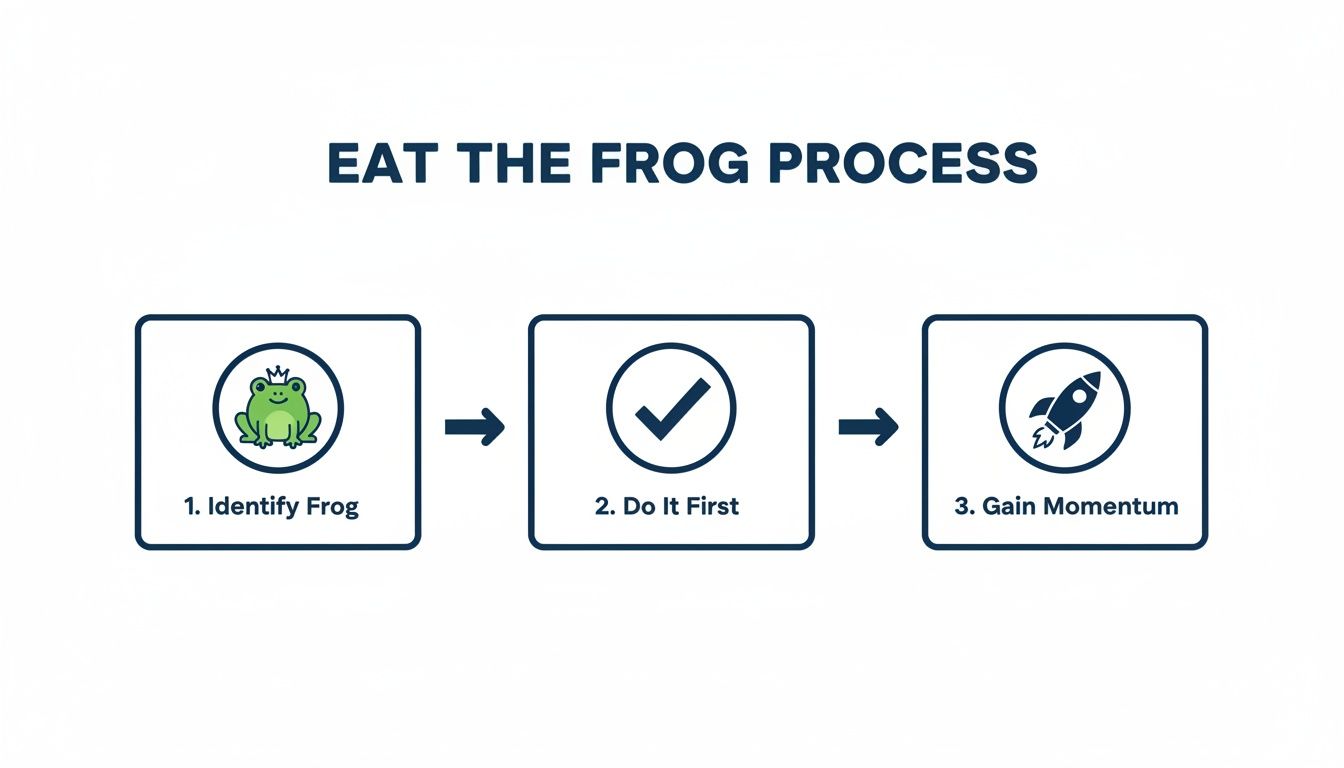
Pinpointing your frog is the first step. Get this right, and you’re set up to act and build momentum that carries you through the rest of your day.
Distinguishing Frogs from Tadpoles
A common mistake is confusing an urgent but low-value task for a real frog. Clearing out your inbox feels productive, but it rarely moves a major project closer to the finish line. That’s a tadpole—small, easy to deal with, but not your main objective.
Think about the difference in impact. For a software engineer, the frog might be refactoring a complex, legacy module that's causing intermittent bugs. The tadpoles are routine code reviews or responding to non-critical Slack messages. One task creates long-term system stability; the others are daily maintenance.
For a manager, the frog could be finalising the budget for the next quarter. The tadpoles are approving expense reports or scheduling team check-ins. It's easy to get bogged down in these smaller tasks, which is why your task list drains you if it isn't prioritised correctly.
A true frog often carries a hint of dread. If a task feels a little daunting and you can clearly see how its completion will make a positive impact, you've likely found your frog.
A Simple Scoring System to Pick Your Frog
To take emotion out of the decision, use a simple scoring matrix. This forces you to think objectively about a task's real-world impact versus your own resistance. The best time to do this is the evening before, so you can start your day with clarity.
Daily Frog Identification Template
Here's a matrix to score and identify your most critical daily task. List your potential candidates and rate them on impact and your resistance.
| Task | Impact Score (1-5) | Dread Score (1-5) | Is This Today's Frog? (Yes/No) |
|---|---|---|---|
| Draft Q3 Project Proposal | 5 | 4 | Yes |
| Reply to non-urgent client emails | 2 | 1 | No |
| Organise digital files | 2 | 2 | No |
| Troubleshoot minor software bug | 3 | 3 | Maybe (if urgent) |
In this example, drafting the project proposal has the highest impact (5) and a high level of dread (4). This combination makes it the clear winner. The goal isn't just to do hard things; it's to do the right hard things. This scoring method helps you find the task that delivers the most value, not just the one that causes the most anxiety.
How to Actually Eat the Frog Every Morning
Knowing your frog is one thing; getting it done is another. This is where most people stumble. The method isn't complex, but it demands discipline. Success doesn't start in the morning; it starts the night before.
The point is to rig the game in your favour. You want to create an environment where doing the hard thing first feels like the easiest path. This means removing decisions and distractions from your morning self, who is least equipped to fight them.

Prepare Your Environment the Night Before
Your morning routine starts the evening before you clock off. Before shutting down your computer, take five minutes to set up your future self for a win. This is more than picking your frog; it's physically and digitally clearing the path.
- Define Tomorrow's Frog: Use the scoring system to find your single most important task. Write it on a sticky note and stick it on your monitor. No ambiguity.
- Clear Your Desk: A cluttered desk can lead to a cluttered mind. Tidy up your physical space, leaving out only what's essential for your frog.
- Set Up Your Digital Space: This is important. Close every unnecessary application and browser tab. If your frog is writing a report, have a blank document open. If it’s coding a feature, have your code editor open with the right files loaded.
This prep work removes friction. When you sit down the next morning, there's no dithering about what to do or where to start. The path is clear. You just have to walk it.
Execute with Fierce Mono-Tasking
The first 60 to 90 minutes of your workday are sacred. This is your dedicated frog-eating time. Nothing else gets a look. During this block, your only job is to work on that one task.
That means no email, no team chat, and no social media. Don't even peek. The urge to clear a few "quick" notifications is the single biggest threat to this strategy. Every ping yanks you out of deep work, and the mental cost of getting back into a focused state is enormous.
Getting this right means embracing the principles of mastering your morning for peak productivity, a philosophy that works for a reason.
Protect your first block of time ruthlessly. It is your highest-leverage period of the day. Wasting it on low-value tasks is a productivity mistake you can't recover from.
If a full 90-minute block feels intimidating, start smaller. The Pomodoro Technique can break it down. A simple timer for 25-minute sprints can help build the muscle for sustained, uninterrupted focus.
Real-World Scenarios
Abstract advice is easy to dismiss. Let's see how this works in a couple of different roles.
For a DevOps Lead: Her frog is to finalise a complex deployment script for a production release. The night before, she opens her IDE, loads the script, and jots down the three logic points she needs to resolve. The next morning, she ignores Slack and email, puts on her headphones, and works solely on that script for 75 minutes. By the time her first daily stand-up begins, the script is done and tested. A huge source of stress is gone before most people have had their second coffee.
For a Financial Analyst: His frog is the quarterly variance analysis, a task that requires total concentration. He logs off the previous day with the main spreadsheet open and the source data files ready. In the morning, he puts his phone in another room and gets to work. He crunches through the most difficult calculations before his colleagues are online, leaving the rest of his day open for meetings and less demanding work.
In both examples, the formula is the same: they defined the frog, prepared their environment, and committed to mono-tasking. That's the secret. It's not magic, just a powerful habit.
Using Data to See if the Method Is Working
Without measurement, any new productivity method is a guess. You might feel more productive when you eat the frog, but feelings aren’t proof. To know if it’s making a difference, you need to look at data. This means getting a picture of your work patterns before you start and then tracking specific metrics to see what changes.
For anyone using WhatPulse, this part is simple. The platform gathers objective data on how you work, giving you a clear view of your focus, distractions, and output. It’s not about surveillance; it's about having the information to confirm a new habit is delivering results.
Setting Your Baseline
Before you start the "eat the frog" method, let WhatPulse run for a typical work week. Don't change anything yet. Work as you normally would. This gives you a baseline measurement of your current habits.
At the end of the week, pull up your data and look at a few metrics:
- Context Switches: How many times are you jumping between different apps? Pay attention to the first couple of hours of your day.
- Focus Time: What percentage of your time is spent in high-value applications (like a code editor) versus distraction magnets (like your email client)?
- Application Usage: Which programs are dominating your morning hours?
This initial data is your starting point. It's the "before" picture you’ll compare everything against.
Tracking Progress and Spotting Positive Change
Once you start the method, the goal is to see measurable shifts in that baseline data. After a week or two of consistently eating your frog, run the same reports. A clear sign of success is a noticeable drop in context switches during your first 90 minutes. This is hard proof that you’re protecting your focus and dedicating peak energy to a single task.
The WhatPulse Professional dashboard makes these changes easy to spot.
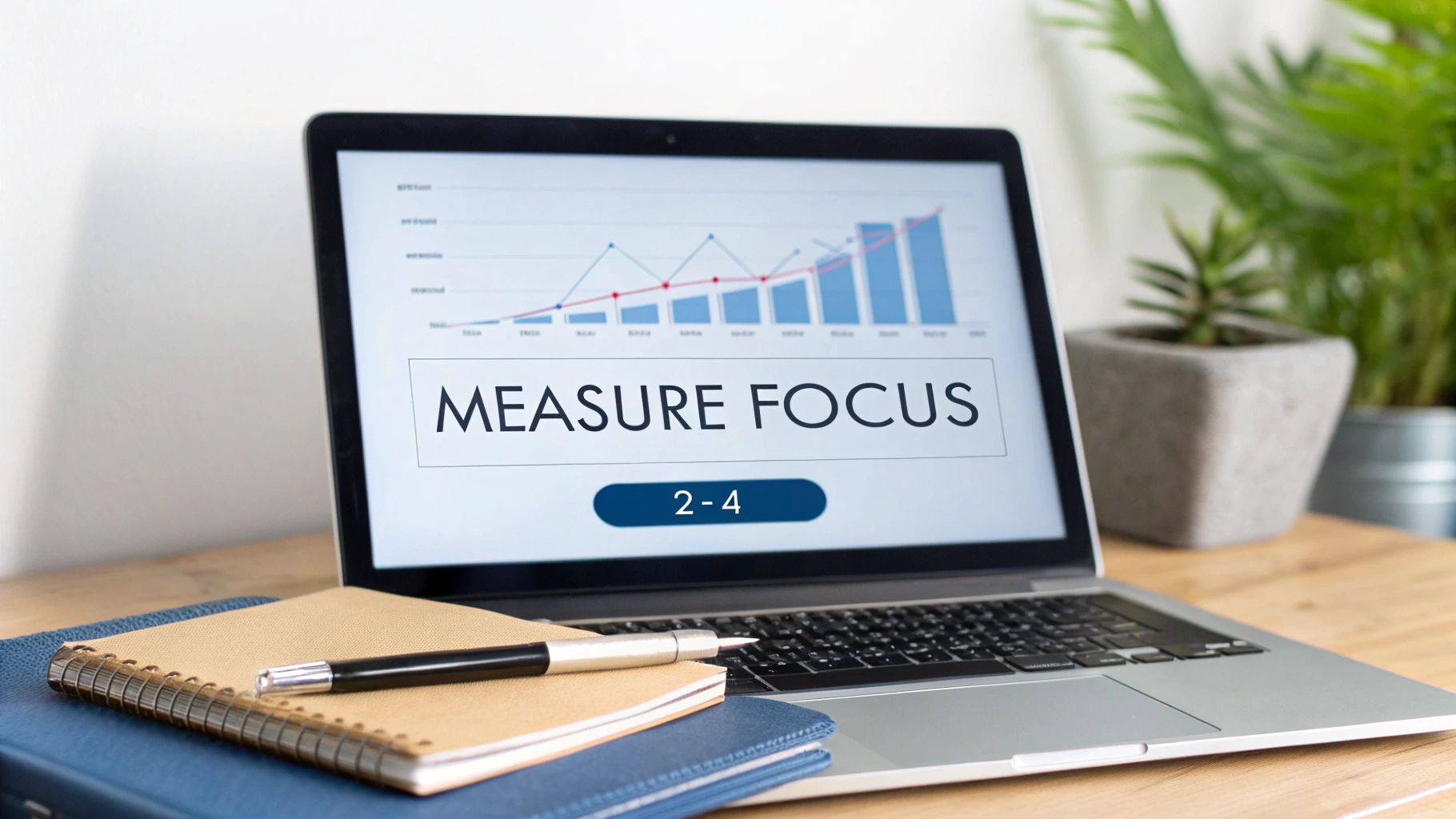
A dashboard view like this helps you see if your focus time is trending up and if high-value application usage is replacing reactive email checking in the morning.
For managers, this kind of data is gold. By viewing anonymised, aggregated team data, you can spot patterns without infringing on privacy. You might discover the entire engineering team’s focus time improves when a "no meetings before 10 AM" rule is implemented to support the eat the frog method. You can learn more about how to optimise work patterns with data transparency in our guide.
This isn't just theory. When a team or a country prioritises its most difficult tasks, output goes up. Netherlands labour productivity, for instance, hit an all-time high in March 2022. This peak shows how tackling daunting tasks drives real gains. For WhatPulse users, this same principle can mean a 12-18% lift in daily output, an improvement captured through project time-tracking.
Data turns a productivity concept into a business strategy. Seeing a 20% reduction in morning context switches isn’t just a personal win; it’s a leading indicator of faster project timelines and less wasted effort.
Data draws a straight line from individual focus to team-wide efficiency. It can uncover opportunities for cost savings, like identifying expensive software licences that are barely used because teams are too fragmented for deep work.
Common Problems When Eating the Frog
Building a new habit is never a straight line. You will run into problems when you first start to eat the frog. The key is to have a plan for when they pop up.
Most challenges fall into a few categories. You might lose steam after a few days, get derailed by an unexpected morning crisis, or pick a frog that’s too big to handle in one go. These are normal friction points, not signs of failure.
When Your Frog Is Too Big
Sometimes you’ll identify a frog that’s more like a multi-day project than a single task. Trying to tackle “Overhaul the entire reporting dashboard” in one morning is a recipe for frustration.
When you realise your frog is too big, don’t abandon it. Break it down. Your goal is to identify the first, meaningful piece of that project. For the dashboard overhaul, that piece might be “Draft the new data schema” or “Create mock-ups for the main summary view.”
This first piece is a concrete action you can complete in a single, focused session of 60-90 minutes. It creates forward movement on the larger project without being overwhelming. Finishing it is still a win.
This approach lets you consistently chip away at your biggest projects. You’re not trying to eat the whole frog at once; you’re tackling the first logical part of it. This builds momentum and keeps you from feeling defeated before you start.
Handling Unexpected Interruptions
Another common hurdle is the morning interruption. A critical server goes down, an urgent client request lands, or a colleague needs immediate help. These things happen and can knock your focus time off the rails.
Your best defence is pre-emptive communication. Let your team know you’re protecting your first hour for deep work. A simple status message in your team chat can work.
Here are a few examples:
- For Team Chat: “Heads up, I’m in focus time until 10:00 AM working on the Q3 deployment script. I'll check messages after. Ping me directly if it's a production emergency.”
- For Your Calendar: Block out the first 60-90 minutes of your day with a recurring event titled “Focus Time - Do Not Disturb.”
This sets clear expectations. It tells your colleagues that you are unavailable for routine questions but can be reached for genuine emergencies. Over time, your team will learn to respect this block, allowing you to eat the frog without constant disruption. It’s about creating boundaries to protect your most productive hours.
Common Questions About Eating the Frog
Even a simple method raises questions once you start putting it into practice. It's one thing to understand the concept and another to apply it when your calendar is a mess. Here are some common situations.
What If My Job Is Reactive and Urgent Tasks Always Appear?
This is a classic problem for anyone in support, operations, or leadership. Your day is often defined by what other people need, making it feel impossible to plan.
Even in the most chaotic environments, you can usually protect the first 30-60 minutes of your day. Think of it as a pre-emptive strike before the day's fires start. If a genuine emergency pops up—something both urgent and important—then that crisis becomes your frog for the day.
The point isn't to be rigid; it's to make a conscious choice instead of letting your inbox dictate your morning. You might be surprised how many "urgent" requests can wait an hour.
How Does This Work for Creative Roles?
For creative work, the frog isn't always the most tedious task. It's often the one that demands the most raw mental energy. It's the kind of work that requires deep, original thinking before meetings and distractions chip away at your focus.
Your frog could be:
- Drafting the initial concept for a new marketing campaign.
- Outlining the structure for a complex article.
- Sketching the first three wireframe ideas for a new feature.
The key is to pick the one activity that will move a big project forward. Then, break it down into a concrete first step you can finish in one sitting, like "write the first 250 words" or "create the main user flow diagram."
A creative's frog isn't about doing something unpleasant; it's about tackling the work that requires your best, freshest thinking before your cognitive energy is spent.
Can My Team Use This Method Together?
Yes. It can be more powerful when a team does it together. A team can define its collective frog for the day or week, which aligns everyone on a single, high-impact goal. For an engineering team, that might be "resolve the top three critical bugs from the latest release."
This creates a shared sense of purpose and a clear mission for the day. It protects the team's collective focus time and gives everyone permission to decline interruptions that aren't related to that main objective. For team leads, it's a way to see if that protected focus time leads to faster progress on the team's biggest priorities. It turns a good individual habit into a shared, effective rhythm for the whole team.
Ready to stop guessing and start measuring your team's focus? WhatPulse provides the privacy-first data you need to see if productivity methods like 'eat the frog' are working. Optimise your team's workday with a free trial today.
Start a free trial