
The advice to eat the frog is a productivity classic. The idea is simple: tackle your biggest, ugliest, most important task first thing in the morning. Get it done, and the rest of your day feels like coasting downhill.
What It Means to Eat the Frog
The "eat the frog" approach feels backward at first. The natural instinct is to ease into the workday by clearing out a few small emails. This method flips that script. You start with the one task you're most likely to procrastinate on.
That task is your "frog." It's the big project that casts a shadow over your to-do list, draining mental energy just by sitting there.
By hitting it head-on, you use your brain when it's freshest—before the day’s pings and interruptions begin. The psychological win from knocking out your worst task first thing sets a productive tone. It kills the dread of procrastination and builds momentum for the easier work that follows.
Distinguishing a Frog from a Nuisance
A common mistake is confusing a true "frog" with tasks that are just annoying or seem urgent. Your daily frog isn't just something you dislike; it's the task that will actually move your goals forward.
To spot your real frog, look for these three signs:
- High Impact: Finishing it gets you much closer to a major goal.
- High Effort: It demands deep focus, creative thinking, or serious mental energy.
- High Resistance: You feel a gut-level urge to put it off until "later."
Answering a tricky but low-stakes email is a nuisance. Writing the first draft of a critical project proposal is a frog. One just clears your inbox; the other creates real value. Learning to tell the difference is the first step.
Here's a quick guide to telling your tasks apart.
Identifying Your Daily Frog
| Task Type | Characteristics | Example |
|---|---|---|
| The Frog | High impact, high effort, high procrastination factor. Moves major goals forward. | "Outline the Q3 strategic plan." |
| The Nuisance | Annoying, maybe urgent, but low impact. Doesn't create much value. | "Reply to that long email chain about catering." |
| The To-Do | Routine, necessary, but low mental effort. Keeps things running. | "Submit your weekly timesheet." |
| The Distraction | Low impact, low effort, feels productive but isn't. Easy to get lost in. | "Reorganise your desktop folders for the third time." |
Figuring out which tasks hold genuine weight is essential. To go deeper into sorting your priorities, the principles behind the time management matrix are a great next step.
Your 'frog' is the task that, if you did nothing else all day, you would still feel you had made meaningful progress.
This isn’t just about ticking boxes. It's about managing your energy and attention. Pushing a high-impact task to the afternoon means you'll be facing it with a tired, distracted mind—making the work harder and the outcome worse. Eat the frog first, and you give your most important work your best.
The Psychology of Why This Method Works
The "eat the frog" method works because it aligns with how our brains handle energy and focus.
Think of your willpower as a battery. It's fully charged when you wake up, but it drains with every decision you make, every email you answer, and every notification you ignore.
When you start your day by clearing out small, easy tasks, you burn that peak mental energy on low-value work. By the time you turn to your "frog," your battery is already half-empty. You're left trying to do your most important work with a tired mind.
Eating the frog flips this. You allocate your best, freshest energy to the one thing that will actually make a difference.
Overcoming Procrastination and Decision Fatigue
Procrastination is often a reaction to feeling overwhelmed. A massive, vaguely defined project feels threatening, so our brains push it away for the quick win of ticking off a simple to-do. This creates a cycle where the dreaded task looms larger the longer we ignore it.
This method breaks that pattern by forcing an early confrontation. Get it done first thing, and you've removed the primary source of anxiety for the rest of the day.
This single action clears the mental fog that builds up when you constantly dread an upcoming task. Instead of carrying that weight all day, you work with the momentum of a major accomplishment already behind you.
It also short-circuits decision fatigue. When you decide the night before what your frog is, you eliminate the morning debate about where to start. You wake up with a clear, singular focus instead of wasting mental energy weighing a dozen different priorities.
Creating Momentum and Flow
There’s a real psychological kick that comes from finishing a difficult task. Your brain releases endorphins, giving you a sense of achievement. This win sets a positive tone for the day, making every subsequent task feel a little easier. It's the difference between starting your day feeling behind and starting it feeling ahead.
This focused approach also creates the perfect conditions for achieving a state of 'flow'—that feeling of deep, effortless concentration. By protecting your morning from distractions to focus on one thing, you're setting the stage for immersive work.
Putting off a big task leads to fragmented attention and a cluttered mind. You can read more about this cognitive load and how it contributes to what many people call brain fog in the workplace.
Eating the frog is a strategy for managing your energy, not just your time. It’s about ensuring your best self is working on your biggest challenges.
How to Eat the Frog as an Individual
Turning "eating the frog" from an idea into a daily habit comes down to a simple, repeatable routine. The goal is to get it out of your head and into your workday, starting tomorrow.
The most powerful step happens the evening before. Before you log off, take five minutes to look at your workload and pinpoint tomorrow's single most important task. That's your frog.
Jot it down on a sticky note and stick it on your monitor. This simple act short-circuits morning indecision. You wake up knowing exactly what you need to do, without wasting your sharpest thinking on figuring out where to start.
Create a Protected Focus Block
Your frog needs a distraction-free zone. For most of us, the first 90 minutes of the workday are the most valuable. You have to defend this block of time to make real progress on your biggest task.
This isn't about willpower; it's about removing temptations before they appear. A few deliberate steps to build a "focus bubble" can make all the difference.
A practical checklist for your protected time:
- Turn Off Notifications: Close your email client completely. Disable all notifications on your phone and computer. No pop-ups, no dings.
- Communicate Your Status: Set your status in team chat to "Focusing" or "Busy." This lets colleagues know you're unavailable for a short period and prevents interruptions.
- Clear Your Digital Workspace: Close every unnecessary browser tab. The only windows you should have open are those directly related to your frog.
- Prepare Your Physical Space: Get everything you need—a glass of water, a notepad, specific files—within arm's reach before you start. Getting up to find something breaks your concentration.
This routine isn't just for massive projects. Even on a day packed with meetings, dedicating just 30 minutes to your frog keeps the momentum going. Consistency beats duration. If you're looking for more ways to structure your environment, these actionable strategies for staying productive working from home can help.
Execute and Build the Habit
With your frog identified and your environment secured, the only thing left to do is begin. Don't check your email. Don't glance at team messages. Just start.
The immediate goal is to make this process an automatic, daily habit. The real payoff comes from doing it consistently. It’s a direct way to reclaim control over your workday and see tangible improvements.
Just start. Work on the task for five minutes. Often, the hardest part is pushing past the initial resistance. Once you're engaged, it's much easier to keep going.
By consistently tackling your hardest task first, you create a powerful feedback loop. You'll finish each day with a genuine sense of accomplishment, reduce the stress of unfinished work, and build momentum. For anyone struggling with the pull of digital pings, pairing this method with some of these 15 tools to minimize digital distractions can be a game-changer.
How Teams and Managers Can Use This Method
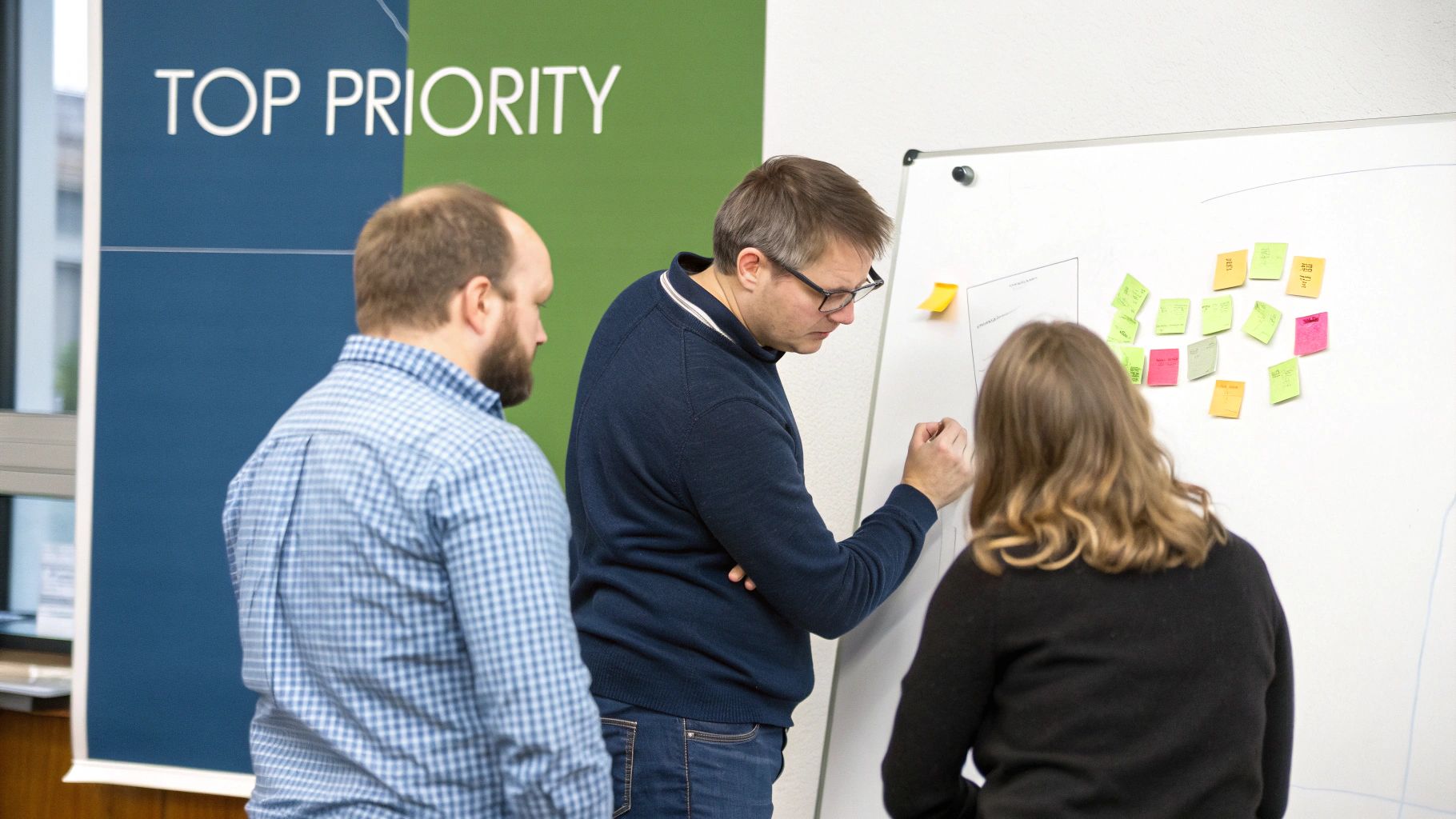
While eating the frog is a fantastic tool for an individual, its real power is unlocked when an entire team gets on board. It stops being a personal productivity hack and becomes a shared operating principle. This creates a common language for what matters and builds a culture around deep, focused work.
For a team, this isn't about everyone tackling the same frog. It’s about building an environment where each person can attack their most critical contribution without friction. When everyone starts their day by pushing their most important domino, the whole project moves faster and bottlenecks disappear.
A manager's job is to build and guard this environment. It’s a shift from managing people's time to protecting their attention.
Fostering Accountability in Daily Stand-Ups
Your daily stand-up meeting is the perfect place to bake this practice into the team’s routine. Instead of rattling off a list of tasks, you can tweak the format to create accountability around high-impact work.
Have each person briefly state their "frog" for the day. That simple act of saying it out loud creates a social contract. It clarifies focus for the individual and gives everyone else visibility into what's most important, stopping minor requests from derailing major progress.
- Before: "I'll be working on the reporting feature today."
- After: "My frog today is finalizing the database schema for the new reporting feature. It's the biggest blocker for the rest of the team."
This small change reframes the entire conversation from "what are you doing?" to "what impact are you making?". It also gives managers a quick way to spot misaligned priorities or overloaded team members before the day spirals.
The Manager’s Role in Protecting Focus
A team can’t eat their frogs if their day is chopped up by reactive meetings and constant pings. The manager’s most critical job is to run interference, carving out and defending blocks of time for deep work.
A manager's most important function here is to be the gatekeeper of the team's collective focus. This means actively pushing back on non-essential meetings and defending the first few hours of the day.
Here are a few concrete ways to do that:
- Institute 'No-Meeting' Mornings: Block out the first two hours of the day—say, 9 AM to 11 AM—as a company-wide time for focused work. Push internal check-ins and non-urgent meetings to the afternoon.
- Audit Recurring Meetings: Challenge the purpose and timing of every recurring meeting. Could that weekly sync be an asynchronous update instead? Does the entire team really need to be there?
- Encourage 'Focus' Status: Make it normal to use "Focusing" or "Deep Work" statuses in team chat apps. Coach the team to respect those signals and batch their non-urgent questions for later.
For IT leaders, this principle extends to the tools themselves. Unreliable software, a slow network, or a clunky internal system can become a surprise "frog" that drains the entire team's energy. Keeping the tech stack stable is a core part of enabling productivity. While high-level figures show national productivity trends, team-level gains come from removing these daily operational headaches. You can find more insights on Netherlands' productivity data on theglobaleconomy.com.
When a team aligns around eating the frog, the culture changes. The focus shifts from being busy to being effective. Critical projects get unblocked faster, creating a calmer, more productive work environment.
Measuring the Impact with Real Data
Adopting the "eat the frog" method feels productive. But without data, you’re guessing about its impact. Quantifying the change is how you justify a new process and figure out where it’s working—or where your team needs support.
To get a handle on how new productivity methods are performing, leaders need to get comfortable with measuring operational efficiency. It’s about moving beyond anecdotes and digging into performance metrics.
This is where a privacy-first analytics tool like WhatPulse Professional comes in. The first step is to establish a baseline. Before you announce any changes, let the tool run for a week or two. This captures your team's existing work patterns and gives you a clear "before" picture to compare against.
Key Performance Indicators to Track
Once you have your baseline, you can track the specific shifts after your team starts eating their frogs. The goal is to see tangible improvements in focus and a reduction in fragmented work, especially during those critical morning hours.
Here are the main metrics to watch:
- Focus Time Increase: You should see a rise in uninterrupted work periods, particularly between 9 AM and 11 AM. This shows team members are successfully protecting their deep work sessions.
- Application Usage Patterns: Look for sustained use of core production apps (like code editors or design software) during those morning focus blocks. At the same time, you want to see less time spent in communication tools like Slack or Outlook.
- Reduction in Context Switching: A key goal is to minimize the mental cost of jumping between tasks. Tracking the frequency of switches between different applications will tell you if this is working. A lower number suggests deeper, more sustained concentration.
The WhatPulse dashboard can visualize these work patterns across the entire team, making it easy to spot trends.
This aggregate view helps you confirm if deep work apps are getting the priority they need during that protected focus time.
Using Data for Coaching, Not Micromanagement
This data isn't for looking over anyone's shoulder; it's a tool for coaching. If a team member's focus time hasn't improved, it opens up a conversation. Maybe their "frog" is poorly defined, or they’re still struggling with interruptions. The data helps you pinpoint the problem with evidence.
The objective is to see trends, not to scrutinize individuals. Aggregated data can show if the "no meetings before 11 AM" rule is actually working or if the team is still getting pulled into reactive tasks.
Here's a quick look at the key metrics you'll want to monitor in WhatPulse to track the effectiveness of your 'eat the frog' strategy.
WhatPulse Metrics for Tracking Success
| Metric to Track | What It Indicates | Desired Trend |
|---|---|---|
| Focus Time | Uninterrupted periods in a single application. | Increase, especially in the morning. |
| Application Usage | Time spent in specific software (e.g., VS Code vs. Slack). | Increase in core work apps; decrease in communication apps during focus hours. |
| Context Switches | How often a user switches between different applications. | Decrease, showing deeper concentration. |
| Adoption Trends | Team-wide changes in work patterns over time. | A clear shift towards focused morning work across the team. |
By tracking these trends, you're not just implementing a productivity hack. You're building a data-backed case for protecting your team’s most valuable resource: their focused attention.
Common Pitfalls and How to Avoid Them
Putting the "eat the frog" method into practice isn’t always clean. Some days, your to-do list feels like a minefield of big, important tasks, and picking just one feels impossible. Other days, an unexpected emergency blows up your carefully laid plans before your first coffee.
These problems are normal. The goal isn't to be perfect; it's to have a realistic way to navigate a messy workday and still move forward. Spotting these common snags is the first step to getting around them.
When Everything Feels Like a Frog
Ever look at your to-do list and see a swamp full of frogs? When multiple tasks all feel critical, it's easy to freeze and do nothing. This usually means your "frog" is too big to be a single task.
The fix is to break it down. If your frog is "Launch the new marketing campaign," that’s not a task—it's a project. Your real frog for today is the one key action that pushes that project forward.
- Break the frog into 'tadpoles'. A tadpole is a small, concrete action you can finish in about 60-90 minutes. Instead of "Launch campaign," your frog for today might be, "Write the copy for the main landing page."
- Find the critical dependency. Ask yourself: "What single thing, if I get it done today, will unblock work for me or someone else on my team?" That’s your frog.
This approach turns an overwhelming project into a string of small, manageable daily wins.
Confusing Urgent Tasks with Important Frogs
Here’s another classic trap: mistaking what's loud for what's important. A demanding task that just landed in your inbox can easily masquerade as a frog. More often than not, these are just low-impact distractions that feel important because they're time-sensitive.
Your real frog is rarely the task that’s screaming the loudest. It’s the one that delivers long-term value.
A simple test is to ask: "If I only get one thing done today, will finishing this task make me feel accomplished when I log off?" If the answer is no, it’s not your frog.
Dealing with unexpected emergencies is part of the job. On days when you get dragged into firefighting, the aim is consistency, not a perfect streak. Acknowledge the disruption, put out the fire, and reschedule your frog for the next focus block you have. Don’t let one derailed morning convince you to abandon the habit.
Common Questions About Eating the Frog
When people first try this method, a few practical questions always pop up. Getting the details right from the start can make a difference in turning this into a lasting habit.
What If My Frog Takes More Than One Morning to Complete?
That’s perfectly normal. If your most important task is a big, multi-day project, your "frog" for the day isn't the whole project—it's the single most important step you can take to move it forward.
You’re not trying to finish a marathon in one sprint. Your goal is to make tangible headway on your biggest priority every morning. Break the huge goal into smaller pieces, then pick the one for today that creates the most momentum or unblocks the next steps.
How Does This Work If I Am Not a Morning Person?
The spirit of the rule is to tackle your hardest task when your personal energy is at its peak. If you do your best, most focused work in the afternoon, then that’s your time to eat the frog.
The principle is about matching your best energy to your biggest challenge. It is not about a rigid 9 AM start time.
The key is self-awareness. Figure out when you're sharpest, schedule that time for your most demanding work, and then protect it. The method should adapt to your natural energy cycles, not the other way around.
Can an Entire Team Have the Same Frog?
It's rare. A team might share a big, common goal, but each person's frog is their specific, critical contribution to reaching it on any given day.
For example, a developer’s frog might be writing a particularly complex function. At the same time, a designer's frog could be wrestling with a tricky UI component for that same feature. The manager's role isn't to assign one identical task to everyone, but to make sure all those individual frogs are hopping in the same direction—straight towards the team's main objective.
Turning these productivity principles into measurable results is the next step. WhatPulse gives you the privacy-first analytics needed to see how focused work actually impacts your team's performance. See how work really gets done at https://whatpulse.pro.
Start a free trial