

Performance in management isn't a theory from a textbook. It’s the tangible result your teams produce. It's how well managers turn strategy into action, get resources to the right places, and guide people toward clear goals.
It’s less about being busy and more about being effective.
What Does Performance in Management Actually Mean

Many definitions get lost in jargon. Performance in management is the bridge between a company's goals and its daily operations. It’s not about vague leadership qualities but about the concrete results from a manager’s decisions.
Consider two managers at a logistics company. One focuses on keeping the team busy. The other zeroes in on optimizing delivery routes to cut idle truck time. The first manager has a busy team. The second has a productive one that directly boosts the bottom line. That’s the difference.
From Managing Tasks to Leading for Results
The switch from a task-focused to a results-driven mindset is where good management happens. You see good performance not in what a manager does, but in what their team achieves. The outcomes are what matter.
This means you measure success with clear metrics tied to business objectives:
- Project Completion: Do projects consistently hit deadlines and stay within budget?
- Team Productivity: Is the team’s output growing without causing burnout?
- Customer Satisfaction: Are client feedback scores rising because of better service?
- Resource Allocation: Are the tools, budget, and people used efficiently?
This perspective is especially important in service-based economies. In the Netherlands, for example, the services sector makes up about 75% of the country’s GDP, a figure that points to strong managerial efficiency in fields like finance and trade.
The Real-World Impact
A practical view of management performance connects every action to a result. In a customer service department, a manager might roll out a new ticketing system. The win isn't just deploying the system; it's the 20% reduction in average ticket resolution time that follows.
The same is true in software development. A manager’s performance isn't just about hitting sprint deadlines. It’s about how those sprints lead to fewer bugs in the live product or a higher feature adoption rate among users. For a deeper look at this discipline, a good SaaS operations management playbook can offer a complete picture.
Effective management isn’t about controlling every detail. It’s about creating an environment where the right outcomes happen because people have the clarity, tools, and direction they need. The performance is in the results, not the process.
Frameworks for Measuring Management Performance
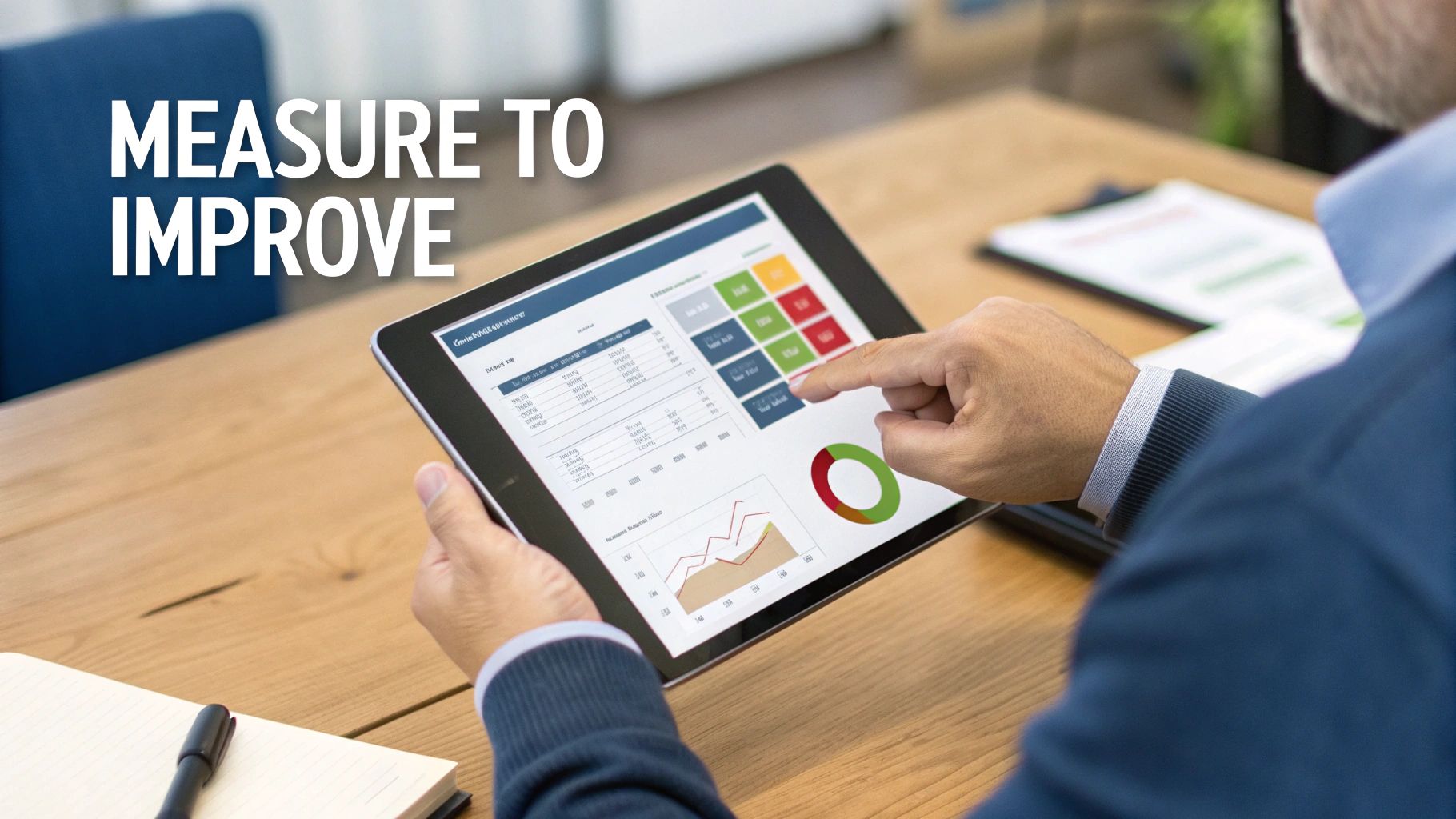
You can’t improve what you don’t measure. Relying on gut feelings about a manager's effectiveness leads to inconsistent results and biased evaluations. To get a real grip on performance, you need a structured approach—a framework that connects daily work with the bigger picture.
These frameworks give everyone a common language for performance. They shift conversations from subjective opinions to objective data, making it easier to see what’s working. This isn't about creating more admin work; it's about building a system for genuine improvement.
Two of the most practical frameworks are the Balanced Scorecard (BSC) and Objectives and Key Results (OKRs).
The Balanced Scorecard
Think of the Balanced Scorecard as a strategic management system. It stops you from focusing only on financial numbers. It requires a more complete view by looking at performance from four different perspectives.
- Financial: How do we look to our shareholders? This is where you find metrics like revenue growth, profitability, and cost management.
- Customer: How do our customers see us? This tracks things like satisfaction scores, retention rates, and market share.
- Internal Processes: What must we be brilliant at? This is about operational efficiency, quality control, and improving the processes that deliver on your customer and financial promises.
- Learning and Growth: How can we keep getting better? This angle covers employee skills, team morale, and your ability to innovate.
By linking these four areas, the BSC helps you connect the dots. You can see how an investment in employee training (Learning and Growth) leads to better internal processes, which improves customer happiness and, finally, improves the bottom line.
Objectives and Key Results
OKRs are a more agile and goal-oriented framework, made famous by tech companies for their sharp focus on outcomes. The structure is simple.
- Objective: Your big, ambitious, qualitative goal. It should be memorable. For instance, "Become the most reliable IT support team in the company."
- Key Results: Two to five measurable, quantitative outcomes that prove you’ve met the objective. For our IT support team example, the key results might be:
- Reduce average ticket resolution time from 8 hours to 4 hours.
- Achieve a user satisfaction score of 95% or higher on resolved tickets.
- Decrease critical system downtime by 50%.
OKRs are usually set quarterly, creating a fast rhythm of goal setting, executing, and reviewing. This cadence keeps teams aligned and focused on what matters now. The goals are supposed to be a stretch. Hitting 70% of a difficult key result is often seen as a major success.
Using these frameworks requires choosing the right indicators. You must understand the difference between outcomes and the activities that drive them. To go deeper, learn more about how to distinguish between lead and lag indicators for more effective measurement.
Comparing Management Performance Frameworks
Which framework should you choose? Neither is better; it depends on your organization’s culture, pace, and strategic needs. The Balanced Scorecard often fits stable organizations that need a holistic, long-term strategic map. OKRs often work well in fast-growing companies that need to adapt quickly and keep everyone aligned on immediate priorities.
Here’s a quick breakdown.
| Aspect | Balanced Scorecard (BSC) | Objectives and Key Results (OKRs) |
|---|---|---|
| Primary Focus | Strategic planning and execution across the entire organization. | Goal setting and alignment, often at the team or department level. |
| Timeframe | Typically annual, with longer-term strategic objectives. | Typically quarterly, promoting agility and rapid feedback cycles. |
| Structure | A balanced set of measures across four fixed perspectives. | A simple hierarchy of an ambitious Objective and measurable Key Results. |
| Goal Style | Goals are often achievable targets linked to strategic initiatives. | Goals are ambitious and aspirational; 70-80% completion is a success. |
| Best For | Mature organizations needing a comprehensive strategic management system. | Fast-paced, growth-oriented companies needing focus and alignment. |
Some organizations use a hybrid model, using the BSC for high-level annual planning and OKRs for quarterly execution within teams. Whatever you choose, the goal is the same: to create clarity, drive focus, and build a repeatable process for improving performance in management.
How to Gather Data Without Invading Privacy
Measuring management performance means you need data. But the moment you start collecting it, you walk a fine line between gaining insight and being intrusive. Good data gathering finds that balance—getting the information you need to improve without making your team feel like they're under a microscope.
The trick is to focus on aggregated, anonymous data that shows patterns, not what one person is doing. You're hunting for systemic friction points and team-wide opportunities. The goal is always improvement, never surveillance.
Choosing the Right Data Sources
Your organization is already a goldmine of performance data. The key is tapping into the right sources—the ones that measure outcomes and processes, not people.
Here are some valuable, privacy-respecting places to look:
- Project Management Software: Tools like Jira or Asana give you hard numbers on project velocity, on-time completion rates, and tasks completed per cycle. This shows workflow bottlenecks without tracking individual screen time.
- Financial Reports: These offer the truth on budget adherence, resource allocation efficiency, and the return on investment for projects. It's a direct line from management decisions to financial results.
- Customer Feedback and CRM Data: Metrics like Net Promoter Score (NPS), customer satisfaction (CSAT), and support ticket resolution times paint a clear picture of how management's performance affects the end-user experience.
These traditional sources give you a solid foundation. But to understand how work actually gets done, endpoint analytics offers a modern, privacy-first way forward.
Tapping into Privacy-First Endpoint Analytics
Endpoint analytics tools gather anonymous, aggregated data directly from employee computers. This isn't about watching what people are typing. It's about understanding which applications are being used, for how long, and whether system resources are used effectively.
This dashboard, for instance, shows an aggregated view of application usage across a team.
A manager can see at a glance which software tools are essential and which might be expensive shelfware, all without peeking at any individual's data.
For example, a tool like WhatPulse could tell an IT manager that only 40% of the company’s expensive design software licenses were touched in the last quarter. That's a powerful, objective performance metric for better budget management. It drives smarter decisions without crossing a privacy line. The focus is on optimizing resources, not monitoring people. You can find a detailed breakdown of the specific, non-invasive data we collect in our privacy and data collection FAQ.
Performance data isn't about catching people out. It's about finding systemic problems. If a new tool has low adoption, the question isn't "Who isn't using it?" It's "Is the tool difficult to use, or was the training inadequate?"
Creating a Transparent Data Policy
Trust is everything. Before you roll out any new data collection method, you need a clear, simple policy that lays out what you're tracking, why, and how that data will be used.
- Be Explicit About the 'Why': State clearly that the goal is to improve processes, optimize tool spending, and remove roadblocks—not to evaluate individual performance.
- Detail What Is (and Isn't) Collected: Get specific. Explain that you’re looking at aggregated application usage and system uptime, not keystrokes, screen content, or personal files.
- Explain Who Sees the Data: Define who has access to the analytics (like department heads or IT managers) and for what purpose.
- Communicate and Listen: Share the policy with everyone and hold a Q&A session. Answering questions openly builds the trust you need for any performance initiative to work.
Once you have this data, knowing how to analyze qualitative data can help you understand the story behind the numbers. This is especially relevant in the Netherlands, where the application performance management market is growing fast as companies use software to get real-time insights. You can read more about the growth of the Dutch APM market to see where the trend is heading.
A Repeatable Workflow for Improving Performance
Frameworks and data are just raw materials. You need a process to turn them into better performance. Without a structured workflow, you’re just collecting data, and any attempts to improve will feel random.
A repeatable workflow turns insights into action. It’s not about adding red tape; it's about building a simple, predictable rhythm for monitoring, analyzing, and acting on performance data. The goal is to make performance management a normal part of how you operate, not a special project.
Step 1: Set Your Benchmarks
Before you can measure progress, you need a starting line. This first step is about setting clear, specific benchmarks based on your chosen framework, whether it’s OKRs, the Balanced Scorecard, or a hybrid model.
Think of these benchmarks as the "before" picture.
For an IT manager, a benchmark might be the current software license utilization rate, which can often be as low as 60%. For an engineering lead, it could be the team's project velocity or the number of bugs reported per release. The numbers must be concrete and tied directly to what your team is trying to achieve.
Step 2: Gather Data Automatically
With benchmarks in place, it’s time to gather data. The most important word here is automation. Manually collecting data is slow, full of errors, and people won't stick with it. Use tools that can pull information from your systems automatically in the background.
This is where a privacy-first endpoint analytics platform like WhatPulse fits into your workflow. An IT manager can use it to automatically track aggregate software usage across the department. This delivers the exact data needed to measure license utilization without manual audits or monitoring. The data just flows into a dashboard, ready for the next step.
This simple flow shows how ethical data gathering works in practice.
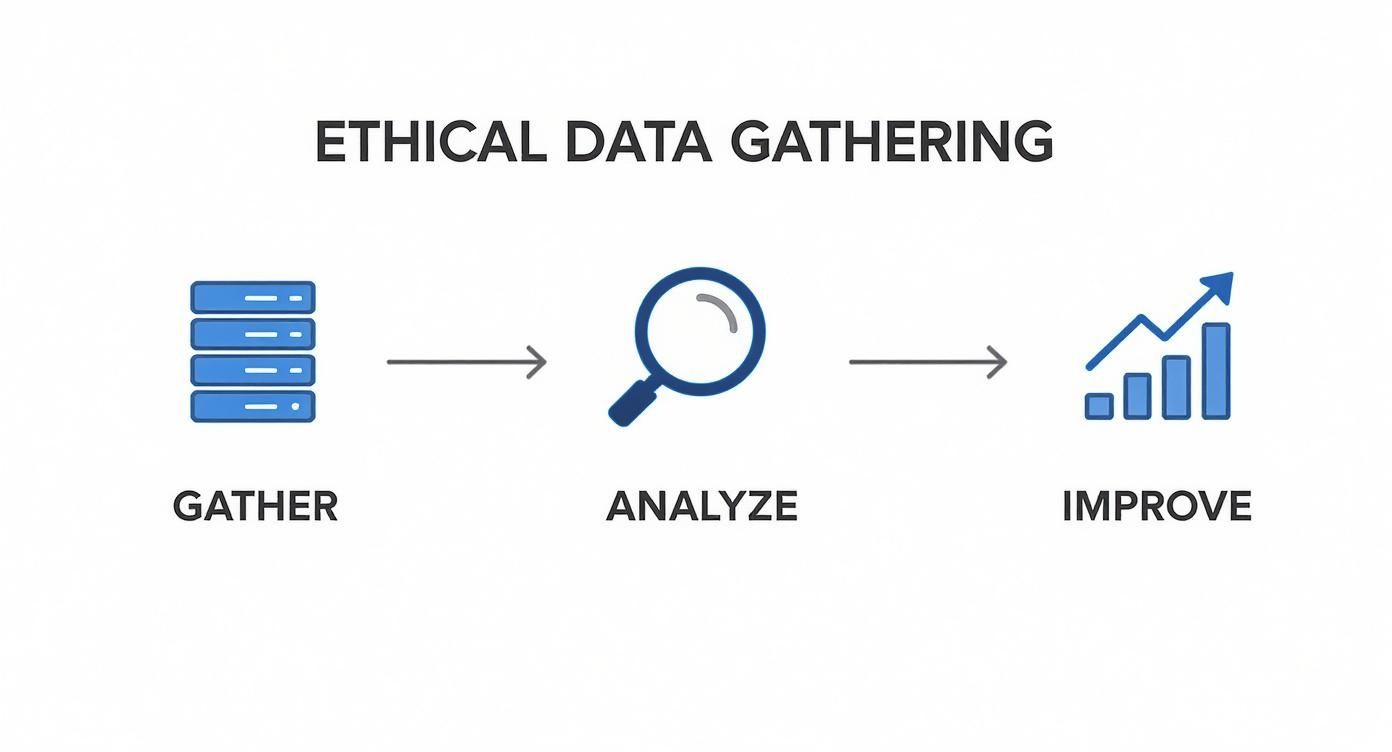
The idea is to create a cycle where data is gathered respectfully, analyzed for real insights, and used to drive meaningful improvements.
Step 3: Analyze Trends and Patterns
Data is useless until you look at it. This step is about regularly reviewing the information you’ve gathered to spot trends and figure out what’s going on. A deep dive isn't necessary every day. A monthly or quarterly review is often the right cadence to see meaningful changes.
Look for anything that deviates from your benchmark.
- Is the adoption of a new tool much slower than expected?
- Has system uptime dipped over the last month?
- Are projects taking longer to complete, or are they getting done faster?
The goal is to move from asking "what happened?" to "why did it happen?". For more on setting up these initial data points, check out our guide on using baseline metrics for continuous improvement.
The best insights often come from connecting different data points. If customer satisfaction scores are down and support ticket resolution times are up, you have a clear, actionable problem to solve.
Step 4: Implement Targeted Interventions
This is where analysis turns into action. Based on your analysis, you implement specific, targeted interventions.
If your data shows that a critical security tool has low adoption, the intervention might be a quick training session. If a team is consistently missing deadlines, the fix might be to refine the project planning process or reallocate resources.
After you make a change, the cycle starts over. You keep gathering data to see if your intervention worked, turning performance management into a living, evidence-based process.
Tailored Action Plans for Different Departments

Good management isn’t a one-size-fits-all strategy. The metrics that show success for an IT team are useless to the finance department. A manager's value comes from applying the right pressure to the right spots.
This means you need specific, relevant action plans for each part of the business. The aim is to get past fuzzy ideas like "let's improve" and create concrete steps that connect daily work with business results.
Action Plan for IT Managers
IT management performance usually comes down to three things: stability, efficiency, and security. The main job is making sure everyone else has the tools they need to work. This plan is about optimizing resources and improving service.
A solid three-step plan to get started would be:
- Benchmark System and Service Metrics. First, get a baseline for your critical IT functions. Key numbers to track include system uptime percentages, the mean time to resolution (MTTR) for support tickets, and current software license utilization rates. This gives you a clear "you are here" map.
- Automate Asset and Usage Tracking. Manually chasing down software usage is a huge time sink. A privacy-first endpoint analytics tool like WhatPulse can give you an automated, aggregate view of which applications are actually being used, without snooping on individuals.
- Conduct a Quarterly License Audit. Use that automated data to find software licenses that are barely used or completely ignored. The goal is to reclaim at least 15-20% of the budget spent on shelfware within six months. This creates a direct line between operational data and financial performance.
This approach flips IT management from a reactive, break-fix model to one that actively creates business value.
Action Plan for Engineering Managers
For engineering leaders, performance is about shipping high-quality code efficiently. The challenge is measuring productivity without using useless metrics like lines of code. You should focus on project velocity, code quality, and how smoothly the development environment runs.
A targeted plan for an engineering manager would include these actions:
- Measure Cycle Time and Deployment Frequency. Instead of counting hours, measure how long it takes for a task to get from "in progress" to "done." Also, track how often your team successfully deploys code. These two metrics give you a real sense of your team's velocity.
- Analyze Toolchain Friction. Use endpoint analytics to see how developers actually interact with their tools. Are they constantly switching between IDEs, terminals, and collaboration apps? A lot of fragmentation can be a sign you need to standardize or better integrate the dev environment.
- Track Bug and Rework Ratios. Keep an eye on the number of bugs that pop up after a feature goes live. A high ratio of rework points to potential problems in your testing or code review process. It's a powerful signal of code quality.
This plan helps managers spot and clear the bottlenecks that frustrate developers and slow innovation.
A common mistake is treating all departments the same. An engineering team's success is defined by innovation velocity and product stability, while a logistics team's performance hinges on operational efficiency and timeliness.
You can see this distinction in sectors where operational excellence is everything. For example, the Netherlands is world-class in logistics management, scoring 4.1 out of 5 on the World Bank's 2022 Logistics Performance Index. That high score comes from a focus on metrics like customs efficiency and timeliness—things unique to that field. You can read more about how those indicators reflect management efficiency in the Dutch logistics sector.
Action Plan for Finance Managers
Finance managers can connect what's happening on the ground to the company's financial health. Their performance is judged on budget accuracy, cost optimization, and the return on technology investments. This plan shows how operational spending hits the bottom line.
A finance manager can take these steps:
- Link Departmental Budgets to Usage Data. Work with IT to get the real data on software usage. Instead of just approving budget requests, tie allocations to verified utilization numbers. If a department is only using half of its software licenses, their next budget should reflect that.
- Calculate the Total Cost of Delivery. Look beyond salaries and license fees. Factor in the costs of system downtime, inefficient workflows, and underused tools. This gives you a much more accurate picture of what it really costs to run each department.
- Model ROI on New Technology. Before signing off on new software, demand a clear business case with a projected ROI. After it’s implemented, use operational data to see if the tool actually delivered, whether by reducing person-hours or increasing output.
Got Questions? We've Got Answers
When you start tracking performance in management, a few common questions always pop up. Here are the answers to the ones we hear most often.
How Often Should We Review Management Performance?
The right rhythm depends on your business cycle. For a fast-paced tech team, a lightweight monthly check-in on key results is perfect. It keeps everyone aligned and allows for quick adjustments.
For more stable departments, a formal quarterly review is usually enough to give a strategic overview without causing meeting fatigue. Consistency is key. Waiting for an annual review is a mistake; by then, it’s too late for any meaningful course correction. The goal is continuous improvement, not a once-a-year report card.
What’s the Biggest Mistake Companies Make?
The most common trap is focusing only on lagging indicators—like financial results—while ignoring the leading indicators that create them. If you only look at quarterly sales figures, you’re missing the story of the team activity, tool usage, or process friction that caused them. A balanced approach measures both the final outcome and the journey to get there.
Another classic blunder is rolling out a complex performance system without getting managers on board or providing proper training. When that happens, the system quickly turns into a bureaucratic chore that everyone resents and nobody finds useful.
How Can We Measure Performance in Creative or R&D Roles?
For roles in creative fields or R&D, you need to shift from output to outcomes. Stop counting things like lines of code or the number of designs produced. Instead, focus on the impact that work has.
For an R&D team, you could look at metrics like:
- The number of projects that successfully move to the next stage of development.
- The documented influence of research findings on the official product roadmap.
- Patents filed or prototypes developed as a result of their work.
For creative teams, you could measure client satisfaction scores, the conversion rates of marketing campaigns they designed, or how users engage with the content they created. Always connect their efforts back to bigger business goals.
Can Endpoint Analytics Genuinely Help?
Yes, but it plays a specific, supportive role. A privacy-first endpoint analytics tool gives you anonymous, aggregate data. This helps managers understand resource allocation and tool usage at a macro level, without ever looking at individuals.
An IT manager might discover that 30% of expensive software licenses are gathering digital dust. That’s a direct, powerful performance indicator for budget management. An engineering manager might see that a new development tool has low adoption, signaling a need for better training or a simpler tool. It’s not about watching people; it’s about finding systemic friction and making smart decisions to boost team-wide efficiency.
Ready to make data-informed decisions without compromising privacy? See how WhatPulse can help you optimize resources and improve team efficiency. Explore the platform today.
Start a free trial