

A skill set matrix is a simple visual grid that maps out who on your team can do what, and how well they can do it. Think of it as a diagnostic tool for your team’s collective talent, turning abstract ideas about "who knows what" into a clear, actionable chart.
What Is a Skill Set Matrix and Why You Need One
Imagine trying to manage a professional sports team without knowing who can play which position, who’s a rising star, and who needs more practice. It would be chaotic. A skill set matrix does the same job for your team: it gives you a clear, at-a-glance overview of your collective strengths and weaknesses.
It moves you beyond gut feelings and assumptions, offering a structured way to see your team's talent landscape. The grid usually lists team members down one side and critical skills across the top. Where they meet, a simple rating shows an individual’s proficiency — maybe something like 'Beginner', 'Intermediate', or 'Expert'. This simple act turns scattered information into organised, strategic intelligence you can act on immediately.
The Strategic Value of a Skills Map
Without a clear map of your team's abilities, you’re basically navigating in the dark. A well-maintained skill set matrix lights up the path forward, helping you make smarter, data-informed decisions that drive efficiency and growth. Its value goes far beyond just keeping records.
For instance, a 2024 survey revealed that 38% of Gen Z employees would quit their jobs to find a more tailored work experience. A skills matrix is a powerful tool for delivering this kind of personalisation, because it helps you:
- Assign Projects Intelligently: Match tasks to the people who have the right skills, which means higher quality work and greater job satisfaction. You can also strategically assign work to team members who want to develop a certain skill.
- Identify Critical Skill Gaps: Proactively spot areas where your team is weak. If only one person holds a crucial skill, you've found a 'knowledge island'—a huge risk if that person leaves.
- Create Targeted Development Plans: Instead of generic training programmes, you can offer personalised learning opportunities that address specific gaps and align with individual career goals. This is a massive boost for motivation and retention.
- Improve Project Planning and Forecasting: Get a real sense of your team’s capacity to take on new projects. Understanding your available skills helps you set realistic timelines and resource plans from the very start.
A skill set matrix is more than just a chart; it's a foundational tool for building a resilient, adaptable, and highly effective team. It ensures that you not only understand the skills you have today but are also prepared for the challenges of tomorrow.
By turning talent management into a visual exercise, the matrix empowers leaders to make objective decisions. It helps kill the guesswork in staffing, justifies training budgets with clear data, and builds a culture where skill development is a shared priority. That kind of clarity is essential for any organisation that wants to stay competitive and agile.
Building Your First Skill Set Matrix Step by Step
Creating a skills matrix sounds like a big project, but it’s really just a few simple steps. Think of it less like a dry HR exercise and more like drawing a map of your team's collective brainpower. The goal is to get a clear, honest picture of what your team can do, right now.
And this isn’t just a task for managers to hand down from on high. To get an accurate map, you need to involve the team from the very beginning. When people have a hand in building the matrix, they’re more likely to give honest answers and actually use it to guide their own growth.
Step 1: Identify Essential Skills
First things first, you need to list the skills that actually matter for your team. This is the foundation of the whole matrix. You’re defining the abilities your team needs to get projects over the line and hit your goals. Just start by brainstorming every skill you can think of, from the highly technical to the crucial soft skills.
For technical teams, this means looking beyond the obvious. It’s not just about what they need today, but also what they’ll need tomorrow. A bit of research into identifying key skills for software engineers can give you a head start on future-proofing your list.
To make sure you don't miss anything important, try thinking in these categories:
- Technical Skills: This is the hard stuff. Think proficiency in specific tools like Python or Figma, programming languages, or operating certain equipment.
- Soft Skills: These are the skills that hold a great team together—things like communication, problem-solving, leadership, and how well people collaborate.
- Role-Specific Skills: Competencies tied directly to a job function, like project management, data analysis, or content writing.
- Domain Knowledge: This is about industry-specific expertise. Does your team understand e-commerce logistics? Financial regulations? This kind of knowledge can be a huge advantage.
Step 2: Define a Clear Proficiency Scale
Once you have your list of skills, you need a straightforward way to measure them. A complicated, ten-point rating system just creates confusion and messy data. Simplicity is your friend here. You want a scale that everyone on the team understands instantly.
A simple three or four-level scale usually does the trick. It gives you enough detail to be useful without getting bogged down in hair-splitting definitions.
| Level | Description | Example Action |
|---|---|---|
| 0 - No Knowledge | The individual has no experience or training in this skill. | Needs complete training from scratch. |
| 1 - Beginner | Can perform basic tasks with supervision and guidance. | Can follow a tutorial to complete a simple task. |
| 2 - Proficient | Works independently and can handle most tasks without assistance. | Can own a feature or task within a project. |
| 3 - Expert | Can teach or mentor others and handle complex, novel challenges. | Can lead a project or troubleshoot critical issues. |
Having a clear scale like this ensures that when someone rates themselves as “Proficient,” it means the exact same thing across the entire team. Consistency is key.
Step 3: Gather the Data
With your skills and scale ready, it’s time to fill in the grid. The best way to get an accurate picture is to combine self-assessments with a manager’s evaluation. This approach balances things out, catching personal blind spots and creating a more reliable snapshot.
Here’s a practical, step-by-step process:
- Start with Self-Assessment: Send a survey or spreadsheet to each team member, asking them to rate their proficiency for every skill on your list. Encourage them to add comments or examples to support their ratings.
- Add Manager Evaluation: Next, have the team lead or manager complete their own assessment for each person, using the same scale. This provides an objective counterbalance.
- Hold a Calibration Meeting: Schedule a 30-minute one-on-one with each team member to review both assessments. Frame this as a career development conversation. Discuss discrepancies, agree on a final rating, and identify 1-2 skills they are excited to develop.
Key Insight: The real value of a skills matrix isn't the finished spreadsheet. It's the conversations it starts—about career ambitions, team strengths, and who can mentor whom.
This is where the matrix stops being a list and starts becoming a strategic tool.
As you can see, the matrix helps you move from simply identifying gaps to making smarter decisions about who works on what and how you plan for the future. With this practical tool in hand, you’re ready to analyse the results and guide your team forward.
How to Analyse Your Matrix for Strategic Insights
So, you’ve built your skills matrix. It’s not just a grid of names and numbers; it’s a goldmine of data waiting to be explored. With the framework in place and the data gathered, the next step is to turn this visual map into powerful, strategic decisions. This is the moment your matrix goes from a static document to a dynamic tool for building a more resilient and effective team.
The first glance at your completed matrix will immediately show you how skills are distributed. You can quickly see where your team is strong and, more importantly, where it might be vulnerable. This initial scan is all about spotting the big patterns before you dive deeper.

Identifying Skill Gaps and Knowledge Islands
The most immediate payoff from analysing your matrix is spotting critical skill gaps. These are the competencies your team needs to succeed but doesn't quite have yet. A skill gap could be a specific technology where no one is an expert, or a soft skill like client negotiation that’s rated low across the board.
Beyond general gaps, you need to keep an eye out for "knowledge islands"—what we call single points of failure. This happens when a vital skill is held by just one person. If that individual leaves or is simply unavailable, projects can grind to a sudden halt.
- To find skill gaps: Look for entire columns in your matrix with consistently low scores (mostly 0s and 1s). These are your team-wide weaknesses that need to be addressed, either through hiring or focused training.
- To find knowledge islands: Scan each row for essential skills where only one person has a high rating (a 3 or 'Expert'). Mark these as high-risk areas.
Once your matrix is filled out, a skills gap analysis is the logical next step. For a structured approach, using something like an AI Team Skills Gap Analysis Template can help formalise what the visual data is telling you.
Uncovering Hidden Talents and Mentorship Opportunities
Analysis isn't just about finding what's missing; it's also about discovering what you already have. Your skills matrix will often reveal hidden talents or expertise you weren't even aware of. You might discover a junior developer with expert-level skills in a new programming language or a designer with an unexpected knack for project management.
These discoveries are invaluable. They let you assign tasks more effectively, giving talented people a chance to shine and contribute in new ways. This doesn't just improve project outcomes—it's a massive boost for employee engagement and morale.
Your matrix is a powerful tool for internal mobility and growth. By identifying your in-house experts, you can create a natural mentorship programme. Pairing an 'Expert' with a 'Beginner' is one of the most cost-effective ways to upskill your team.
This same thinking is applied on a much larger scale. In the Netherlands, the Build Up Skills project uses a detailed skills matrix to find competency gaps in the construction sector. They categorise skills by specialism and profession to figure out exactly where development is needed most. You can apply this same strategic lens to your own team's data.
Driving Strategic Workforce Decisions
Ultimately, the insights you pull from your matrix should drive concrete actions that make your team and your organisation stronger. The data you've gathered is the evidence you need to make informed decisions instead of just relying on gut feelings. Translating this raw data into strategic actions is where the real value lies, a process we cover more in our guide on how to turn data into decisions.
Here are a few practical actions you can take based on your analysis:
- Refine Hiring Priorities: If you spot a critical, ongoing skill gap that can't be filled with training, you now have hard data to justify a new hire. Your matrix spells out the exact skill set you need to look for.
- Justify Training Budgets: Instead of making vague requests for training, you can present specific data. Showing that 80% of your team lacks proficiency in a key technology makes a much more compelling case for a targeted training programme.
- Build Balanced Project Teams: When putting a new team together, use the matrix to ensure you have a healthy mix of skills. You can avoid overloading one person with all the critical responsibilities and make sure there's enough expertise to handle any challenge.
- Create Personalised Development Plans: Sit down with your team members and use the matrix as a conversation starter about their career goals. You can pinpoint the skills they want to develop and map out a clear path for them to get there, whether it's through mentorship, online courses, or hands-on project experience.
Integrating Your Matrix with Workforce Planning
A completed skills matrix gives you a great snapshot of what your team can do right now. But its real power comes when you use it to look ahead. By connecting this tool to your workforce planning, you can stop reacting to challenges and start proactively building a team that's ready for whatever comes next.
This isn't about guesswork. It's about connecting the dots between the skills you have today and the ones you'll need to hit your long-term business goals. Your matrix becomes the foundational document that guides how you prepare for market shifts, new technology, and future projects, making sure your team stays agile and competitive.
Forecasting Future Skill Demands
The first step is figuring out which skills will become essential in the coming months and years. This involves looking at industry trends, your company’s strategic goals, and the technology roadmap. Are you planning to adopt a new software platform? Is your industry moving towards automation? These questions directly shape the skills your team will need.
Here’s a practical action plan to get started:
- Review the Business Roadmap: Sit down with leadership to review the company's 1-3 year strategic goals. For each goal (e.g., "launch a mobile app"), list the required technical and soft skills.
- Conduct Trend Analysis: Dedicate time each quarter to research industry reports (e.g., from Gartner, Forrester) and competitor job postings. Identify 3-5 emerging skills relevant to your team.
- Create a 'Future State' Matrix: Clone your current matrix spreadsheet. Add the new skills you've identified and highlight them. This visual comparison immediately shows your most critical future gaps.
Building a Roadmap for Upskilling and Reskilling
Once you’ve identified those future skill gaps, your matrix becomes a blueprint for a targeted talent development strategy. Instead of spending money on generic training programmes, you can create a clear, actionable roadmap for upskilling (making existing skills stronger) and reskilling (learning new ones).
This focused approach ensures your training budget is spent effectively, aligning development with both employee aspirations and what the business actually needs.
By proactively managing your talent pipeline with a skills matrix, you build a workforce that doesn't just adapt to change—it drives it. This forward-looking approach is a key differentiator in a competitive landscape.
This kind of strategic alignment is crucial, especially in an evolving job market. Take the Netherlands, for example. Projections show that between 2022 and 2035, the proportion of workers with high-level qualifications is set to jump from 42% to 55%. Meanwhile, the share with low qualifications is expected to drop from 18% to just 9%.
This trend highlights a national shift toward a more skilled labour force, making proactive workforce planning essential for any organisation. You can explore more on this from Cedefop's research on European skills forecasts.
Aligning Individual Growth with Organisational Needs
The most effective workforce planning happens when company goals and individual career ambitions line up. Use the matrix as a tool for developmental conversations with your team members. Show them where the organisation is headed and discuss how they can be part of that journey.
This approach fosters a culture of continuous learning and shows a clear commitment to employee growth.
This integration is a core part of any solid workforce planning strategy. A well-defined plan, guided by the data in your skills matrix, ensures that every training initiative and new hire moves you closer to your long-term objectives. To learn more, check out our guide on developing a comprehensive workforce planning strategy. When you use your matrix this way, you’re not just filling gaps—you’re building a future-proof team.
Common Mistakes and How to Avoid Them
A skills matrix is a powerful tool, but its value vanishes if it becomes inaccurate or gets ignored. Think of it like a garden—it needs constant attention to thrive. Otherwise, it quickly becomes an overgrown, useless plot of outdated information.
Avoiding a few common pitfalls can be the difference between having a dynamic strategic asset and just another forgotten spreadsheet.
One of the biggest mistakes is creating the matrix and then walking away. A "set it and forget it" mindset guarantees the data will be obsolete in months as people learn new skills and projects change. This can't be a one-time administrative chore; it has to be a living document.
Keeping Your Matrix Relevant and Alive
To stop your matrix from gathering digital dust, you need to build maintenance right into your team’s regular workflow. This doesn’t have to be a huge effort. The trick is to make updates small, frequent, and tied to things you’re already doing.
Here are a few practical ways to keep it current:
- Post-Project Reviews: Make a quick update of the skills matrix a standard part of your project debrief or retrospective. It’s the perfect time to capture new skills learned and proficiency improvements while they're still fresh in everyone's mind.
- Quarterly Check-ins: Schedule a brief, 15-minute chat with each team member every quarter. Use this time to discuss their growth, update their skill levels, and talk about what they want to learn next.
- Link to Development Plans: Connect the matrix directly to individual performance and development plans. When someone completes a training course or gets a certification, updating their skills on the matrix should be the final step.
A skills matrix is most effective when it reflects momentum, not just a moment in time. Treat it as a dynamic dashboard of your team's capabilities, not a static portrait.
Avoiding Vague Scales and Underutilised Skills
Another critical mistake is using a fuzzy, ill-defined proficiency scale. If "Intermediate" means one thing to your senior developer and something totally different to a junior designer, your data is fundamentally broken. Your scale needs to be concrete, with clear descriptions for each level, so everyone is speaking the same language.
Perhaps the biggest waste, though, is skill underutilisation—spotting valuable talents that never actually get put to use. This problem is more common than many leaders realise. Even in a highly educated workforce like the one in the Netherlands, challenges in effectively activating skills persist due to the rise of flexible employment and other labour market complexities. You can read more in the OECD’s diagnostic report on skills activation in the Netherlands.
To fight this, you have to actively look for opportunities to deploy those underused skills. When you’re planning a new project, consult the matrix specifically to find people with relevant secondary or developing talents. Giving team members a chance to apply these skills doesn't just help the project—it also boosts their engagement and helps them grow. This is how the matrix transforms from a simple inventory into an active tool for opportunity.
Augmenting Your Matrix with Real-World Data
A self-assessed skills matrix is a brilliant starting point, but let's be honest—it relies on perception. To really elevate your matrix from a static picture to a living, breathing system, you need to anchor it in objective, real-world data. This is where you move beyond what people think they can do and start looking at what they actually do.
By layering in activity-based data, you can validate the proficiency levels on your matrix with hard evidence. Suddenly, it transforms into a much more accurate and reliable tool for assigning projects, managing talent, and making smart strategic decisions.
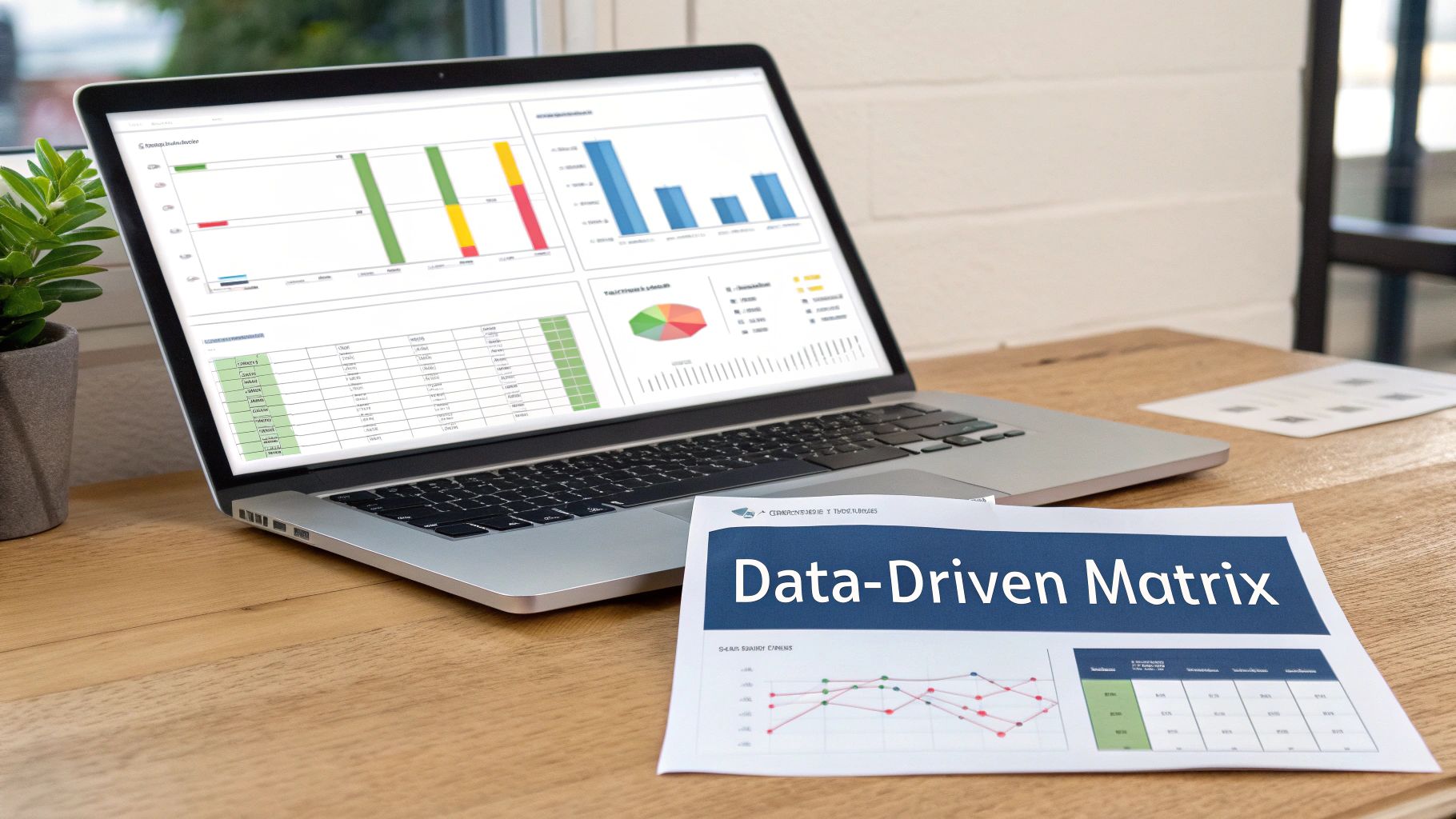
The idea is to move from simple grids to powerful analytics, using data to refine and sharpen your understanding of your team's capabilities.
Connecting Data Sources to Your Matrix
The key is to connect your skills matrix to the tools your team uses every single day. This creates a feedback loop where real activity continuously informs your map of team capabilities. Think of it as adding a layer of truth to your assessments.
For a software development team, this could mean looking at:
- Version Control Activity: Diving into commit history in platforms like GitHub can reveal who is consistently working with specific programming languages or frameworks. A high volume of quality commits in Python over the last few months is solid proof of a high proficiency rating.
- Application Usage Analytics: Tools like WhatPulse can track which applications are actively being used. If someone is listed as a Figma expert, their usage data should show they spend significant time in that application. This kind of transparency helps to optimise work patterns and validate skills in a way self-reporting never could.
An Actionable Approach to Data Integration
You don’t need a complex, automated system to get started. Begin with a simple, manual check and build from there. The goal is to cross-reference your matrix with objective data points to either confirm or question the ratings.
By comparing self-reported skills with actual usage data, you create a more honest and accurate picture of your team's true capabilities. This data-driven approach removes bias and supports more effective talent development conversations.
For example, imagine a team member rates themselves as an expert in a specific tool, but their activity data shows minimal usage over the past quarter. This isn’t a "gotcha" moment; it's the start of a productive conversation.
Perhaps their skills have gotten rusty, or their role has shifted away from that tool. This insight allows you to take action, whether it's assigning them a project that uses that skill or scheduling some refresher training.
Traditional vs Data-Augmented Skill Set Matrix
Adding objective data fundamentally changes the nature and reliability of your skills matrix. It moves from a well-intentioned but flawed guide to a strategic asset grounded in reality. Here’s a quick comparison of the two approaches:
| Feature | Traditional Matrix (Self-Assessed) | Augmented Matrix (Data-Validated) |
|---|---|---|
| Data Source | Subjective self-ratings, manager opinions. | Objective application and tooling usage data. |
| Accuracy | Prone to bias (over/under-confidence). | High, as it's based on actual behaviour. |
| Updates | Manual and infrequent (e.g., quarterly). | Can be updated continuously or in near real-time. |
| Insight | A static snapshot of perceived skills. | A dynamic view of applied, current skills. |
| Conversations | Can lead to debates based on opinion. | Facilitates fact-based coaching conversations. |
| Decision-Making | Based on potentially outdated or inaccurate info. | Supports strategic decisions with verified data. |
Ultimately, augmenting your matrix with real-world data removes the guesswork. It allows you to build a team development plan based not on what people say they can do, but on what their daily actions prove they do.
Answering Your Questions About Skill Set Matrices
Once you decide to build a skill set matrix, a few practical questions almost always come up. Getting these right from the start helps you build a tool that your team actually trusts and uses, turning it from just another spreadsheet into a genuinely useful guide.
Let’s tackle the most common ones. A good approach here ensures your matrix becomes a living document that informs real decisions, not one that gathers dust.
How Often Should a Skill Set Matrix Be Updated?
The honest answer? It depends entirely on how fast your team moves. A static, once-a-year review just doesn't cut it anymore. In today's work environment, that data becomes obsolete so quickly that the matrix loses its value for any real planning.
For most teams, a quarterly review hits the sweet spot. It’s frequent enough to capture real progress and new skills without feeling like a constant administrative chore. But if you’re running in a more agile or fast-paced setting, you might need to check in more often.
Consider tying updates to your existing workflows:
- After a big project wraps up: This is the perfect moment to look back and log the new skills and experience people gained.
- During sprint retrospectives: For agile teams, a quick check-in after each sprint can capture smaller, incremental skill gains.
The trick is to make it a natural part of how you already operate, not a separate, dreaded task.
What's the Best Format for a Matrix?
There’s no single “best” format, and anyone who tells you otherwise is probably selling something. The right choice depends on your team's size and how complex your skill-tracking needs are. The goal is to start with something that works for you right now.
For smaller teams, a well-organised spreadsheet in Microsoft Excel or Google Sheets is often the perfect starting point. It’s simple, everyone knows how to use it, and you don’t need any special software. As your organisation grows, though, spreadsheets can become a real headache to manage.
When you outgrow a simple grid, dedicated Human Resources (HR) or skills management software can offer much better analytics, scalability, and integrations. The smartest strategy is to start simple and scale up only when you need to.
How Can I Encourage Honest Self-Assessments?
This one is all about trust. If your team thinks the matrix is just another tool for performance reviews, you’ll get inflated ratings. People will naturally score themselves higher if they’re worried about negative consequences. You have to frame the skill set matrix as a development tool from day one.
To create an environment where honesty is the default, make it crystal clear that its main purpose is growth. Communicate that the matrix is there to spot opportunities for training, find mentors, and get people the support they need—not to judge or penalise them.
A great way to do this is by combining self-assessments with a manager’s input. This turns the process into a collaborative conversation about career development. It builds trust and helps ensure the final ratings are both fair and grounded in reality.
Ready to see if your skills matrix matches reality? WhatPulse gives you objective data on application usage, showing you which skills are actually being put into practice. See how our privacy-first analytics can give your team’s development a serious boost at https://whatpulse.pro.
Start a free trial