
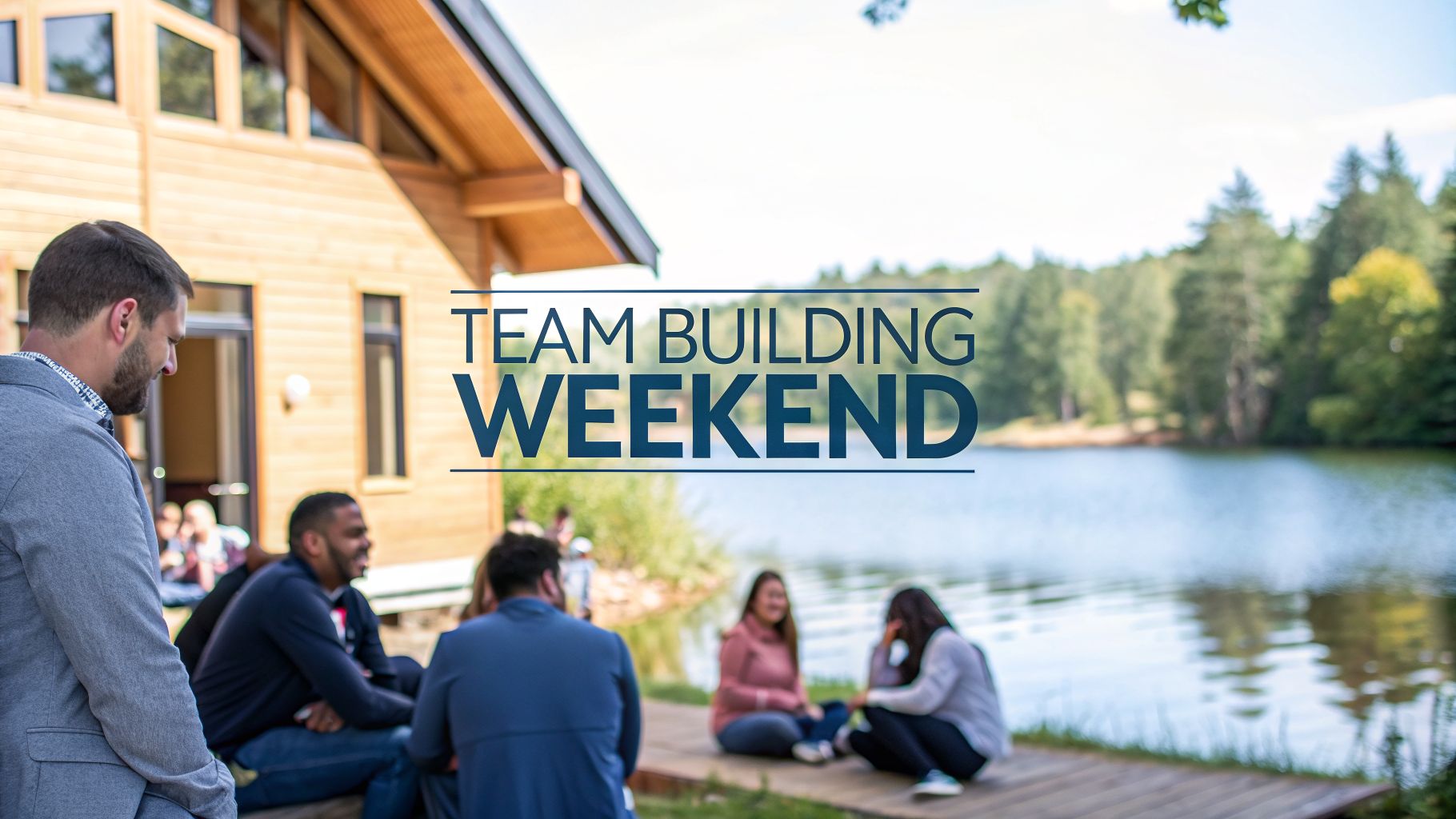
A team-building weekend is more than getting your team out of the office. It's a chance to step away from daily work, solve real problems, and reset how everyone works together in a new environment. Done right, it’s not a social retreat for a temporary morale boost; it's an investment with specific business goals, whether that’s smoothing out cross-departmental workflows or kicking off a major project.
You're aiming for a tangible return, not just a few fun days.
Planning a Weekend That Actually Delivers
A successful team weekend doesn't just happen. It's the result of a deliberate process that links clear goals to the right activities and to measurable outcomes. I’ve seen too many companies stumble by getting bogged down in logistics or picking activities that are fun but irrelevant to their real challenges.
Treat the weekend like a strategic project, not just an HR event. Think of it as an opportunity to tackle persistent workplace issues—like communication silos or the slow adoption of new software—in a focused, immersive setting.
This is the flow I always recommend for structuring your planning.

The diagram lays out a simple sequence: define your objectives first, then select activities that serve them, and finally, measure the impact. Following this order prevents the classic mistake of planning fun activities before you know what you're trying to achieve.
From Vague Ideas to Concrete Plans
The first real step is to move past a general desire for "better teamwork" and get to specific, solvable problems. A weekend away is a significant investment, so it needs to produce more than just good feelings. It should create observable changes in how people work together once they're back at their desks.
To get a feel for what’s possible, look at the broader world of company away days, which are designed to do more than just provide a break.
A team-building weekend succeeds when it solves a problem you can't fix during a standard 40-hour work week. The change of scenery isn't just for fun; it's to disrupt routines and encourage new ways of thinking and interacting.
Connecting Activities to Your Goals
Once you have your objectives locked in, you can choose activities that directly support them. Resist the pull of generic team-building exercises unless they genuinely align with what you need to fix.
Here’s what that looks like in practice:
- Objective: Integrate a new, cross-functional project team.
- Activity: A collaborative problem-solving challenge where success is impossible without combining different skill sets. This directly mirrors the work they'll be doing.
- Objective: Improve communication between siloed departments (e.g., Sales and Engineering).
- Activity: A workshop where mixed teams have to build something physical together. This forces them to negotiate, plan, and communicate clearly under light-hearted pressure.
A great agenda will mix these structured, goal-oriented sessions with plenty of opportunities for informal socialising. You'd be surprised how often the most valuable connections are made during unstructured downtime. It's where people get to know each other as individuals, not just as job titles, building the personal trust needed for effective collaboration.
Defining Your Objectives And How To Measure Them
A great team-building weekend starts with a clear answer to one question: Why are we doing this? Fuzzy goals like “improving team morale” don't give you a way to measure success.
You need to get specific. Are you trying to get new hires up to speed, smooth out friction between the design and engineering teams, or kick off a huge new project with a unified vision? Each of those goals requires a different plan. For example, instead of aiming to "improve communication," a concrete goal is: "reduce cross-departmental email response times by 15%" in the month after the weekend.

Suddenly, the weekend isn't just a company perk. It's an investment with a clear benchmark you can show to leadership.
Establishing A Baseline With Privacy-First Analytics
To prove the weekend made a difference, you need to know what your team’s workflow looked like before the event. This is where you move beyond feelings and into facts. Abstract notions of "better collaboration" are tough to prove, but shifts in digital work patterns are not.
This is where privacy-respecting analytics come in. Using a platform like WhatPulse, you can anonymously track aggregate metrics that paint a picture of team dynamics without looking at what an individual is typing or doing. It gives you a solid "before" state to measure against.
Here are a few key metrics to establish your baseline:
- Application Usage: Which tools are people actually using? Is that expensive new software licence gathering digital dust?
- Keyboard and Mouse Activity Patterns: This isn't about surveillance. It’s about spotting inefficiency. A high level of context switching—flicking rapidly between different apps—is a strong signal of distraction or a broken workflow.
- Network Traffic: Aggregate data can reveal which internal servers or cloud services get the most use, showing the real communication pathways between teams.
This data-driven approach takes the guesswork out of the equation. You're no longer just hoping for an improvement; you're setting up the tools to measure it.
Setting Specific And Measurable Goals
Once you have that baseline data, you can set goals that are tied directly to those metrics. This makes it far easier to justify the budget upfront and demonstrate the return on investment afterwards.
The most powerful objectives are those that solve a tangible business problem. A weekend retreat can be the perfect environment to reset habits and introduce better ways of working.
Here are a few examples of how this looks in practice:
- Objective: Increase adoption of our new project management tool.
- Pre-Event Metric: The tool makes up only 5% of active application time for the project team.
- Post-Event Goal: Increase usage to 25% within 60 days.
- Objective: Break down departmental silos and encourage more cross-functional work.
- Pre-Event Metric: Network data shows 90% of traffic from the engineering team stays on their own servers.
- Post-Event Goal: Increase their traffic to shared, cross-departmental resources by 20%.
- Objective: Help the team achieve deeper focus and reduce multitasking.
- Pre-Event Metric: Activity patterns show an average of 12 application switches per hour per team member.
- Post-Event Goal: Reduce this context switching by 15% to show more focused work blocks.
This kind of structured approach is particularly effective in the Netherlands, where team-building weekends are an established part of corporate culture. A study by Erasmus University Rotterdam found that Dutch firms running structured weekend activities saw a 22% reduction in absenteeism and 12% higher software adoption rates. For finance teams, the ROI is clear: every €1,000 invested can yield over €4,000 in saved turnover costs. Discover more findings about team-building effectiveness. This is the kind of data that allows CIOs and IT directors to build a solid business case, proving a team-building weekend is a smart investment.
Building Your Agenda With The Right Activities
This is where your strategy meets the real world. The activities you select will either turn this weekend into a powerful investment or just an expensive, awkward break from work. Your mission is to build an agenda that mixes structured, goal-driven sessions with the casual downtime where real connections are often forged.
An agenda is never one-size-fits-all. A high-octane, competitive weekend that a sales team would love will almost certainly backfire with a group of engineers who’d rather dig into a complex, collaborative problem. Stop picking activities just because they sound fun. Choose them because they directly serve the goals you’ve already set.
Matching Activities To Team Types
Different teams have entirely different operating systems. Forcing a room full of introverted developers into loud, high-energy challenges is a rookie mistake, but one that happens all the time. The best activities should feel like a natural extension of their skills, just applied in a fresh context.
For Technical Teams (Engineering, DevOps): Forget trust falls. Think collaborative hackathons or practical problem-solving workshops. The challenge can mirror their day-to-day work—like designing a new system or squashing a complex bug—but without the pressure of deadlines. The win is in the collaborative process, not just the final product.
For Sales or Marketing Teams: These teams often thrive on competition and clear goals. A scavenger hunt with cryptic clues or a business simulation where teams battle for market share can be perfect. These games tap into their natural drive while forcing them to strategise and work as a single unit.
For Leadership Teams: The focus here should be on high-level strategy and alignment. Think facilitated sessions dissecting future business challenges, using personality assessments (like Myers-Briggs or DISC) to unlock better communication, or even just a relaxed strategic retreat with minimal structure.
For Cross-Functional Teams: The goal is to break down silos. A 'build something' challenge is a fantastic way to do this. Whether it’s a physical gadget or a simple app prototype, it forces designers, engineers, and marketers to rely on each other and appreciate what everyone brings to the table.
Sometimes, inspiration comes from looking at what works elsewhere. For example, checking out the wide range of unforgettable team building events Perth offers can spark some ideas you can adapt for your own team and location.
Structuring A Balanced Weekend Agenda
A schedule packed to the minute doesn't create breakthroughs; it creates burnout. The most successful agendas blend intense, focused sessions with generous periods for rest and informal chats. People need headspace to process new ideas and talk to each other without a facilitator steering the conversation.
This is why we recommend moving away from a rigid Day 1 / Day 2 schedule and towards a more flexible framework that prioritises the objective.
Sample Agenda Frameworks
Below is a comparison of how you might structure an agenda based on what your team needs most. Notice how the pacing and activity types shift depending on the primary goal.
| Team Type | Primary Objective | Key Activity Example | Pacing |
|---|---|---|---|
| New Project Team | Rapid Bonding & Role Clarity | "Build Something" Challenge | Intense, then social |
| Leadership Team | Strategic Alignment | Facilitated Future-State Workshop | Slow, reflective, lots of discussion |
| Burned-Out Team | Rest & Reconnection | Nature walk, unstructured free time, shared meal | Relaxed, low-pressure |
| Sales Team | Boost Morale & Competition | Team-based simulation game | High-energy, competitive |
This approach helps ensure that the structure of the weekend directly supports the outcome you're aiming for, rather than just filling time.
Integrating Hybrid And Remote Team Members
For hybrid teams, a weekend together is a golden opportunity. But pointing a webcam at the main group isn't inclusion—it's an afterthought. You have to design parallel experiences that make remote staff feel like active participants, not just spectators.
If your remote team members feel like they're just watching the main event on a screen, you've failed. True inclusion requires creating shared experiences, even when people are in different locations.
Here are a few ways to get this right:
- Run Parallel Digital Activities. While the in-person group tackles a physical escape room, set up the remote team with a challenging digital version. Afterwards, bring both groups together for a joint debrief to share what they learned.
- Give Remote Members Leadership Roles. Assign a remote team member to lead a virtual brainstorming session or facilitate a digital-first exercise. This gives them ownership and positions them at the centre of the action.
- Ship Experience Boxes. Send a curated box to remote employees. Fill it with the same snacks, company swag, and materials for a shared activity (like a virtual cocktail-making class) so everyone can engage their senses together.
If you're planning an event with an outdoor element, our guide on organising an engaging outdoor team building day offers more specific tactics for hybrid teams.
This isn't just about feeling good; the investment pays off in clear, measurable ways. A 2026 Randstad Nederland survey found that 63% of tech leaders observed better team communication following offsite retreats. For managers using platforms like WhatPulse to see work patterns, this translates to hard data. One study showed a 15% drop in inefficient context switching after an event, and Dutch organisations that hold regular offsites have cut employee turnover by 24% in high-churn sectors. The numbers don't lie: a well-run weekend is a powerful business strategy, not just a perk.
Budgeting And Justifying The Expense
Let’s be honest, getting a budget signed off for a team-building weekend is tough. Vague promises about “improving morale” won’t cut it with your finance department. You need to stop thinking of it as a cost and start framing it as a strategic investment.
The first step is building a proper, line-item budget. This isn't just about listing costs; it's about showing you’ve thought through every detail and have a firm grip on the financial side of the project.

Building Your Budget Line Item Checklist
A detailed budget is your best defence against last-minute financial headaches. Leadership respects a plan that accounts for the big-ticket items and the small details that always add up.
Here’s a checklist to get you started. Think of it as a template to adapt for your own event, ensuring you don't miss anything.
Budget Line Item Checklist
| Category | Expense Item | Budgeting Tip |
|---|---|---|
| Venue & Lodging | Accommodation, meeting rooms, activity spaces. | Look for all-inclusive quotes to simplify costs. Always ask if they offer a corporate rate or a package deal for multi-day events. |
| Food & Beverage | All meals, coffee breaks, snacks, evening drinks. | Confirm how they handle dietary requirements and if there's an extra charge. Budget for 10% more than you expect for drinks and snacks. |
| Travel & Transport | Flights, trains, coach hire, airport transfers. | Book travel well in advance for the best rates. A single coach is often cheaper than reimbursing individual travel expenses. |
| Activities & Facilitation | External facilitators, activity providers, equipment rental. | Get crystal-clear pricing—is it per-person or a flat fee? Ask what’s included (like materials and insurance). |
| Technology | Wi-Fi access, AV equipment, hybrid participation tools. | Check if the venue's standard Wi-Fi is strong enough. If not, you may need to budget for a dedicated hotspot. |
| Miscellaneous | Company swag, prizes, insurance, contingency fund. | Always include a 15-20% contingency line item. It’s far better to have it and not need it than to go over budget. |
Having this level of detail ready shows you're serious and have done your homework, which goes a long way in building trust.
Framing The Expense As A Tangible Investment
Once you have your total cost, the real work begins: showing how that number turns into a positive return for the business. This is where you connect the weekend’s activities to hard, measurable business metrics. Forget the fluffy stuff; numbers are what get a budget approved.
The easiest way to justify an expense is to show it’s cheaper than the alternative. A team-building weekend might seem costly, but it's often far less expensive than losing a key employee.
Start with the cost of employee turnover. In the Dutch tech sector, for example, replacing a single skilled employee can cost upwards of €45,000 when you factor in recruitment fees, onboarding time, and lost productivity. If your weekend helps retain just one engineer who was thinking of leaving, it has already paid for itself several times over.
That’s the kind of direct financial argument a CFO will listen to.
Calculating Potential ROI Before The Event
You can also project potential returns by digging into existing operational inefficiencies. A platform like WhatPulse is great for this. Use its pre-event data to spot expensive, underused software licences.
Imagine you spot an issue. You can then design a workshop during the weekend to get everyone trained up and using the tool properly.
Here’s a simple scenario:
- You pay €100 per user per month for a project management tool.
- The data shows only 20% of the team actively uses it.
- Your weekend includes a practical session on integrating this tool into daily workflows.
- Your goal is to increase adoption to 80%.
The ROI here is the value you unlock from software you were already paying for. Suddenly, a "training session" becomes a direct cost-saving measure. To go deeper on this, our guide on how to calculate the ROI of your initiatives offers a more detailed framework.
By combining the high cost of turnover with potential gains from better software use, you build a powerful financial narrative. You’re no longer asking for money for a 'fun weekend'; you’re presenting a calculated plan to reduce costs and boost efficiency. That’s how you get your budget approved.
Getting the Guardrails Right: Risk, Compliance, and Accessibility
It’s easy to get swept up in the fun parts of planning—the activities, the food, the location. But a truly great team weekend is one where everyone feels safe, included, and able to be themselves. Getting the boring-but-critical details right isn't about red tape; it’s about protecting your team and the company.
Let’s be blunt: you absolutely need liability insurance. Don't just assume your standard company policy has you covered for offsite events. Check the fine print. If it doesn't, or if you're planning anything adventurous like kayaking or rock climbing, you'll need a separate event policy. Always get written confirmation from the venue about what their insurance does and doesn't cover for your group.
You should also put together a simple Code of Conduct for the weekend. This isn’t a 20-page legal document. Think of it as a one-pager that sets clear expectations on behaviour, especially around alcohol and how people treat each other. Sending it out beforehand sets the tone and gives you a clear framework for stepping in if something goes wrong.
Data Privacy and GDPR
If you're planning to run surveys or use tools to measure the event's impact, you need to think about data privacy from day one. Under GDPR, you can't just collect data without a good reason and explicit permission.
- Be completely transparent. Tell people exactly what data you’re collecting and why. If you're using a tool like WhatPulse to see if work patterns change after the event, make it clear that the data is anonymous and aggregated.
- Ask for consent. Use a simple opt-in for any feedback app or survey. Consent is never assumed.
- Collect only what you need. Don’t ask for personal information unless it’s essential for measuring your specific goals.
Neglecting GDPR isn't an option. The fines are huge, yes, but the damage you can do to employee trust is far worse. Build privacy into your plan, don't just bolt it on at the end.
Designing for Real Inclusivity
Accessibility means so much more than just having wheelchair ramps. A truly inclusive event considers the whole spectrum of human needs, from physical abilities to personality types. Thinking about this early on is the difference between a good event and one that accidentally leaves people out.
The best way to start is with a confidential questionnaire sent to everyone well in advance. Ask about:
- Dietary needs: Go beyond just "vegetarian." Ask about specific allergies, intolerances, or religious requirements. This information should go directly and only to the caterer.
- Physical considerations: Ask if there are mobility issues or health conditions that could make certain activities difficult or unsafe. This gives you time to plan great alternatives.
- Neurodiversity and personalities: Remember your introverts and neurodivergent team members. A packed schedule of high-energy, "forced fun" can be completely draining for them.
With this information, you can design a weekend that works for everyone. That means building in quiet spaces for people to decompress and recharge. It means offering a genuine choice of activities. For every competitive, high-octane game, have a low-key, collaborative option running alongside it. A creative workshop or a strategic problem-solving session can build bonds just as well as a hike.
The goal is to create an atmosphere where everyone can show up and participate comfortably, without feeling like they have to ask for a special favour.
Analysing The Impact And Reporting On Success

The weekend might be over, but your work isn't quite done. Once everyone has headed home, the final piece is to connect the event back to the business goals you set from the start. It’s time to find out what actually changed.
This is where you pull out your pre-event baseline data. By comparing the 'before' and 'after', you shift the conversation from anecdotes and good feelings to hard evidence. This is what justifies the budget and proves the weekend was more than just a well-deserved break.
Blending The Hard Data With The Human Story
A proper analysis needs to look at two kinds of information. First, you've got your quantitative metrics. This is the raw data that shows whether you hit the specific, measurable goals you defined in your plan. Using privacy-respecting analytics tools, you can spot tangible shifts in how work gets done.
- Software Adoption: Did that expensive new CRM finally see an uptick in use after the training session? The application data will tell you if the workshop translated into real-world action.
- Workflow Efficiency: Are people switching between apps less often? A drop in context-switching, visible through keyboard and mouse activity, is a strong signal of deeper focus.
- Collaboration Patterns: You can even look at network traffic to see if communication has genuinely increased between departments that were previously siloed.
Next, you need the qualitative side of the story. This is where you uncover the human experience behind the numbers. Post-event surveys are your friend here, but only if you ask the right questions. Generic queries like "Did you have fun?" won't give you much to work with.
Instead, ask targeted, open-ended questions that tie directly to your objectives. "Describe one way your communication with the design team has changed since the retreat," will give you far more insight than a simple 1-5 rating on "collaboration."
Putting Together Your Report For Leadership
With both sets of data in hand, you can build a concise, powerful report for your stakeholders. The aim isn't to create a hundred-page slide deck nobody will read. It's to tell a clear, compelling story that's backed by solid proof. Keep it simple and direct.
Your final report should really only have four parts:
- A quick recap of the original event objectives.
- The "before and after" quantitative data. For instance, "We saw a 25% increase in CRM usage and a 15% reduction in average application switching post-event."
- A few powerful qualitative examples. Pull direct quotes from your survey responses that illustrate a specific change in behaviour or perspective.
- A summary of the return on investment (ROI). Connect the weekend's cost to concrete business outcomes, like improved project velocity or reduced staff turnover risk.
This final step closes the loop, turning a great event into a proven business investment. For a more structured way to tackle this post-event analysis, you might find our guide on conducting an effective after-action review useful.
Frequently Asked Questions
How Far In Advance Should We Plan A Team Building Weekend?
This is a question I get a lot, and the honest answer is: probably earlier than you think. If you’re planning anything that involves travel and booking a specific venue, you need to be thinking six to nine months ahead.
I know that sounds like a long time, but the best venues and facilitators get booked up fast. Planning this far out gives you first choice, not just the leftovers. You'll also find you have more room to negotiate on price. More importantly, it gives your team plenty of time to sort out their personal lives, which makes a huge difference to attendance and how people feel about the event.
For a simpler weekend closer to home, you can likely get away with a three or four-month lead time. But the rule of thumb is always to lock in your big-ticket items first—the venue and any key people you need to hire. Everything else can fall into place after that.
Are Team Building Weekends Effective For Fully Remote Teams?
Absolutely. In fact, I’d argue they are more critical for remote teams than for any other. When your team only knows each other through a screen, an offsite weekend is where the real connection happens. It’s when Slack avatars finally turn into actual people.
The key is to change your focus. The goal isn't to replicate work that could have been done on a video call. It's about creating the space for all the informal social moments that remote work misses out on.
The real magic happens over a shared meal, during a walk between sessions, or in the downtime you build into the schedule. That’s where you build the kind of trust and rapport that survives the distance.
Of course, the logistics require more thought. You’ll be coordinating travel from multiple cities, so the agenda has to be compelling enough to justify the time and expense of bringing everyone together.
What Is The Best Way To Handle Employees Who Do Not Want To Participate?
This is a delicate one, and it comes up often. First, it helps to frame the event properly. This isn't just a mandatory party; it's a strategic offsite that's part of the job. Setting that professional tone from the start helps.
After that, the best approach is to listen. When someone is reluctant, it’s rarely because they just don't feel like going. There are usually very real reasons behind it.
Common reasons I've seen include:
- Family commitments: Parents or caregivers often have responsibilities they can't simply put on hold for a weekend.
- Social anxiety: For some people, the idea of being "on" socially for 48 hours is genuinely exhausting.
- Activity mismatch: A weekend of intense physical challenges won't appeal to everyone, and that's okay.
Where you can, offer flexibility. Perhaps someone can join for the main strategy sessions but opt out of staying overnight. Building an agenda with a mix of different activities—and including scheduled downtime—is also crucial for catering to different personalities. A weekend built with purpose is always going to be more compelling than one that feels like forced fun.
Ready to get a real, data-driven view of your team's work patterns? With WhatPulse, you can measure the impact of your team building weekend by tracking software adoption and focus time, all while protecting employee privacy. See how it works at https://whatpulse.pro.
Start a free trial